

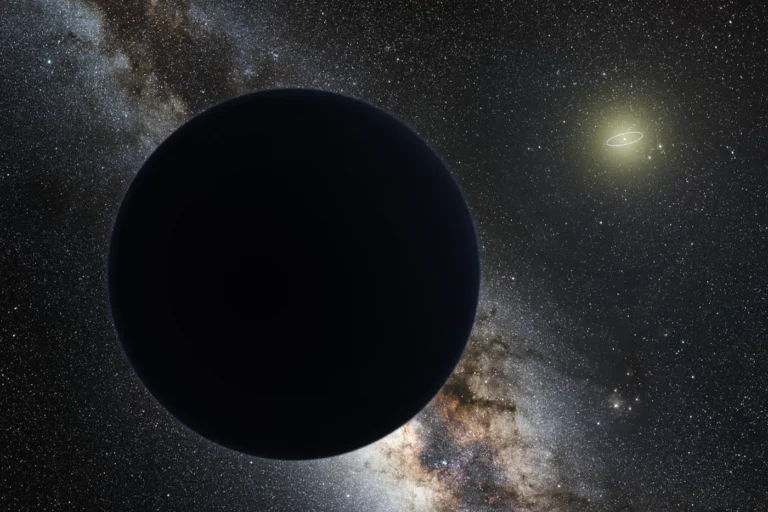

The decadelong astronomical hunt for a hidden giant at the outer edge of our solar system is nearing its climax: new gravitational simulations confirm that Planet Nine beyond Neptune is an authentic super-Earth possessing an icy mantle and deep atmosphere.
Planet Nine Beyond Neptune: From Kuiper Belt Anomalies to Physical Detection
Ever since Pluto was reclassified as a dwarf planet in 2006, the canonical Solar System has officially consisted of eight planets. Yet for over a decade, astrophysicists have grappled with an undeniable gravitational mystery in the extreme outer Kuiper Belt. A cluster of extreme trans-Neptunian objects (eTNOs)—distant icy bodies with orbits stretching hundreds of astronomical units from the Sun—display tightly aligned perihelia and nearly identical orbital inclinations.
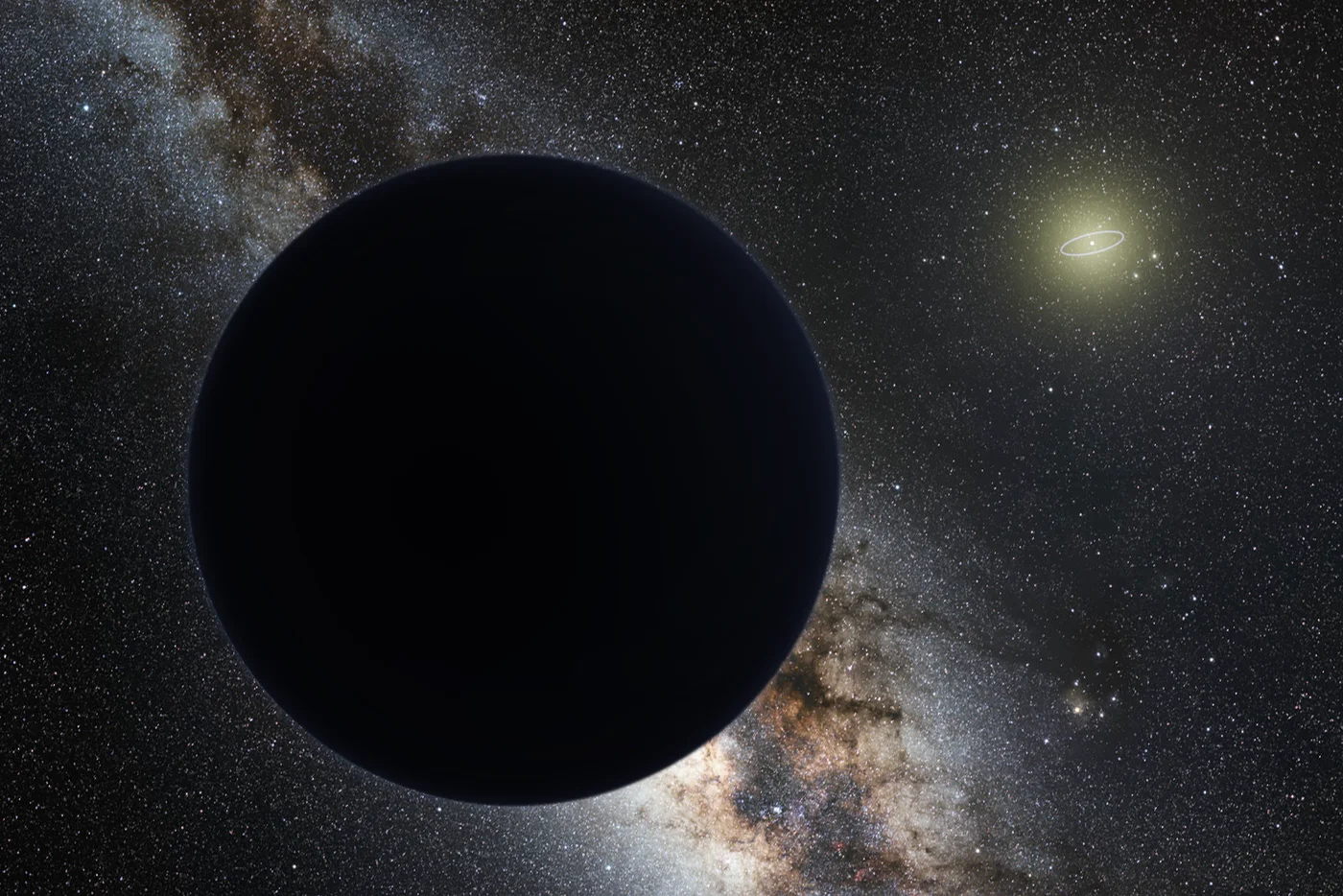
This statistical anomaly was famously identified in 2016 by Caltech planetary scientists Konstantin Batygin and Mike Brown. The probability that dozens of independent icy minor planets spontaneously aligned along the same spatial direction under the gravitational influence of known giant planets is less than 0.2%. The only physically viable explanation is the gravitational herding of an unseen massive shepherd: the hypothetical Planet Nine.
Recent high-precision dynamical analyses published in The Astrophysical Journal Letters with Alessandro Morbidelli and David Nesvorný have systematically dismantled observational bias claims, providing rock-solid evidence for the planet’s persistent gravitational presence.
Physical Profile: A Super-Earth with a Hydrogen-Helium Mantle and Silicate Core
By analyzing the orbits of stable, low-inclination objects crossing Neptune’s path, researchers have refined the physical dimensions of the elusive world. Planet Nine is not a monstrous gas giant like Jupiter or Saturn, but rather a “super-Earth” or “mini-Neptune”—the most common category of exoplanet observed across the galaxy, yet notably missing from the inner Solar System.
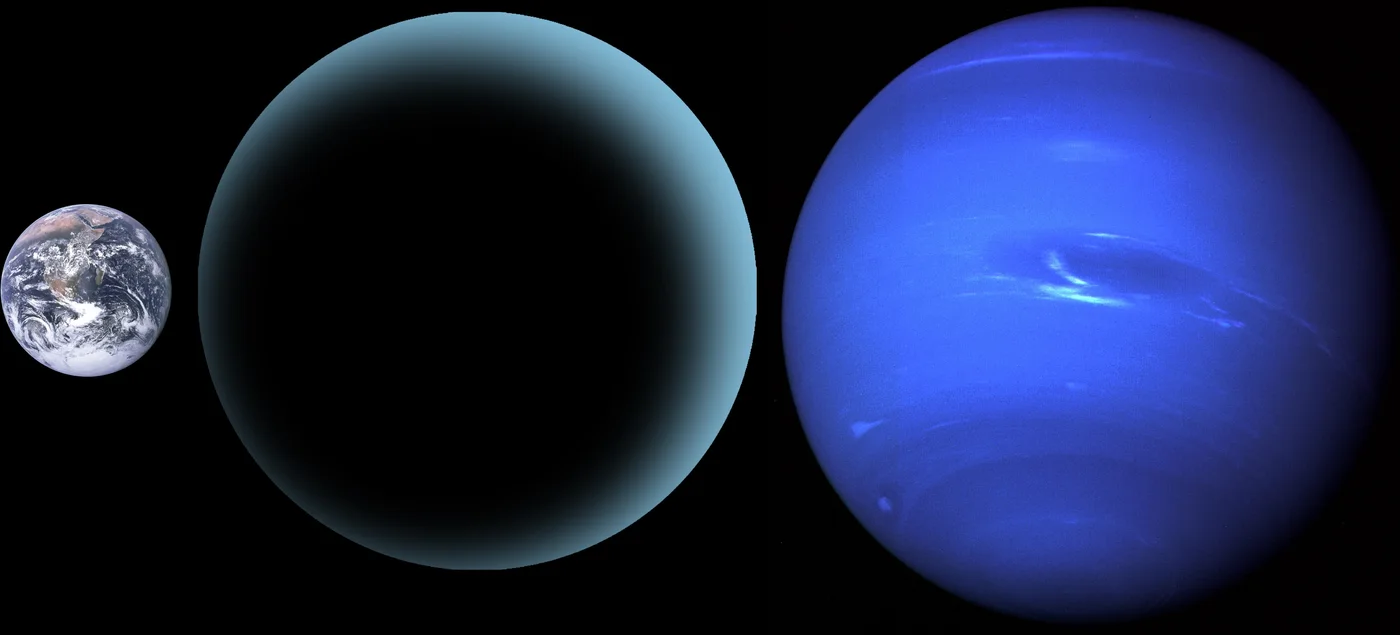
Its estimated mass ranges between 5 and 7 Earth masses (with an outer constraint between 4 and 10 Earth masses), corresponding to a physical diameter between 2.5 and 3.5 Earth radii. At this gravitational scale, the planet comfortably retains a primordial atmosphere dominated by molecular hydrogen and helium, enriched with trace methane that imparts a deep azure or aquamarine hue.
Beneath this thick gaseous blanket lies an immense mantle of supercritical, compressed water and ammonia ice, encasing a dense rocky silicate-iron core. Cloud-top temperatures hover around minus 226 degrees Celsius (47 Kelvin), as sunlight at such immense distances provides virtually zero thermal heating, leaving the world enveloped in permanent cosmic twilight.
«Every new extreme trans-Neptunian object added to the catalog strengthens the gravitational signal. Without Planet Nine, the orbital architecture of the outer Kuiper Belt would dissolve within millions of years. It is out there, and our telescope technology has finally caught up with the mathematical predictions.»
Konstantin Batygin, Professor of Planetary Sciences, California Institute of Technology (Caltech)
An Immense Elliptical Orbit: A 10,000-Year Voyage Through the Deep Void
Planet Nine travels along an eccentric elliptical trajectory characterized by an eccentricity between 0.2 and 0.5. Its semi-major axis spans 380 to 500 astronomical units (AU)—more than 13 to 17 times the distance between the Sun and Neptune, and ten times farther than Pluto’s average orbit.
At perihelion (closest approach), the world comes within 250 to 300 AU of the Sun, while at aphelion it ventures 600 to 800 AU into the deep void, brushing against the inner boundary of the Oort Cloud. Its orbital plane is tilted 15 to 20 degrees relative to the ecliptic, and completing a single orbital revolution takes an astonishing 7,400 to 12,000 Earth years.
This immense spatial detachment explains why direct visual confirmation has proven exceptionally challenging. Sunlight reaching 500 AU is attenuated by a factor of 250,000 relative to Earth. The reflected sunlight traveling back to terrestrial telescopes diminishes by the fourth power of distance ($r^{-4}$), rendering Planet Nine an exceedingly faint target of approximately 22nd apparent magnitude.
Predicted mass is 5–7 Earth masses, with a physical radius of 2.5–3.5 Earths. A thick hydrogen-helium gaseous envelope surrounds a water-ammonia ice mantle.
Semi-major axis spans 380–500 AU (15x farther than Neptune). Eccentricity of 0.2–0.5 and inclination of 15–20 degrees yield a 10,000-year orbital period.
Upper cloud temperature is approximately 47 Kelvin (-226°C). Methane absorption produces an intense deep azure or dark aquamarine appearance.
The Vera C. Rubin Observatory (LSST, Chile) with its 3.2-gigapixel camera is primed to detect the 22nd-magnitude planet within 1–2 years of survey operation.
Cosmic Origins: Primordial Ejection or Captured Extrasolar World
How did such a massive planet find itself in such an extreme orbit? In the primordial protoplanetary disk 4.5 billion years ago, material density at hundreds of astronomical units was far too sparse to assemble a multi-Earth-mass core.
The dominant theoretical model posits that Planet Nine formed much closer to the Sun—between the early embryonic orbits of Jupiter and Saturn. During the era of giant planet migration (described by the Nice model), gravitational resonance between the gas giants slingshot the young sub-Neptune outward. Gravitational nudges from nearby sibling stars in the Sun’s natal birth cluster subsequently circularized its eccentric orbit, preventing it from escaping into interstellar space.
A compelling alternative suggests the Sun captured an extrasolar planet during a close stellar flyby in its primordial cluster. Investigating such ancient celestial bodies bridges our understanding of astronomical evolution and planetary geology, much like how studying Earth’s oldest rock formations reveals the inception of terrestrial crustal dynamics.
- Gravitational Shepherd: The clustered eccentric orbits of over 25 extreme TNOs cannot be maintained without an external massive gravitational perturber.
- Bias Refutation: Statistical clustering cannot be explained by observational selection effects or stellar flybys according to supercomputer simulations.
- Ultra-Faint Signature: The planet’s apparent brightness is dimmed to magnitude ~22 due to sunlight attenuation following an inverse-fourth-power law ($r^{-4}$).
- Prime Search Sector: Orbital modeling places the world near its aphelion in the constellation Taurus against the dense Milky Way galactic plane.
- Scientific Milestone: Direct visual confirmation will restore the nine-planet paradigm and provide the first nearby example of a true super-Earth.
The Vera C. Rubin Observatory Poised to Resolve the Mystery
In recent years, wide-field optical and infrared surveys—including NASA’s WISE mission, the Pan-STARRS1 survey in Hawaii, and the Zwicky Transient Facility (ZTF) at Palomar—have methodically searched large swathes of the sky. These efforts have successfully eliminated roughly 78% of the predicted parameter space, pinning Planet Nine’s most likely current position near aphelion against the crowded stellar background of the galactic plane in Taurus and Orion.
The definitive conclusion is now within reach. The state-of-the-art Vera C. Rubin Observatory in Chile, equipped with the 8.4-meter Simonyi Survey Telescope and the world’s largest 3.2-gigapixel digital camera, is beginning its 10-year Legacy Survey of Space and Time (LSST).
With the unprecedented capability to detect objects down to magnitude 24.5 in a single 30-second exposure, the Rubin Observatory will capture the subtle apparent motion of Planet Nine against distant background stars. If the planet resides within its predicted orbit, it will be discovered and imaged within the first two years of operations, permanently rewriting astronomy textbooks.