

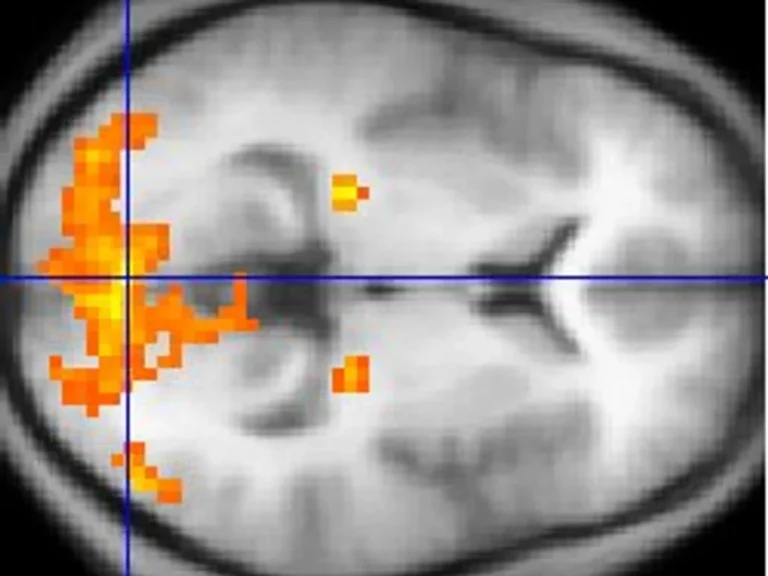

For centuries, philosophers, mathematicians, and cognitive scientists have debated how non-material numerical concepts achieve biological representation within the wet circuitry of the human cerebral cortex. A landmark neuroimaging investigation has now answered one of cognitive science’s most enduring mysteries: researchers have demonstrated that the mental number line brain map operates as a continuous spatial coordinate layout embedded deep within the intraparietal sulcus. Utilizing ultra-high-field 7-Tesla functional magnetic resonance imaging, an international neuroscience team at France’s NeuroSpin research center captured how human parietal cortex projects not only discrete whole integers, but also continuous symbolic fractions, onto a unified spatial continuum, recycling ancient visual navigation circuits for advanced mathematical reasoning.
The Architecture of Thought: How the Brain Maps Abstract Quantities to Space
In the late nineteenth century, Sir Francis Galton, a founder of modern psychometrics, documented a curious cognitive phenomenon: when contemplating numbers, many educated individuals spontaneously visualized them arranged along an invisible geometric trajectory in three-dimensional space. For decades, mainstream neuroscience tended to dismiss these introspective reports as idiosyncratic forms of synesthesia. However, in the late 1990s, renowned French cognitive neuroscientist Stanislas Dehaene formulated the seminal “Number Sense” framework, proving that the Spatial-Numerical Association of Response Codes (SNARC effect) is universal across human cultures: people instinctively map small quantities to left space and large quantities to right space.
Despite this realization, a profound theoretical obstacle remained: for decades, the mental number line brain concept was examined almost exclusively using natural whole numbers (1, 2, 3, 4…). Human infants effortlessly learn to count discrete entities—fingers, apples, or footsteps—where each object represents an isolated, integer unit. But cultural mathematics extends far beyond counting discrete items: humanity devised rational fractions (1/2, 3/4, 5/8), continuous ratios, and real numbers that have no straightforward one-to-one correspondence with physical objects.
This posed a fundamental conundrum: does the human brain construct a dedicated algorithmic calculator for fractions through school education, or did biological evolution engineer a way to fold continuous ratios directly into our ancestral spatial coordinate system? To resolve this puzzle, cognitive neuroscientists needed to peer into living human brain circuits with sub-millimeter precision that conventional hospital scanners could never achieve.
The NeuroSpin Breakthrough: Ultra-High-Field 7T fMRI Unveils Shared Cortical Coordinates
A decisive breakthrough has emerged from an international research collaboration based at the NeuroSpin neuroimaging center in Saclay, France, jointly supported by CEA and INSERM. In a landmark paper published in PLOS Biology, a team led by Daniela Valério, Samuel Debray, and Stanislas Dehaene presented groundbreaking findings from whole-brain functional magnetic resonance imaging conducted on a state-of-the-art 7-Tesla research scanner.
Operating at roughly double the magnetic field strength of standard 3T clinical devices, the 7T scanner produces an extraordinary signal-to-noise ratio that enables functional mapping at sub-millimeter voxel resolutions. Mathematically educated adult volunteers were placed inside the scanner and presented with hundreds of numerical stimuli presented in two distinct symbolic formats: Arabic whole integers (ranging from 1 to 9) and symbolic common fractions (ranging from 1/9 to 8/9). Participants engaged in rapid magnitude comparison tasks against a fixed reference value.
By applying multivariate pattern analysis (MVPA) and population receptive field (pRF) modeling, the researchers reconstructed the topographical geometry of numerical semantics for the first time. The imaging data delivered an unambiguous verdict: the human brain does not delegate fractions to a separate, isolated computational compartment. Instead, cortical activation forms a unified two-dimensional semantic manifold where one axis charts numerical magnitude (from zero to one and beyond) and the orthogonal axis differentiates symbolic presentation format.
Sub-millimeter spatial resolution on ultra-high-field 7T scanners mapped the micro-topographical architecture of human parietal cortex.
Discrete whole integers (1, 2, 8) and continuous fractions (1/4, 2/3) are processed by shared neuronal populations across an integrated coordinate continuum.
The anterior intraparietal sulcus functions as an internal geometric compass, populated by neuronal clusters selectively tuned to numerical magnitudes.
Human culture and formal mathematical reasoning do not forge new organs, but co-opt ancestral primate spatial orientation networks.
Topography of the Intraparietal Sulcus: Magnitude Tuning Across Cortical Space
The anatomical core of this internal spatial geometry was localized to the intraparietal sulcus (IPS) in the dorsal parietal lobe, with extensive bilateral involvement of the anterior inferior parietal cortex. In non-human primates, this very cortical corridor coordinates spatial visual orientation, reaching, and grasp mechanics. Ultra-high-resolution functional maps revealed that neuronal clusters along the banks of the IPS are arranged in continuous topographical gradients, forming a veritable biological number ruler.
Each microscopic cluster of neurons within the IPS exhibits a distinct population receptive field characterized by a bell-shaped Gaussian tuning curve. For instance, a dedicated neural population responds maximally to the magnitude 0.5 (regardless of whether the input is rendered as the fraction “1/2” or the midpoint of a physical line), with its firing rate trailing off smoothly as inputs shift toward 0.3 or 0.7. An adjacent cluster is selectively tuned to 0.75 (“3/4”). This spatial arrangement mirrors the retinotopic maps of the primary visual cortex, where adjacent cortical columns correspond to adjacent regions of the visual field.
Remarkably, the brain translates a composite fraction consisting of two separate Arabic numerals (numerator and denominator) into a unified analog magnitude in less than 200 milliseconds without executing tedious serial division algorithms. Just as rigorous scientific inquiry reveals how microbiological dynamics and concealed biological mechanisms in domestic environments operate under precise empirical laws, the intrinsic spatial architecture of the parietal cortex governs the geometric structure of human abstract mathematics.
«We have experimentally established for the first time that the human brain does not recruit a detached calculator for fractional concepts, but elegantly recycles an ancestral spatial number line. Whole numbers and continuous ratios project onto a unified geometric coordinate map deep within the intraparietal sulcus.»
Stanislas Dehaene, Professor at Collège de France and Director of NeuroSpin (UNICOG)
Neuronal Recycling in Action: Repurposing Primate Spatial Circuits for Advanced Math
The empirical discoveries at NeuroSpin provide compelling confirmation of the “Neuronal Recycling Hypothesis,” a theoretical framework articulated by Stanislas Dehaene in the early 2000s. According to this theory, cultural innovations such as literacy, formal arithmetic, and calculus emerged far too recently in evolutionary history (a few millennia ago) for natural selection to have forged dedicated cortical organs or specialized genetic blueprints.
Instead, human culture achieves its astonishing intellectual feats through a process of cortical co-optation: education invades and reprograms ancestral, evolutionarily conserved neural circuits originally shaped for physical survival. In reading, the brain repurposes primate visual shape recognition circuits in the fusiform gyrus (the visual word form area). In mathematics, symbolic numbers colonize ancestral parietal circuits that ancient arboreal primates utilized to calculate branch distances, trajectory vectors, and foraging yields.
As Samuel Debray points out, learning advanced mathematical concepts during childhood is fundamentally a process of neural re-calibration. When elementary students learn fractions, their brains do not synthesize novel computing machinery; rather, they stretch and refine the continuous coordinate map of the intraparietal sulcus. The conceptual gulf between zero and one, which once seemed like an empty void to an early learner, is progressively populated by an ultra-fine lattice of rational coordinates.
- Ultra-high-field 7T fMRI confirms the existence of a shared two-dimensional semantic map of numerical magnitudes in human parietal cortex.
- Symbolic fractions and whole integers activate overlapping neural ensembles within the intraparietal sulcus (IPS) and inferior temporal gyrus.
- Neuronal population receptive fields (pRF) exhibit classic Gaussian tuning curves characterized by preferred magnitude tuning.
- The human brain translates fractional symbols like 3/4 into continuous magnitude values near 0.75 within 200 ms without formal arithmetic steps.
- These neurobiological insights provide a transformative roadmap for remediating dyscalculia and restructuring foundational mathematics curricula.
Educational Frontiers and Dyscalculia: Translating Brain Topography into Better Learning
The real-world implications of the NeuroSpin findings resonate far beyond theoretical neuroscience, offering transformative potential for primary education and clinical neuropsychology. Fractions have long been recognized as a formidable stumbling block in global mathematics education. Millions of children experience severe math anxiety and cognitive roadblocks when the intuitive rules of whole numbers break down—such as discovering that multiplying two fractions yields a smaller quantity rather than a larger one.
The new research demonstrates that rote memorization of mechanical algorithms (such as “cross-multiplying” or “inverting and multiplying”) conflicts with the brain’s intrinsic spatial architecture. To cultivate genuine mathematical intuition, pedagogy must align with the spatial topography of the intraparietal sulcus. Incorporating continuous visual number lines, dynamic slider bars, and geometric area models allows developing minds to ground fractions directly into their parietal spatial coordinate systems. Classroom trials show that spatial-numerical training dramatically enhances conceptual comprehension and diminishes math avoidance.
Furthermore, these discoveries provide novel diagnostic biomarkers for developmental dyscalculia—a persistent cognitive disability affecting up to 6% of the global population. Clinicians can now evaluate whether arithmetic deficits stem from aberrant micro-topographical organization or degraded spatial tuning curves within the IPS. Designing targeted neuro-educational games with real-time feedback can help recalibrate disrupted cortical maps, proving that uniting cognitive neuroscience with classroom pedagogy can unlock abstract mathematical literacy for every child.