



The high-profile sale of an exquisitely preserved tyrannosaurid skeleton known as “Jodi” at Sotheby’s for millions of dollars has sent shockwaves through the international paleontological community. Beyond serving as a trophy for an anonymous private collector, the specimen has reignited the fiercest taxonomy debate in dinosaur paleontology—a four-decade dispute over whether this agile, deadly carnivore represents a distinct pygmy tyrannosaur genus, Nanotyrannus lancensis, or merely an adolescent Tyrannosaurus rex. This scientific clash transcends bone morphology, laying bare the deep ethical crises surrounding the commercialization of rare natural history treasures.
A Four-Decade Enigma: The Inception of the Pygmy Tyrant
The origins of this taxonomic feud date back to 1942, when paleontologist Charles Gilmore unearthed a small, slender theropod skull in the Hell Creek Formation of Montana. Initially designated as a juvenile Gorgosaurus lancensis, the fossil remained largely uncontroversial until 1988, when renowned paleontologist Robert Bakker, alongside Philip Currie and Michael Williams, re-examined the Cleveland Museum of Natural History specimen. Their startling observation revealed that the cranial sutures between facial bones were thoroughly fused.
In vertebrate anatomy, the obliteration of cranial sutures represents a hallmark of skeletal maturity. Bakker and his colleagues formally erected a new genus and species: Nanotyrannus lancensis (“pygmy tyrant”). Under their evolutionary model, approximately 66 million years ago, a slender, long-legged predator weighing roughly one metric ton hunted synchronously alongside the nine-ton colossus Tyrannosaurus rex.
However, in the early 2000s, an alternative school of thought led by Thomas Holtz and Jack Horner gained widespread traction. They proposed extreme ontogenetic variation: that tyrannosaurs underwent radical anatomical transformations during maturation. Under Horner’s paradigm, all putative Nanotyrannus specimens were reinterpreted as juvenile T. rex individuals between 11 and 14 years old, possessing slender frames prior to an explosive teenage growth spurt.
The “Jodi” Specimen: Exceptional Preservation and Auction Frenzy
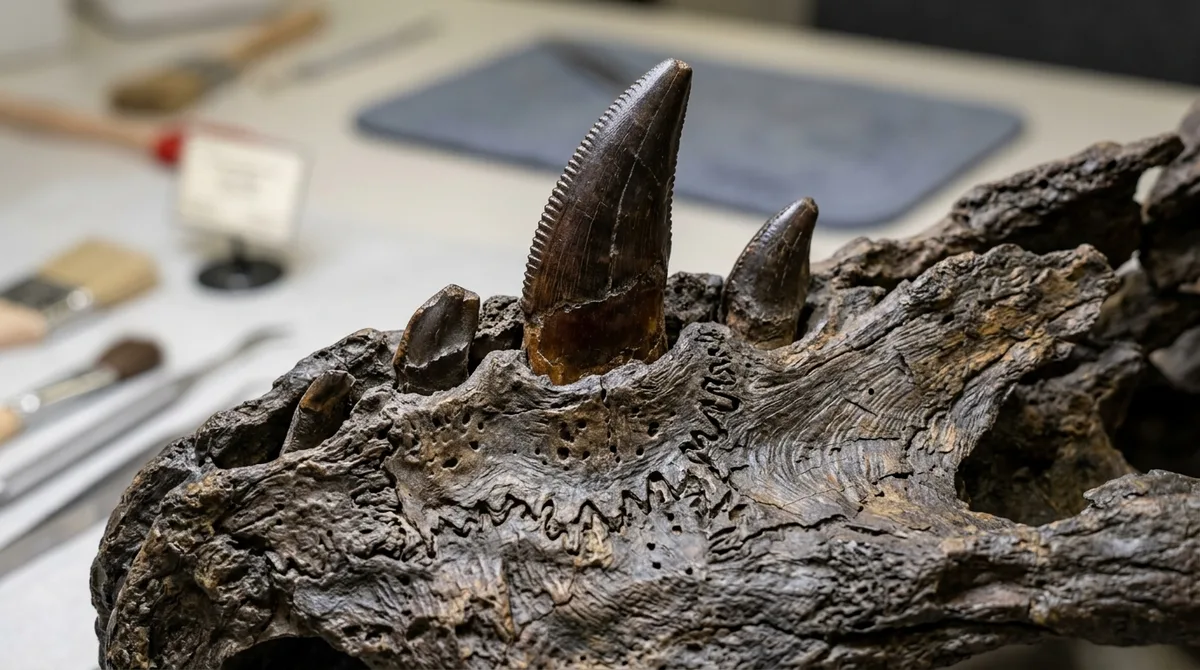
The discovery of “Jodi”, excavated on private ranch land in Montana, was anticipated as the empirical benchmark to settle the debate. The specimen boasts more than 85 percent skeletal completeness, including an intact cranium, pristine dentition, cervical series, pelvis, and extraordinarily preserved forelimbs.
Jodi’s anatomical configuration immediately challenged the juvenile T. rex hypothesis. The specimen’s forearms are significantly longer, more robust, and articulated with large, heavily curved predatory claws. While adult T. rex individuals possessed famously vestigial forelimbs incapable of reaching their mouths, Jodi possessed functional, mechanically advantageous grasping limbs adapted for seizing thrashing quarry.
Furthermore, Jodi’s lower jaw features 17 tooth positions, compared to only 11 to 12 in mature T. rex specimens. For the ontogenetic hypothesis to stand, one would have to accept that a growing theropod did not merely shed teeth, but underwent an unprecedented reduction in tooth sockets and a complete redesign of alveolar bone architecture—a phenomenon without precedent in theropod evolution.
The debate whether Nanotyrannus represents a pygmy species or adolescent T. Rex has raged since 1988.
Jodi displays unprecedented preservation of the skull, elongated grasping forelimbs, and pelvic girdle.
Cortical growth ring analysis confirmed an External Fundamental System (EFS), proving Jodi was a mature adult.
Multimillion-dollar private sales prevent public museums and researchers from accessing critical holotypes.
Bone Histology: Growth Rings Confirm Adult Skeletal Maturity
The most decisive empirical evidence against the juvenile T. rex theory has emerged from paleohistology. Researchers Nick Longrich and Evan Saitta analyzed thin cross-sections of cortical bone from comparable small tyrannosaur skeletons, including the renowned “Jane” specimen and related private fossils. The counting of lines of arrested growth (LAGs) in dinosaur cortical bone functions identically to dendrochronology in trees.
Histological examinations yielded unmistakable evidence: the outermost growth rings of Jodi compress into a tightly packed outer band known as an External Fundamental System (EFS). An EFS develops exclusively when an animal has completely concluded its exponential growth phase and achieved skeletal adulthood. Jodi was not a rapidly growing teenager, but a fully grown adult predator that expired at a mass between 900 and 1,500 kilograms.
Had Jodi been a young T. rex, bone vascularization would exhibit wide, porous fibro-lamellar tissue characteristic of exponential adolescent growth (during which T. rex gained up to 2.5 kg daily). Instead, Jodi’s bone matrix demonstrates the dense, remodelled Haversian tissue of an adult whose terminal size had already been attained.
«When critical holotypes vanish into private luxury penthouses, science loses irreplaceable pages of evolutionary history. The Jodi specimen preserves crucial answers regarding apex predator biology, yet researchers risk losing access to it forever.»
Dr. Nick Longrich, Senior Lecturer in Paleontology and Evolutionary Biology at the University of Bath
Niche Partitioning: Sympatric Predators of the Late Cretaceous
Validating Nanotyrannus as a legitimate taxon completely reshapes our comprehension of Late Cretaceous ecosystems. Rather than T. rex monopolizing all predatory niches across its developmental phases, ecological modeling reveals sophisticated niche partitioning.
With its elongated tibia and specialized arctometatarsalian foot structure, Nanotyrannus was engineered for sustained pursuit, capable of sprinting at speeds exceeding 45 km/h (28 mph). It specialized in hunting fleet-footed ornithopods, pachycephalosaurs, and subadult ceratopsians. Its acute stereoscopic vision and olfactory lobes made it an agile pursuit hunter on open floodplains.
Conversely, the adult Tyrannosaurus rex was an armored bruiser possessing an unmatched bite force of 35 to 50 kilonewtons capable of pulverizing bone, designed to subdue colossal Triceratops and Edmontosaurus. The two tyrannosaurids coexisted by targeting disparate prey spectra—a classic example of sympatric niche differentiation akin to cheetahs and lions cohabiting the contemporary Serengeti.
- Jodi possesses 17 teeth per dentary, whereas adult T. rex exhibits only 11 to 12 tooth positions.
- Elongated, muscular forelimbs with sharp recurved claws served as active predatory grasping weapons.
- Nanotyrannus occupied an agile pursuit predator niche alongside the bone-crushing T. rex.
- The Society of Vertebrate Paleontology (SVP) advocates restricting private sales of rare fossil holotypes.
The Commercial Auction Crisis: Science Denied Access to Holotypes
The multimillion-dollar Sotheby’s sale of Jodi highlights a profound crisis in modern paleontology. Under United States property law, fossils discovered on private land belong exclusively to the landowner, permitting unrestricted commercial auction. Astronomical valuations driven by private collectors have priced university museums and academic institutions out of the market.
The Society of Vertebrate Paleontology (SVP) has repeatedly sounded the alarm: specimens confined to private estates are removed from scientific peer review. Researchers cannot conduct micro-CT scans, extract histological cores, or publish repeatable analyses. Leading scientific journals increasingly refuse to publish papers reliant on privately owned fossils lacking public repositation guarantees.
Paleontologists are lobbying for international treaty protections for irreplaceable fossil holotypes and the establishment of scientific acquisition endowments. The story of Jodi stands as an urgent reminder that the chronicles of Earth’s prehistoric past belong to global scientific heritage, not private auction portfolios.