


In the late 1970s, the prestigious McDonnell Laboratory for Psychical Research at Washington University triumphantly announced empirical proof of genuine psychokinesis and paranormal metal bending in two gifted teenagers. However, three years of glowing academic reports collapsed into monumental disgrace when legendary magician and skeptic James Randi unveiled Project Alpha, proving the “psychics” were amateur illusionists using basic sleight of hand.
A Half-Million-Dollar Grant and the Dawn of Psychic Research
During the late 1970s, the global academic zeitgeist was gripped by an unprecedented fascination with extrasensory perception (ESP) and psychokinesis. The international spectacle surrounding Uri Geller—who captivated television audiences worldwide by seemingly bending solid metal cutlery through concentrated willpower—prompted distinguished university researchers to ponder whether macroscopic psycho-physical interactions were genuinely real. In 1979, aerospace industrialist James Smith McDonnell (founder of McDonnell Douglas aerospace conglomerate) channeled this cultural fascination into an endowment of $500,000 to Washington University in St. Louis to establish the specialized McDonnell Laboratory for Psychical Research.
Directed by credentialed physicist Dr. Peter Phillips, the laboratory aimed to apply the unyielding rigor of mainstream physical sciences to the study of psychic phenomena. Outfitted with high-precision strain gauges, laser interferometers, video recording rigs, and sealed environmental chambers, the laboratory launched a nationwide talent search for individuals demonstrating anomalous psycho-kinetic capabilities. Hundreds of claimants were screened, but two young men stood out in spectacular fashion: 18-year-old Steve Shaw (now world-renowned mentalist Banachek) and 17-year-old Michael Edwards. From their initial trials, Shaw and Edwards dazzled the faculty: bending spoons under transparent bell jars, relocating sealed ampoule contents, and deflecting magnetic needle gauges. Unknown to the McDonnell researchers, however, these gifted prodigies were undercover operatives of the greatest debunking mastermind in history: James “The Amazing” Randi.
The Anatomy of Deception: Protocol Rules Ignored
James Randi, a world-class escape artist, magician, and founding member of the Committee for the Scientific Investigation of Claims of the Paranormal (CSICOP), foresaw that academic physicists possessed zero immunity against professional deception. Before Shaw and Edwards entered the university, Randi sent Dr. Phillips an extensive, formal memorandum offering pro bono experimental design consulting. Randi urged the physicists to adhere to strict investigative tenets: never permit the subjects to handle test objects outside direct camera views, mark all test specimens with indelible microscopic etching, never allow the subjects to adjust room illumination, and strictly prohibit subjects from dictating test conditions.
Dr. Phillips and his research associates dismissed Randi’s advisory letters as arrogant interference from a stage entertainer, confident that doctoral degrees in physics equipped them to discern physical truth. Randi’s operational mandate to Shaw and Edwards was brilliantly ethical: “Never claim to possess genuine psychic powers. If directly asked under oath whether your feats are magic tricks, tell the truth immediately. But so long as the scientists choose to believe, give them a show.” The teenagers proceeded to bend spoons by pressing them against laboratory tables when scientists looked toward computer monitors, switched envelopes during moments of ambient dimming, and moved compass needles with micro-magnets hidden beneath their fingernails. The epistemological challenge of distinguishing authentic phenomena from observational artifacts has been a recurrent theme in scientific history: as examined on Vinegret.Net in our study of rigorous experimental validation and historical data integrity, methodological precision remains the bedrock of genuine discovery.
The Trap of Confirmation Bias: Academics in Self-Delusion
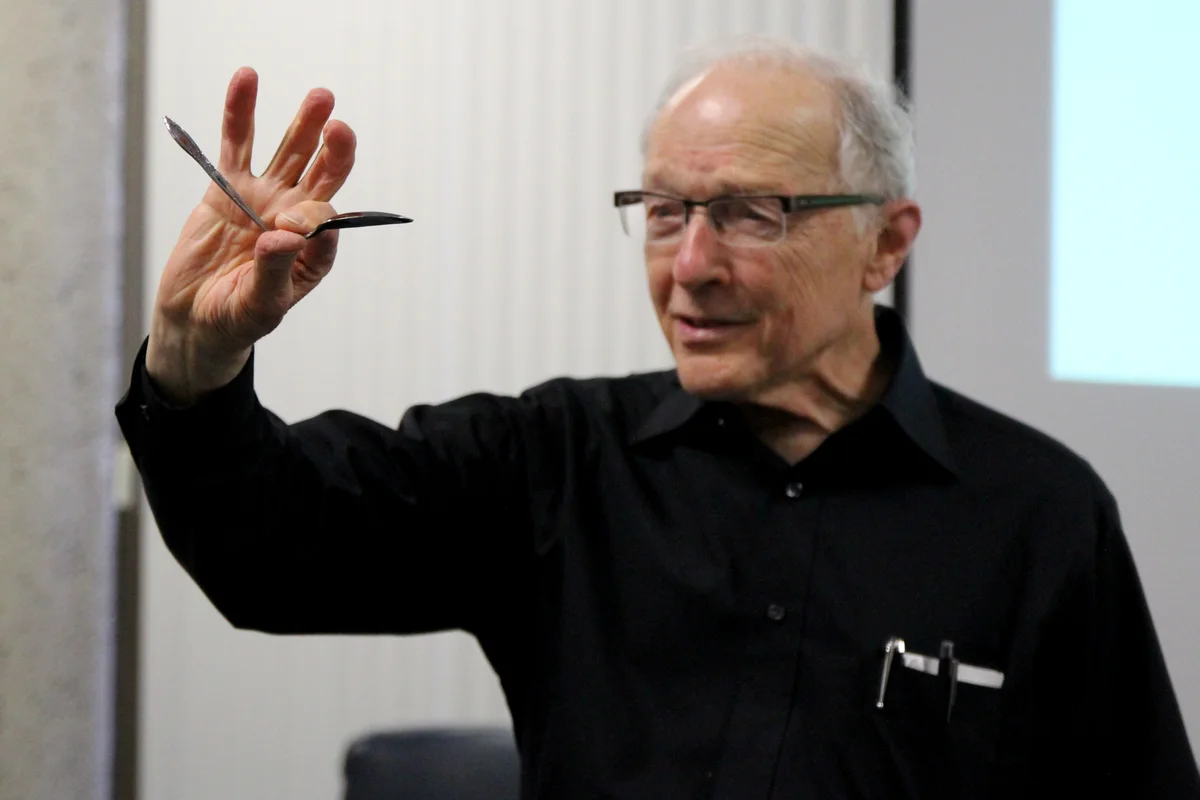
Between 1979 and 1982, the McDonnell Laboratory produced dozens of preliminary papers, video presentations, and conference lectures heralding the discovery of verified macroscopic psychokinesis. At prestigious gatherings such as the Parapsychological Association conventions, physicists proudly screened footage of Shaw and Edwards bending surgical stainless steel rods and generating electric currents in sealed circuits.
The researchers had fallen headlong into the psychological quagmire of confirmation bias. Whenever rigorous controls were experimentally imposed and the boys were physically unable to palm or bend specimens, the scientists rationalized the failure as “psychic inhibition caused by skeptical skepticism” or subject fatigue. Conversely, when Shaw requested that ambient lights be lowered or asked to hold a test tube in his warm hands “to align psychic bio-rhythms,” the scientists readily capitulated, confusing experimental accommodation with research collaboration. Not once did the laboratory invite a professional conjuror to review raw video recordings. This tragic blindness mirrors critical lessons explored on Vinegret.Net in our report on rigorous astrophysical observation and systemic hypothesis testing, where empirical validation requires eliminating all confounding terrestrial variables.
The Illusion of Psychokinetic Bending
Teenage mentalists Steve Shaw and Michael Edwards bent steel spoons and sealed test specimens by exploiting fundamental misdirection loopholes overlooked by physicists.
Catastrophic Double-Blind Failure
McDonnell physicists routinely compromised experimental isolation: allowing subjects to dictate lighting, touch specimens, and manipulate measurement instruments.
Confirmation Bias in Ivory Towers
Eminent scientists were so desperate to discover novel quantum consciousness interactions that they discarded critical warnings from professional stage illusionists.
A Watershed for Scientific Skepticism
The sensational 1983 public exposure fundamentally revolutionized experimental controls, permanently ending the golden era of credulous parapsychological institutes.
The 1983 Press Conference: Randi Drops the Bombshell
By early 1983, Dr. Phillips had prepared a comprehensive monograph for submission to prestigious peer-reviewed journals, poised to formally canonize psychokinesis into the scientific record. Realizing that the academic hoax had reached the threshold of institutional legitimation, Randi decided the moment for revelation had arrived. On February 28, 1983, at a packed press conference hosted by Discover magazine in New York City, Randi took the podium alongside Steve Shaw and Michael Edwards.
Randi stunned the international press corps by announcing Project Alpha and unveiling raw McDonnell Laboratory footage side-by-side with live demonstrations. Before the flashing cameras, Shaw and Edwards replicated every single “miracle” that had baffled the Washington University physicists for three years, explaining the sleight-of-hand mechanics in granular detail. The fallout was catastrophic for the parapsychology movement. Institutional funding evaporated almost overnight, academic credibility was obliterated, and the McDonnell Laboratory was permanently shuttered by Washington University’s board of trustees.
Enduring Lessons for Epistemology and Scientific Skepticism
The philosophical reverberations of Project Alpha extend far beyond the debunking of spoon bending. Randi articulated a fundamental epistemological truth that remains vital today: physical scientists are fundamentally trained to investigate an honest universe. Subatomic particles do not deliberately deceive the researcher; biochemical molecules do not palm evidence behind their back. When trained researchers confront an active human agent attempting to mislead them, standard academic methodologies fail unless cross-pollinated with expertise in conjuring and perception psychology.
Following Project Alpha, Steve Shaw went on to build a legendary career as mentalist Banachek, becoming an international authority on deception detection and psychological influence. Randi established the James Randi Educational Foundation (JREF), offering the famous One Million Dollar Paranormal Challenge to anyone who could demonstrate anomalous abilities under mutually agreed scientific controls—a prize that was never claimed.
Scientific Epilogue: Inoculation Against Delusion
In our current digital era plagued by deepfakes, algorithmic confirmation bubbles, and pseudo-scientific panaceas, the legacy of Project Alpha serves as an indispensable intellectual vaccine. True scientific skepticism is not cynicism; it is the profound, disciplined commitment to truth over wishful thinking.