

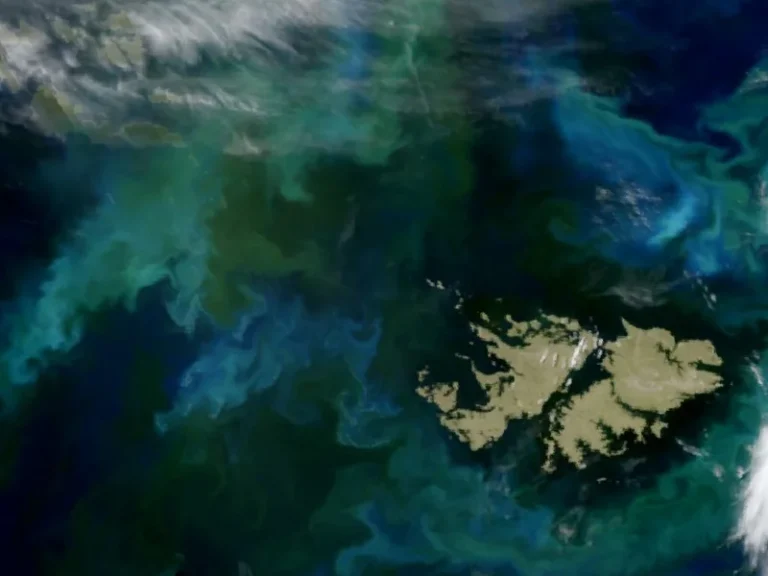

The prolonged climate phenomenon known as El Niño has grown so intense and persistent that it has physically reshaped the biological appearance of the Pacific Ocean across millions of square kilometers. NASA’s state-of-the-art PACE satellite revealed that this planetary event altered ocean colour from orbit, shifting vast swathes of normally vibrant, emerald-green equatorial waters into barren, crystal-clear deep blue deserts following a catastrophic collapse in phytoplankton upwelling.
A New Eye on the Biosphere: The Hyperspectral Power of PACE
In early 2024, the National Aeronautics and Space Administration (NASA) launched its flagship environmental observatory, the Plankton, Aerosol, Cloud, ocean Ecosystem (PACE) satellite. For decades, satellite oceanography had relied on multispectral heritage sensors such as MODIS and VIIRS, which gathered light across only a handful of broad, discrete spectral bands. PACE fundamentally transformed this field through its primary instrument, the Ocean Color Instrument (OCI). OCI functions as a continuous hyperspectral spectrometer, capturing sunlight reflected from the ocean across hundreds of adjacent wavelengths from ultraviolet through near-infrared.
As explained by lead scientist Dr. Matthew Kehrli (Matthew Kehrli) of NASA’s Goddard Space Flight Center, hyperspectral observation empowers oceanographers to look far beyond bulk chlorophyll concentrations. Instead of simply measuring whether a patch of water is “green,” researchers can now identify the specific functional communities of microscopic algae present, evaluate their physiological stress, and track the flow of biochemical nutrients throughout the pelagic zone.
Crucially, PACE began scientific operations during the mature stage of an extraordinarily tenacious El Niño event within the El Niño Southern Oscillation (ENSO) cycle. The newly calibrated OCI instrument immediately captured a breathtaking, planetary-scale optical shift across the equatorial Pacific, providing the world with the most detailed record ever assembled of climate disruption impacting ocean biology.
The Upwelling Engine Stalls: How El Niño Chokes Marine Nutrients
To understand why the ocean’s changing tint represents an ecological crisis, one must examine the physical mechanics governing the tropical Pacific. Under neutral conditions or during La Niña phases, intense easterly trade winds blow continuously along the equator. These winds push sun-warmed surface waters westward toward Indonesia, creating the Western Pacific Warm Pool. In response, cold, dense water from the ocean depths rises along the western coast of South America and along the equator in a vital process known as upwelling.
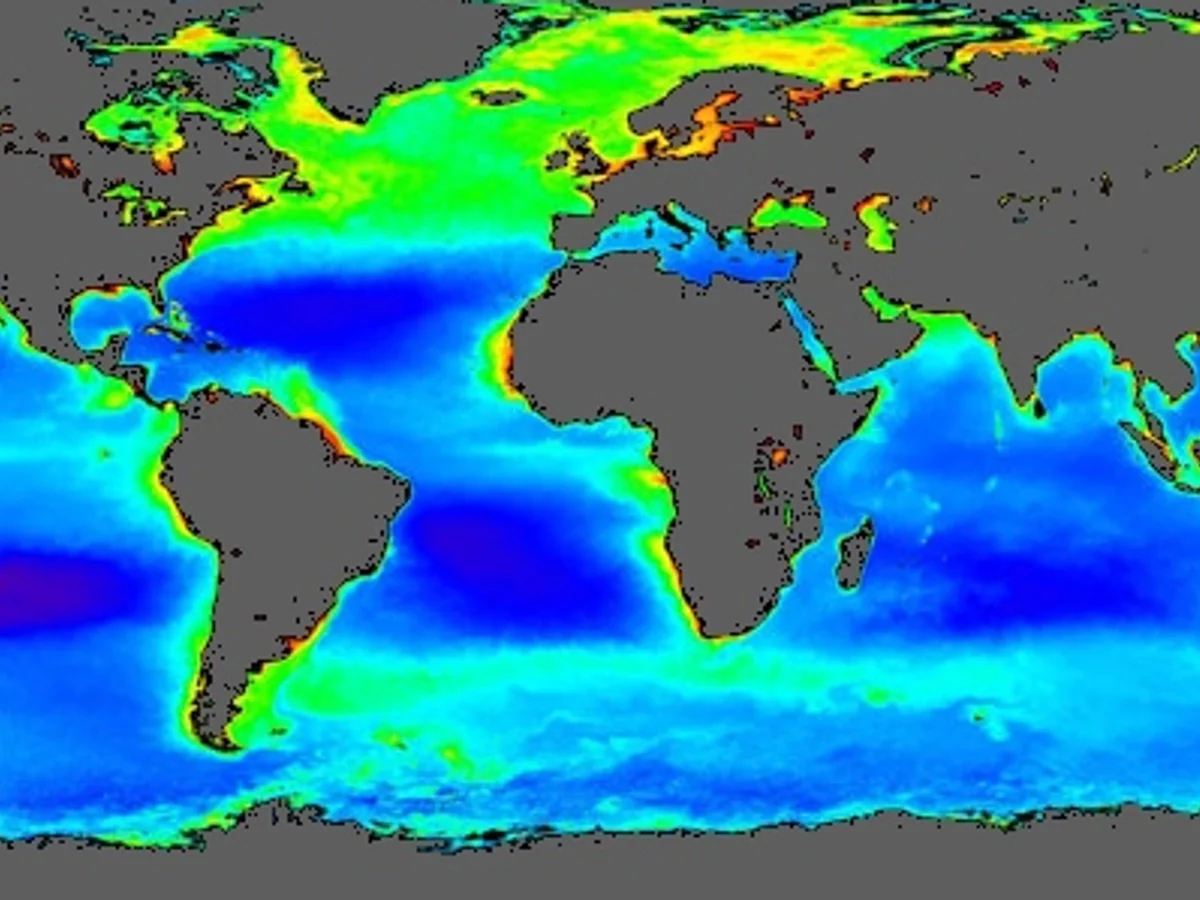
These deep, abyssal currents are packed with essential inorganic nutrients: nitrates, phosphates, silicate, and bioactive iron derived from the decomposition of organic matter settling on the seafloor. When this nutrient-dense water enters the sunlit photic zone, it fuels massive blooms of phytoplankton—single-celled microscopic algae and photosynthetic cyanobacteria. The dense accumulation of chlorophyll-a absorbs blue and red wavelengths while reflecting green light, turning the fertile equatorial Pacific into a thriving, turquoise-green biological oasis.
During a severe El Niño, however, this planetary wind engine falters. The easterly trade winds diminish substantially or reverse into westerlies. Warm surface waters surge eastward across the Pacific, depressing the thermocline and capping the cold, nutrient-rich deep currents beneath a thick blanket of stagnant, overheated water. This thermal stratification completely chokes off the upwelling elevator, starving surface phytoplankton of the basic mineral nutrients required for photosynthesis.
Weakening trade winds halted the vertical transport of sub-surface waters rich in nitrates, phosphates, and dissolved iron.
Plummeting chlorophyll-a concentrations shifted the Apparent Visible Wavelength (AVW) from emerald-green to cobalt blue.
The disappearance of primary producers starved zooplankton, anchoveta stocks, pelagic fish, seabirds, and marine mammals.
PACE’s Ocean Color Instrument scans across hundreds of continuous wavelengths to decode aquatic biogeochemistry from orbit.
From Emerald to Cobalt: Decoding the AVW Chromatic Metric
To quantify this chromatic makeover from orbit, NASA scientists employ the Apparent Visible Wavelength (AVW) metric. AVW represents the weighted average wavelength of visible sunlight reflected by the water’s surface, calculated from hyperspectral OCI radiometry. In nutrient-rich waters bustling with algal blooms, the AVW index registers between 500 and 530 nanometers, corresponding to vibrant green and yellow-green spectra.
With the collapse of upwelling, vast populations of diatoms, dinoflagellates, and coccolithophores rapidly starved and died off. As their green pigments vanished, the equatorial Pacific lost the microscopic scattering particles that imparted its characteristic green hue. Depleted of biological life, the water became exceptionally transparent, absorbing red, orange, and green photons while backscattering only high-energy, short-wavelength blue light. Consequently, the AVW index plunged below 470 nanometers, indicating a sweeping transition into barren, cobalt-blue waters.
The PACE satellite imagery exposed an expansive swath of optical desertification stretching thousands of kilometers across the Pacific basin. These observations highlight how satellite optics integrate with wider atmospheric phenomena, bridging the study of marine ecology with broader discussions on global environmental monitoring and advanced scientific instrumentation needed to navigate climate volatility.
«Some people think of water as being just blue, but it is truly amazing the multitude of colours the ocean can be. PACE enables the global scientific community to observe El Niño across more continuous wavelengths of light than ever before, diagnosing marine ecological distress in near-real time.»
Dr. Matthew Kehrli, lead research scientist for the PACE satellite mission at NASA’s Goddard Space Flight Center
Trophic Web Breakdown: From Microscopic Algae to Pelagic Predators
While clear, crystal-blue waters evoke idyllic tropical postcards, in biological oceanography deep blue is the definitive signature of a marine desert. Phytoplankton constitutes the foundational pillar of the entire marine food web, synthesizing the primary organic carbon that sustains everything from zooplankton and krill to apex pelagic predators.
The collapse of primary productivity triggered an immediate shockwave throughout the oceanic trophic cascade. Deprived of food, zooplankton populations plummeted, precipitating an acute starvation crisis for commercially crucial forage fish, most notably the Peruvian anchoveta (Engraulis ringens). As schools of small pelagic fish withered, millions of seabirds, including guano-producing boobies, cormorants, and pelicans, perished from severe malnutrition along the coastline.
Higher trophic levels suffered immense stress. Cetaceans, including blue and humpback whales migrating through tropical waters, encountered biological wastelands instead of traditional feeding aggregations, forcing them to expend precious energy reserves traveling vast distances. The optical shift recorded by PACE provides tangible proof that thermal climate anomalies directly translate into widespread ecological collapse.
The Biological Carbon Pump and Long-Term Climate Feedbacks
Beyond immediate wildlife mortality, the widespread demise of phytoplankton impairs one of Earth’s primary climate stabilizers: the biological carbon pump. Marine microscopic algae are responsible for roughly 50% of the planet’s photosynthetic carbon fixation, producing half the oxygen we breathe and absorbing billions of tons of anthropogenic carbon dioxide annually.
Under healthy conditions, dying phytoplankton aggregates into “marine snow,” which sinks into the deep abyss, effectively sequestering carbon within benthic sediments for centuries. When upwelling ceases and phytoplankton productivity plummets, this biological sink stalls. Furthermore, warmer ocean waters exhibit reduced solubility for gases, decreasing the ocean’s physical capacity to dissolve atmospheric CO2. This feedback loop threatens to leave higher concentrations of greenhouse gases in the atmosphere, accelerating the pace of global warming.
NASA’s PACE mission has established that hyperspectral ocean color monitoring is no longer an abstract academic exercise, but an essential diagnostic tool for planetary survival. By deciphering the subtle chromatic language of the sea, scientists can detect the earliest warning signs of oceanic distress, helping humanity anticipate and navigate the profound ecological upheavals of our changing world. Also read our related investigative feature on global environmental monitoring and advanced scientific instrumentation.