

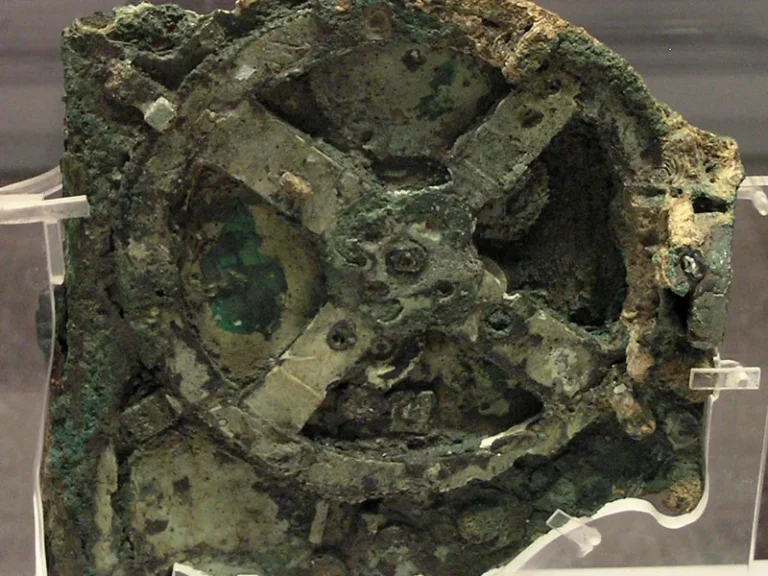

In the spring of 1900, sponge divers taking shelter from a violent Mediterranean gale off the rugged coast of Antikythera stumbled upon the submerged wreck of an ancient Roman cargo vessel laden with classical Greek treasures. Resting among colossal marble statues and amphorae lay an unremarkable, heavily calcified lump of corroded bronze. Decades of investigative science revealed an astonishing truth: the Antikythera mechanism analog computer Ancient Greece anticipated the evolution of precision mechanical clockwork by more than fifteen centuries. Driven by thirty-seven miniature interlocking bronze gears and planetary differentials, this second-century BC technological masterpiece calculated the positions of the Sun, Moon, eclipse sequences, and Panhellenic athletic festivals with sub-millimeter precision.
Accidental Discovery: An Enigma Raised from the Mediterranean Deep
In April 1900, a crew of Greek sponge divers hailing from the island of Symi, commanded by Captain Dimitrios Kondos, sought refuge from a ferocious storm in a sheltered cove off the barren islet of Antikythera, midway between the Peloponnese and Crete. Once the gale subsided, diver Elias Stadiatis descended in standard canvas-and-brass diving gear to inspect the seabed at a depth of 45 meters. He resurfaced in a state of agitation, describing a seabed strewn with a rotting heap of corpses and bronze horses. In reality, he had discovered an immense Roman shipwreck filled with looted Greek art bound for the villas of the Roman elite.
During the perilous recovery expedition that spanned 1900 to 1901, archeologists retrieved magnificent bronze and marble sculptures, intricate glassware, and amphorae. Consigned to museum crates as an unclassified oddity was a corroded, calcified green block that had fractured into multiple fragments. For months, it sat unnoticed in the courtyard of the National Archaeological Museum in Athens.
In May 1902, Greek politician and archaeologist Valerios Stais closely examined the eroding fragments. To his astonishment, he detected the unmistakable profile of miniature gear wheels with clean triangular teeth, visible between layers of oxidized bronze and bearing minute Greek astronomical inscriptions. The discovery ignited decades of skepticism, as conventional historians insisted complex gear technology was impossible in the pre-Christian classical world.

Deciphering the Enigma: High-Resolution 3D Microfocus Tomography
The scientific renaissance of the mechanism began in the 1950s through the pioneering efforts of British science historian Derek de Solla Price. Utilizing gamma-ray and early industrial radiograms, Price established in his seminal 1974 monograph «Gears from the Greeks» that the 82 surviving fragments comprised a cohesive calendrical calculating machine.
The definitive technological leap arrived in 2005 with the formation of the international Antikythera Mechanism Research Project (AMRP), spearheaded by mathematician Tony Freeth and astronomer Mike Edmunds. The team commissioned an eight-ton industrial microfocus X-ray computed tomography system—the X-Tek Bladerunner—transported directly to Athens. The resulting 3D volumetric scans resolved the interior anatomy of the oxidized fragments with sub-micron fidelity.
The scans revealed dozens of gear assemblies hidden deep within the limestone concretions and exposed more than 3,500 characters of previously invisible micro-inscribed text. This inscription served as an integrated user manual and astronomical treatise, settling beyond doubt that the artifact was humanity’s earliest surviving analog computer.
The mechanism contained at least 37 precision bronze cogs with triangular 60-degree teeth, hand-cut from a single virgin bronze sheet with astonishing geometric uniformity.
The apparatus debuted epicyclic gearing using a pin-and-slot mechanism, reproducing Hipparchus’s theory of the Moon’s variable orbital velocity centuries ahead of Kepler.
The rear lower spiral dial traced the 223-month Saros cycle, predicting the exact hour, lunar disk coloration, and associated atmospheric wind vectors for eclipses.
A subsidiary four-year Olympiad dial coordinated the prestigious Greek athletic festivals: the Olympic, Pythian, Isthmian, and Nemean games.
Mechanical Architecture: The Metonic Cycle, Saros, and Keplerian Previews
Housed in a compact wooden case measuring approximately 34×18×9 centimeters with hinged bronze doors, the mechanism was operated via a hand-turned drive arbor. The front dial showcased a dual concentric ring: an outer 365-day Egyptian solar calendar ring adjustable for leap years every four years, and an inner 360-degree zodiac ring with Greek constellation markers.
The reverse side featured two sweeping spiral dials of breathtaking mathematical ingenuity. The upper five-turn spiral traced the 235 synodic months of the Metonic cycle (equivalent to 19 solar years), harmonizing solar and lunar calendars. Nested inside were auxiliary indicators for the 76-year Callippic cycle and a dedicated four-year Olympiad dial tracking Panhellenic athletic games.
The lower four-turn spiral tracked the 223-month Saros cycle for predicting solar and lunar eclipses. Within individual glyph compartments, craftsmen engraved specific codes denoting the anticipated eclipse hour, lunar obscuration color, and prevailing wind directions associated with the event.
The pinnacle of the engineering lies in its epicyclic lunar anomaly train. The astronomer Hipparchus discovered that the Moon moves non-uniformly across the sky, accelerating near perigee and decelerating at apogee. The mechanism replicated this Keplerian behavior in bronze: a lower gear drove an upper gear via an offset pin sliding inside a machined slot, inducing periodic acceleration and deceleration that precisely reproduced the Moon’s elliptical velocity.
«No mechanical device of comparable sophistication is recorded in human history until the emergence of cathedral astronomical clocks in fourteenth-century Europe.»
Professor Tony Freeth, Mathematician and Lead Researcher, Antikythera Mechanism Research Project (UCL)
Historical Provenance: From Archimedes of Syracuse to the Rhodian School
The identity of the master artisan behind this computational marvel remains one of antiquity’s greatest fascinations. In his dialogue «De Re Publica», Roman orator Marcus Tullius Cicero explicitly described a bronze planetarium built by Archimedes of Syracuse, brought to Rome by General Marcus Claudius Marcellus following the siege of 212 BC. Cicero recounted how the mechanism tracked the motions of the Sun, Moon, and the five known planets.
In another text, Cicero detailed an astronomical sphere recently constructed by his friend and mentor Posidonius of Rhodes. Modern epigraphic analysis of the month names engraved on the Metonic dial revealed distinct Corinthian-Greek dialect roots, pointing toward Syracuse (a Corinthian colony) or the northwestern Greek region of Epirus.
Contemporary consensus posits that the theoretical mechanics stemmed from Archimedes and Hipparchus, while the specific machine recovered from the shipwreck was crafted in an elite workshop on Rhodes around 150–100 BC. This confirms that advanced mathematical engineering was not an isolated aberration, but a thriving, institutionalized discipline in Hellenistic science.
- The Roman merchant shipwreck occurred between 70 and 60 BC off the desolate islet of Antikythera.
- Microfocus 3D X-ray tomography revealed over 3,500 characters of explanatory Greek inscriptions.
- Bronze gear thickness averages just 1.5 to 2 millimeters, with wheel diameters reaching 13 centimeters.
- A small manual side crank allowed the operator to advance calendar dates and watch all celestial cycles track simultaneously.
Lost Knowledge and the Rewriting of Classical Technological History
The recovery of the Antikythera mechanism permanently dismantled the Eurocentric dogma that precision engineering emerged only during the High Renaissance. It proves that Hellenistic civilization possessed an extraordinary synthesis of theoretical astronomy, spherical trigonometry, and industrial craftsmanship.
Had this mechanical tradition not been extinguished by Roman geopolitical conquest and the subsequent disintegration of Mediterranean infrastructure, humanity’s Industrial Revolution might have unfolded over a millennium earlier. Echoes of this technology survived precariously in medieval Islamic astronomical treatises, notably through the gear models of al-Biruni, before returning to Western Europe.
In 2021, an engineering collective at University College London (UCL) unveiled a complete mathematical reconstruction of the lost front planetarium display, demonstrating how gear trains simulated the retrograde loops of Mercury, Venus, Mars, Jupiter, and Saturn. The Antikythera mechanism stands as timeless testament to the boundless ingenuity of ancient science, preserving the celestial order in bronze. Also read our related investigative feature on foundational principles of analog computing and continuous physical system modeling.