



Freshwater lakes across the globe are losing their ecological individuality and beginning to fluctuate in lockstep, according to a new study published in the Proceedings of the National Academy of Sciences (PNAS). Researchers found that global lake synchronization has surged over the past 25 years, eroding a critical natural buffer against environmental disruption.
In the not-so-distant past, individual lakes varied widely from one another, shaped by distinct local watersheds, geology, and microclimates. That diversity served as an ecological safety net: if one lake suffered a severe algal bloom, a neighboring body of water could remain healthy and unaffected.

What 2,000 Lakes and Century-Long Sediment Records Reveal
Led by scientists at the Chinese Academy of Sciences, the research team combined satellite observations of roughly 2,000 lakes worldwide over the past 25 years with century-long sediment records from 119 lakes. By tracking algae levels and water clarity—two core indicators of a lake’s metabolic activity—the researchers mapped how freshwater ecosystems behave over time.
Regardless of region or latitude, the team discovered that fluctuations in algae and water clarity have shifted steadily into lockstep, particularly since the year 2000. On a 0-to-1 scale, global lake synchronization in sediment production jumped from around 0.1 prior to 1980 to roughly 0.6 after 2000.
25 years of satellite monitoring paired with century-long sediment cores from 119 lakes.
Sediment production synchrony rose sixfold after 2000 compared with pre-1980 levels.
Global climate change combined with socioeconomic pressures such as land-use transformation.
Simultaneous greenhouse gas pulses and widespread aquatic hypoxia across continents.
Why Global Lake Synchronization Erodes Natural Buffers
The researchers argue that lakes can no longer be understood as isolated systems governed purely by local conditions. Instead, they are increasingly coupled by global climate warming and human land-use changes, echoing broader planetary-scale risks modeled in modern climate simulations.
“The emerging evidence for increasing global lake synchrony calls for a conceptual shift: lake ecosystems can no longer be viewed as isolated systems experiencing local degradation, but should also be recognized as sensitive indicators of increasingly coupled environmental pressures,”
Study authors in Proceedings of the National Academy of Sciences (PNAS)
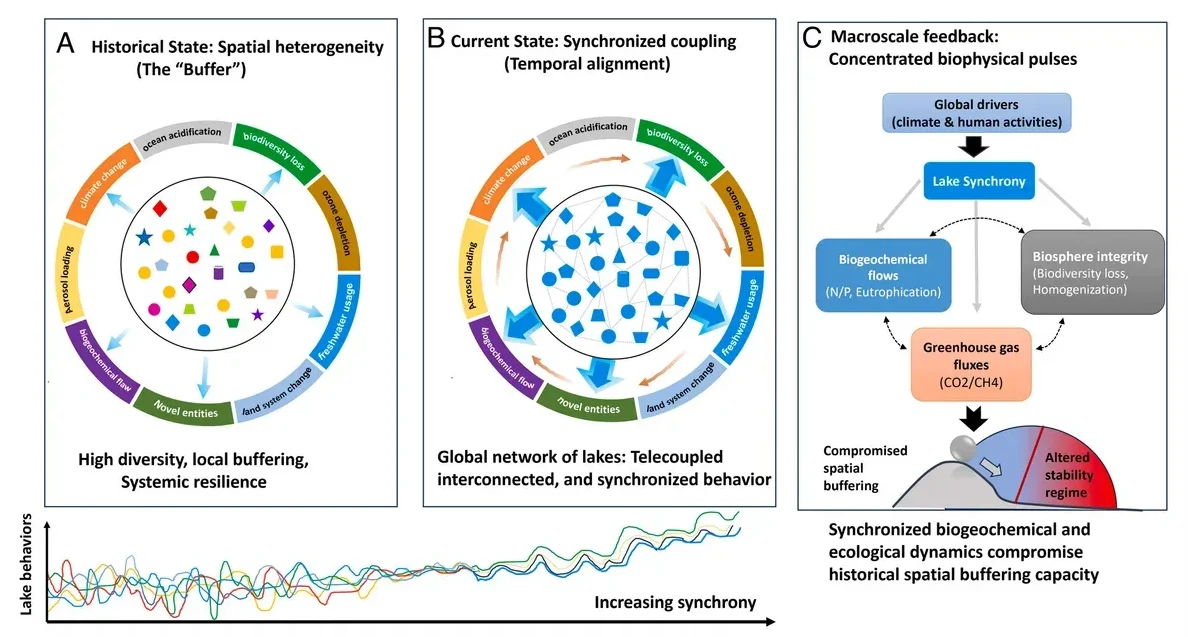
Amplifiers of the Triple Planetary Crisis
This rising lake synchronization mirrors a wider homogenization of Earth’s biosphere. Across continents, invasive species are displacing native wildlife, while sprawling farmland and suburbs turn once-distinct habitats into uniform landscapes. Scientists view this flattening as a hallmark of the Anthropocene—an era in which human activity reshapes geology, climate, and ecosystems alike, threatening vital ecological networks from freshwater basins to pollinator populations.
“This loss of buffering capacity transforms lakes from passive, regionally distinct systems into active amplifiers of global environmental risks. Synchronized lakes can concentrate biophysical fluxes, potentially triggering high-amplitude global pulses, such as simultaneous greenhouse gas emissions or widespread aquatic hypoxia, thereby exacerbating the triple planetary crisis,”
Dr. Zhang Ke, lead study author, Nanjing Institute of Geography and Limnology, Chinese Academy of Sciences
The “triple planetary crisis” is the United Nations’ term for the interconnected threats of climate change, biodiversity loss, and pollution. Further context on the findings was shared in an official Chinese Academy of Sciences report.
Global lake synchronization means freshwater ecosystems are losing their ability to buffer regional shocks. Instead of isolated blooms or oxygen drops, the planet faces the risk of simultaneous freshwater crises and amplified greenhouse gas emissions across continents.