


An extraordinary stroke of archaeological fortune that began with a farmer searching for a lost hammer in an English field yielded the Hoxne Hoard, whose crowning glory is the exquisite 1600-year-old Hoxne Empress pepper pot.
The Hoxne Empress Pepper Pot: A Lost Hammer and the Discovery of the Century in Suffolk
On a November morning in 1992, Suffolk farmer Peter Whatling was ploughing an agricultural field near the village of Hoxne in eastern England when his iron working hammer fell from the tractor. Reluctant to abandon the tool in the freshly turned clay, Whatling requested assistance from his friend Eric Lawes, a retired municipal gardener and metal-detecting enthusiast.
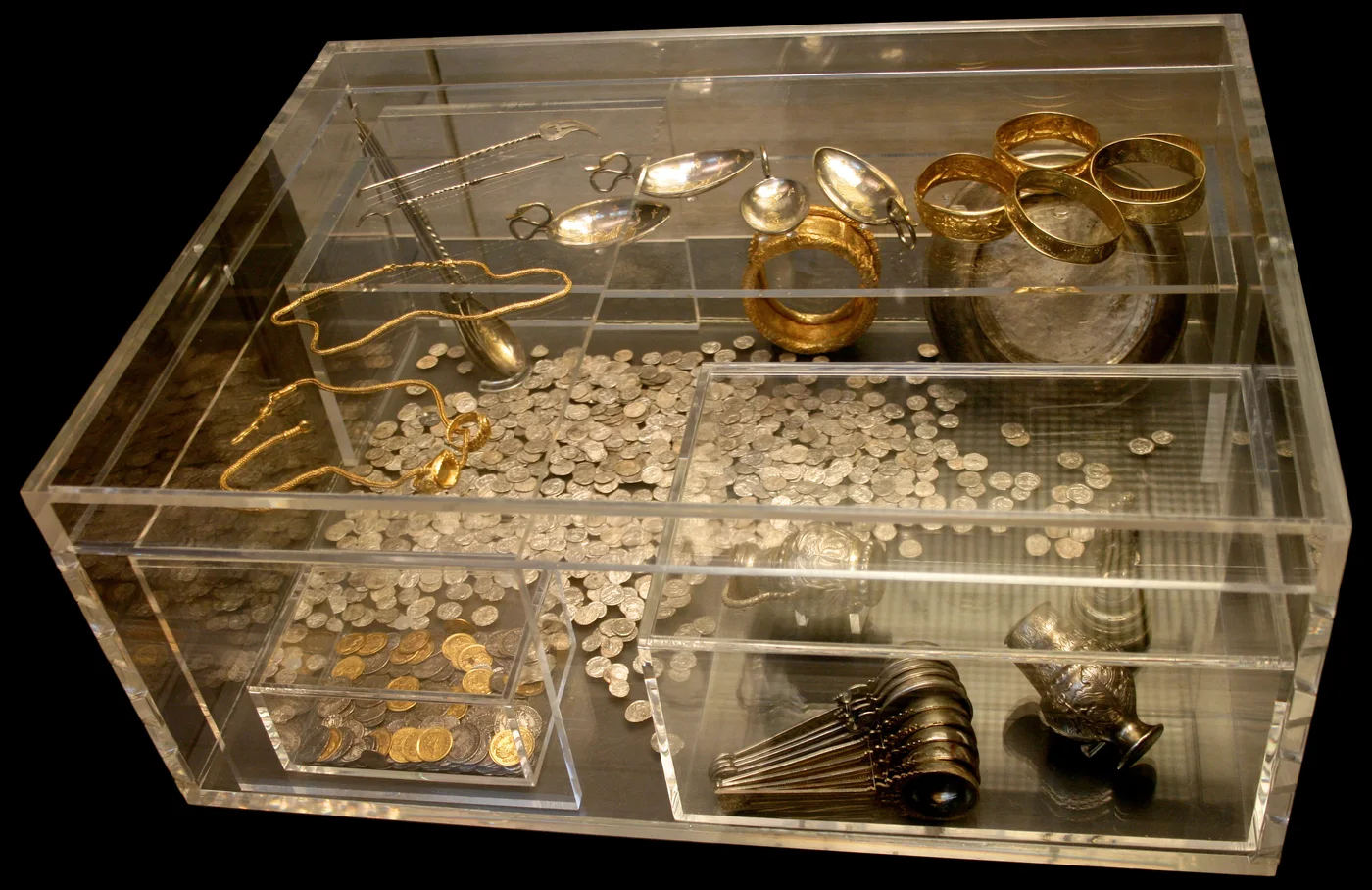
Upon sweeping the field, Lawes immediately received an exceptionally strong detector signal. Digging into the sod, he uncovered not a hammer, but gleaming Roman gold solidi, heavy silver spoons, and ornate coiled bangles. Recognizing the immense archaeological sensitivity of the find, Lawes immediately halted digging and contacted the Suffolk County archaeological service and local police.
Professional excavations commenced the following dawn, revealing the **Hoxne Hoard**—the largest cache of late Roman gold and silver coins (14,865 pieces), tableware, and personal jewellery ever discovered in Roman Britain. The undisputed crown jewel of the collection was the magnificent Hoxne Empress pepper pot (piperatorium), dating to circa 400 AD.
Masterpiece of Late Roman Silversmithing: Gilding, Volumen Scroll, and Court Coiffure
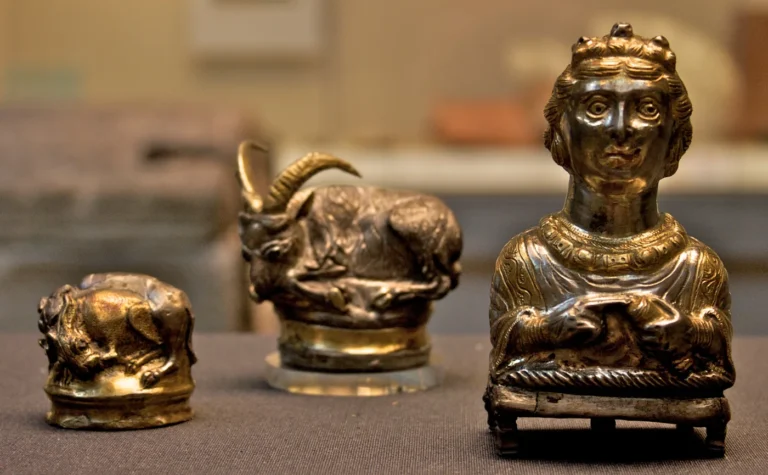
Standing just 10.3 centimetres tall, the hollow cast-silver vessel depicts the bust of an aristocratic Roman noblewoman. The modeling demonstrates astonishing anatomical and stylistic refinement: her facial contours are sculpted with expressive naturalism, her almond-shaped eyes are inlaid with dark niello, and her drapery is accentuated with rich mercury fire-gilding.
Her intricate coiffure reflects imperial court fashion from the reign of Emperor Theodosius the Great (late 4th to early 5th century). Elaborately crimped tresses are separated into geometric plaits, woven across the nape of her neck, and bound with pearl-set fillets. In her left hand, she clasps a rolled parchment scroll (*volumen*)—a classic visual symbol of aristocratic erudition, philosophical literacy, and elite civic standing.
While popularly dubbed the “Empress” and historically linked to Saint Helena or Empress Fausta, British Museum curators led by Catherine Johns conclude that the bust portrays an idealized wealthy Roman Christian matron—the matriarch of an elite villa estate in Britannia Secunda.
«The Hoxne Hoard and its iconic Empress pepper pot illuminate an unprecedented pinnacle of luxury, cosmopolitan trade, and mechanical brilliance in late Roman Britain. It weaves together classical sculpture, innovative engineering, and trade links that bridged Britain to the Indian Ocean.»
Dr. Roger Bland, Former Keeper of Prehistory and Europe, The British Museum
Ingenious Fourth-Century Engineering: The Three-Way Valve Dispenser
The Empress was far more than an opulent mantelpiece statuette: she was a fully functional, high-precision luxury condiment dispenser known as a *piperatorium*. Concealed within the base of the silver bust, ancient silversmiths engineered an ingenious rotating brass disk mechanism.
Operated via an external lever, the disk features three precise calibrated settings. In the closed position, solid metal blanks the aperture, providing an airtight seal that protected volatile ground spices from atmospheric moisture. In the second position, a wide semicircular opening aligns to allow rapid refilling with powdered pepper via a funnel. In the third setting, a perforated grid of fine holes turns the statuette into a shaker for delicate, even seasoning at the banquet table.
Alongside the Empress, the Hoxne Hoard contained three other silver-gilt pepper pots crafted in exquisite zoomorphic designs: a leaping hound pursuing a hare, and an alpine ibex. This complete service proves that Roman elite banqueting was an intricately choreographed culinary theater.
A farmer lost his working iron hammer in a Suffolk field, and his metal-detecting friend uncovered an oak chest packed with 15,000 Roman coins and gold.
A rotating brass disc at the base features three settings: airtight seal, wide refill aperture, and a perforated shaker grid for even seasoning.
Black pepper arrived from India’s Malabar coast across a two-year maritime trek, costing its weight in silver and demanded as ransom by Alaric’s Goths.
Concealed as Roman legions abandoned Britain to Saxon coastal raids, the hoard remained undisturbed beneath Suffolk clay for 1,600 years.
Black Pepper: Rome’s Liquid Gold from Across the Indian Ocean
To understand the immense social prestige of this vessel, one must appreciate the staggering value of black pepper in the late Roman Empire. Pepper does not grow in Europe—peppercorns (*Piper nigrum*) were imported via monsoon-driven maritime fleets from the Malabar Coast of southwestern India (modern-day Kerala).
The voyage across the Indian Ocean, the Red Sea, and Egypt’s Eastern Desert caravans took up to two years, braving shipwrecks and piracy. Pliny the Elder recorded that pepper was valued literally by its weight in silver. When Alaric the Visigoth laid siege to Rome in 408 AD, he demanded 3,000 pounds of Indian pepper as part of the ransom to spare the imperial capital from sacking.
Sprinkling Indian pepper from a gilded silver effigy was the ultimate flex of planetary wealth and imperial reach. Preserving such intricate utilitarian masterworks through 16 centuries of burial represents a historic triumph, much like how systematic cave excavations uncover the chronological depths of ancient cultures.
- Dimensions & Metallurgy: Stands 10.3 cm high, cast in high-purity silver with mercury fire-gilding and black niello eye inlays.
- Iconography of the Scroll: The volumen scroll in her left hand denotes philosophical literacy, patrician lineage, and high civic status.
- Britain’s Richest Hoard: Contains 14,865 gold solidi and silver siliquae minted under emperors from Constantius II to Honorius.
- Four Zoomorphic Piperatoria: Includes three companion animal-shaped spice shakers: a leaping hound, a hare, and an alpine ibex.
- The Displayed Hammer: Whatling’s lost 20th-century hammer was officially donated and is displayed alongside the Roman gold in the British Museum.
The Fall of Roman Britain: Why the Treasure Was Buried in 410 AD
Coinage analysis terminus post quem indicates the hoard was packed into an oak chest with padlocks around 407–410 AD. This was the catastrophic twilight of Roman authority in Britain: in 407 AD, the usurper Constantine III stripped the island of its defensive legions to mount a continental campaign, and in 410 AD, Emperor Honorius issued his famous rescript instructing British civitates to “look to their own defenses.”
Vulnerable to devastating seaborne raids by Saxon pirates, Picts, and Scots, wealthy Romano-British aristocrats buried their portable fortunes, expecting to recover them once civil order was restored. Yet the owners of the Hoxne estate never returned—likely killed in the ensuing collapse or fleeing as refugees to Gaul.
Remarkably, Peter Whatling’s lost hammer was also successfully retrieved by archaeologists! Today, that humble 20th-century iron tool occupies a place of honor in the British Museum galleries alongside the glittering Empress, reminding visitors that humanity’s greatest historical treasures are often unearthed through the simplest everyday accidents.