

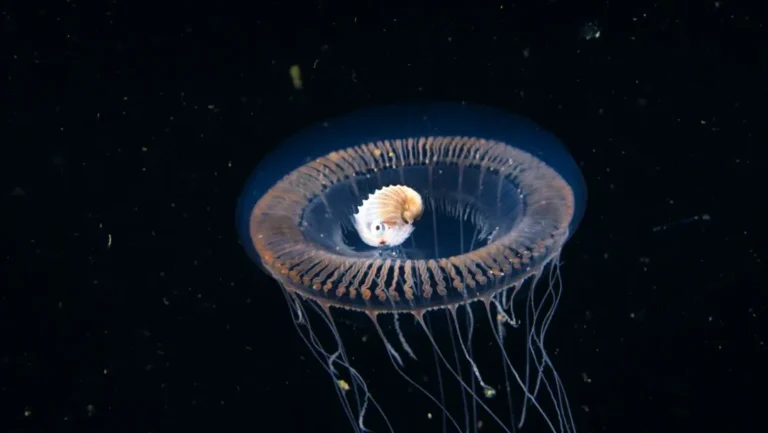

Gaze out across the open ocean at midnight and the black expanse appears completely still, yet just meters beneath the surface a colossal rush hour is raging. Every single night, trillions of deep-sea organisms ascend from the icy twilight zone toward the surface to feed under the cover of darkness. Riding the crest of this monumental biological movement is the argonaut octopus (Argonauta) — a peanut-sized, open-ocean cephalopod that hitchhikes on jellyfish and secretes a paper-thin shell unlike any other octopus on Earth.
The Cosmic Scale of Earth’s Diel Vertical Migration
Known to marine biologists as the Diel Vertical Migration (DVM), this nightly phenomenon represents the largest coordinated movement of biomass on our planet, dwarfing all terrestrial wildlife migrations combined. Each evening, as sunlight fades, the mesopelagic twilight zone (stretching between 200 and 1,000 meters deep) stirs into frantic vertical motion. Billions of tons of lanternfish, krill, salps, and siphonophores ascend toward the plankton-rich epipelagic sunlit zone.
This journey is an evolutionary gamble between starvation and predation. Deep water offers shelter from visual predators but minimal calories; surface waters offer abundant food but acute daylight hazards. The mass transit occurs exclusively under nightfall, with trillions of organisms diving back down into the abyss before the first ray of dawn.
Science writer Rachael Funnell reports that BBC Studios’ natural history series Blue Planet III spotlights this spectacular phenomenon in episode five, «The Deep». Producer Eva Spielvogel remarked that blackwater diving during the vertical migration feels like «floating in outer space», surrounded by an endless abyss illuminated only by bioluminescent organisms flashing like distant galaxies.
The Paper Nautilus: The World’s Only Shelled Octopus
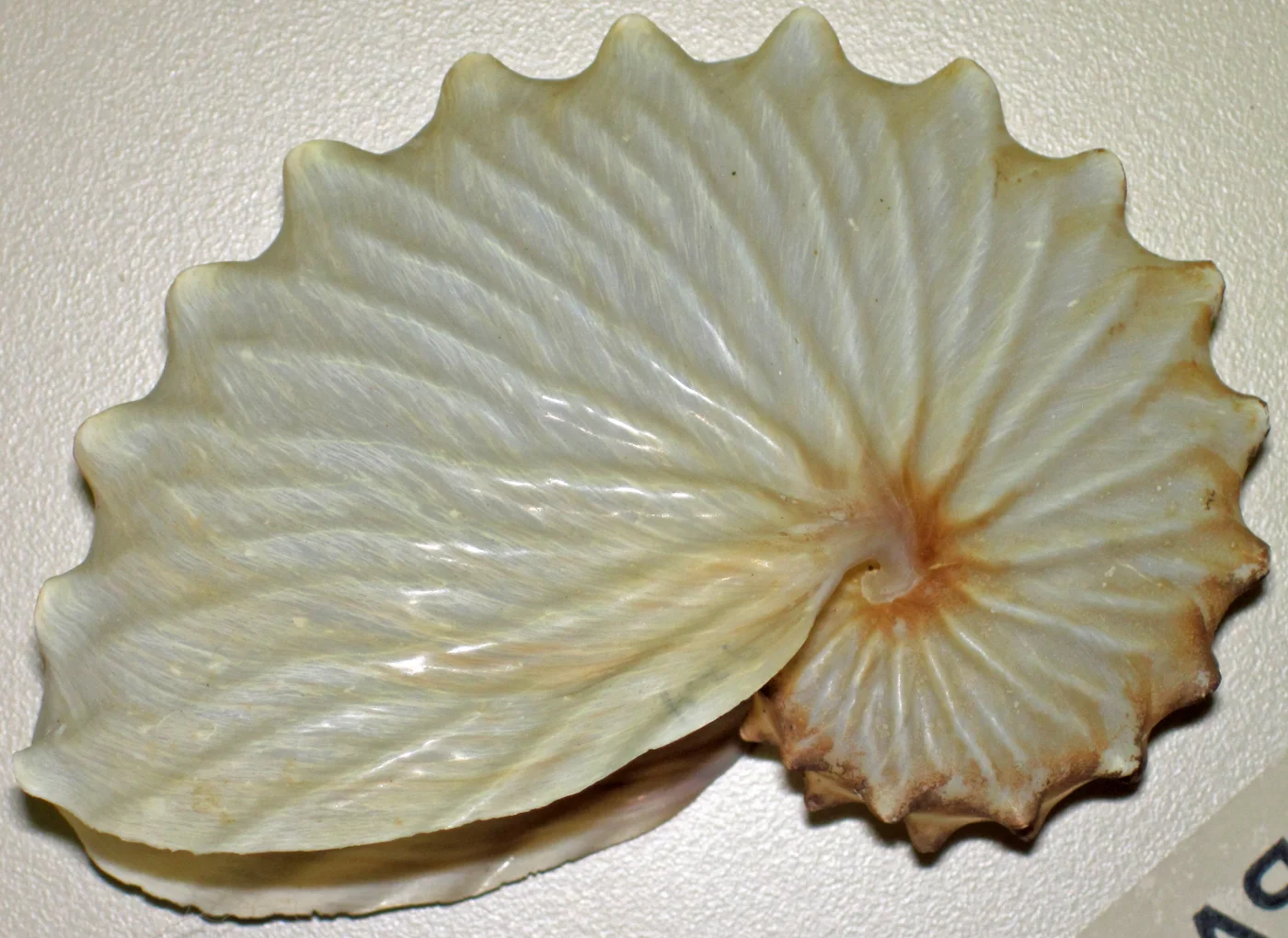
Despite their colloquial nickname «paper nautilus», argonauts are not related to the ancestral chambered nautilus (Nautilidae). They are true, highly derived pelagic octopuses belonging to the order Octopoda. Yet they shatter the fundamental rule of cephalopod evolution: female argonauts possess a delicate, spiraling, translucent calcite shell resembling fine porcelain.
Unlike traditional gastropod or bivalve shells, the argonaut’s shell is not secreted by the mantle tissue. Instead, the female secretes thin layers of calcite from specialized glandular webs located on the tips of her two dorsal arms. She molds this fragile vessel around her body, using it primarily as a protective brood chamber (eggcase) for thousands of developing eggs.
Pioneering cephalopod biologist Dr Julian Finn of Museums Victoria in Melbourne uncovered a revolutionary dual function: the shell serves as an active buoyancy tank. The female ascends to the sea surface, scoops a pocket of air using her dorsal arms, seals the bubble inside the apex of the shell, and dives back into the water column. The trapped air bubble provides perfect neutral buoyancy, allowing her to hover effortlessly without expending swimming energy.
«By sheer biomass, it is regarded as the largest daily movement of life on the planet. Witnessing this at night is like floating in space amidst living galaxies.»
Dr Julian Finn, Senior Curator of Marine Invertebrates at Museums Victoria
Phoresy and Jellyfish Hitchhiking: Mastering Pelagic Survival
In the pelagic open ocean, there are no crevices, boulders, or reefs to provide shelter. Adult female argonauts measure roughly 10 to 20 centimeters, while males are minuscule dwarfs rarely exceeding two centimeters. Lacking the powerful jet propulsion of squid, argonauts rely on phoresy — the biological art of hitchhiking on other organisms.
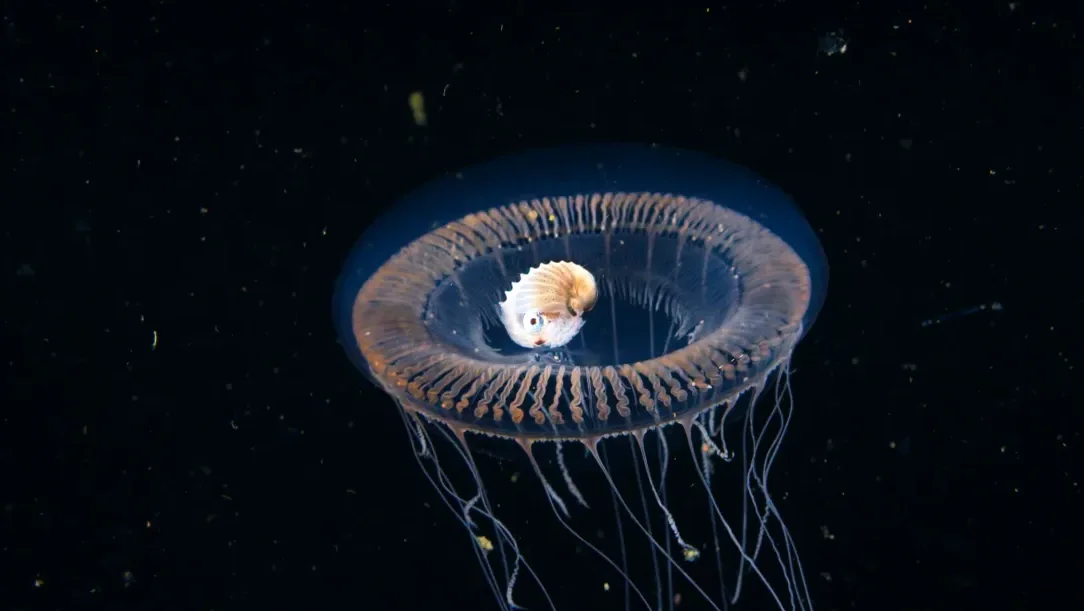
Acclaimed underwater macro cinematographer Mike Bartick captured extraordinary footage of female argonauts clinging to drifting deep-sea jellyfish and transparent salp chains with their suckers. The jellyfish provides effortless locomotion, passive camouflage, and formidable defense thanks to its stinging nematocyst tentacles.
Researchers have observed argonauts actively nibbling food scraps caught in the jellyfish’s tentacles and sheltering beneath the umbrella bell. Understanding these complex symbiotic interactions expands our scientific insight into how pelagic species establish survival refuges across the global ocean.
Trillions of marine organisms ascend hundreds of meters from the deep ocean every night to feed under cover of darkness.
Female argonauts build paper-thin spiral shells with specialized arms, capturing surface air to attain neutral buoyancy.
Lacking strong swimming power, argonauts ride jellyfish for effortless pelagic transport and protective stinging defense.
Males are hundreds of times smaller than females, lacking shells and releasing an autonomous detachable arm for fertilization.
Extreme Sexual Dimorphism and the Detachable Arm
The reproductive biology of the argonaut features one of the most extreme sexual dimorphisms in the animal kingdom: females can outweigh dwarf males by up to 600 times. Males never build a shell and spend their brief lives seeking females while drifting inside protective salps.
The male fertilizes the female using a specialized reproductive arm known as a hectocotylus, which stores spermatophores. During mating, the hectocotylus detaches completely from the male’s body and swims autonomously into the female’s mantle cavity, where it remains viable until egg laying. Early 19th-century zoologists originally classified this detached, undulating arm as an independent parasitic worm until Georges Cuvier solved the riddle.
Following egg hatching, the female argonaut succumbs to senescence, and her fragile calcite eggcase drifts across ocean currents, occasionally washing ashore as a treasured discovery for beachcombers and shell collectors.
- Named after the Greek myth of the Argonauts, ancient mariners believed these octopuses used their dorsal arms as sails to cross the seas.
- The argonaut shell is surprisingly flexible underwater but hardens and turns porcelain-brittle upon drying in the air.
- During the filming of Blue Planet III, cinematographers recorded multiple females vertically stacked on a single salp chain.
- Unlike benthic octopuses that crawl across the seafloor, argonauts spend their entire existence drifting in open pelagic space.