



Aboard China’s Tiangong space station, scientists have attained an unprecedented quantum milestone: producing the coldest temperature in the universe ever recorded for synthetic matter. By cooling a cloud of rubidium atoms down to an astonishing 9.7 picokelvin—less than ten trillionths of a degree above absolute zero—physicists created an ultra-stable Bose-Einstein Condensate in orbit, inaugurating a transformative era in deep-space quantum metrology and dark matter detection.
Colder Than Deep Space: How the Coldest Temperature in the Universe Was Achieved
In a milestone study published in the journal Science, a joint collaborative team from the Technology and Engineering Center for Space Utilization under the Chinese Academy of Sciences (CSU / CAS), Peking University, and the Shanghai Institute of Optics and Fine Mechanics (SIOM) reported creating a macroscopic quantum gas at a temperature of just 9.7 picokelvin (9.7 × 10⁻¹² Kelvin).

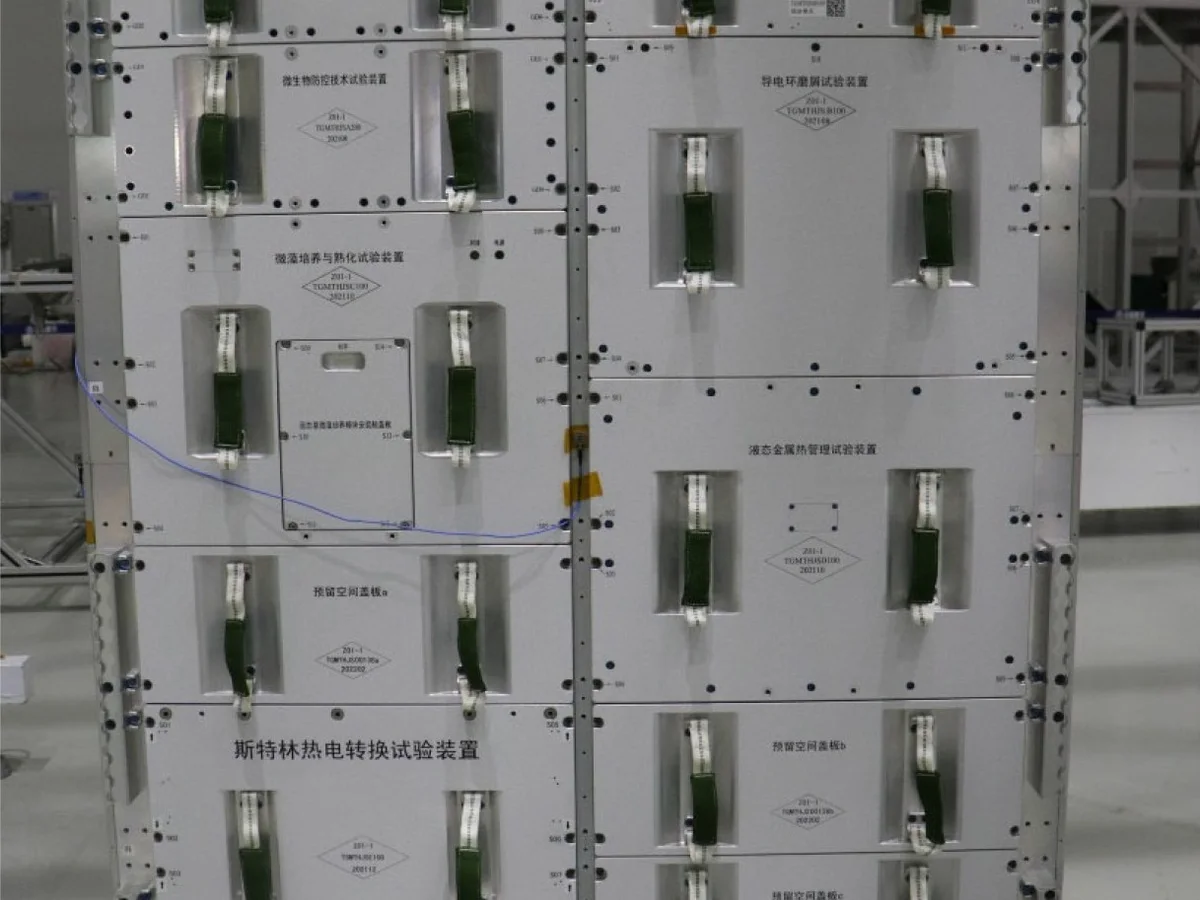
To contextualize this extreme, the coldest natural voids in deep space—bathed solely in the cosmic microwave background radiation left over from the Big Bang—rest at approximately 2.73 Kelvin. The atomic ensemble cooled inside the Cold Atom Physics Rack within Tiangong’s Mengtian laboratory module is hundreds of billions of times colder than the void of the cosmos, hovering within an infinitesimal fraction of absolute zero (-273.15 °C).
Corresponding lead investigators Professor Xiaoji Zhou and Professor Xuzong Chen of Peking University, together with Professor Weibiao Chen of SIOM, noted that this breakthrough is nearly four times colder than the previous terrestrial record of 38 picokelvins achieved in 2021 by German researchers utilizing the Bremen Drop Tower.
This quantum triumph expands modern theoretical horizons: as demonstrated by quantum gases and ultra-cold atomic physics in optical lattices, as thermal agitation approaches zero, discrete atomic wavepackets merge into a singular, macroscopic quantum entity.
The Microgravity Imperative: Overcoming Gravitational Sag
Achieving temperatures in the single-digit picokelvin regime is practically unattainable on Earth due to the fundamental barrier of gravitational sag. In terrestrial vacuum chambers, a cloud of ultra-cold atoms is inexorably pulled downward by gravity, collapsing against the container walls unless held by strong electromagnetic or optical traps.
However, confining potentials inevitably generate secondary heating through mechanical compression and photon scattering. Furthermore, once traps are switched off to measure ballistic free expansion, terrestrial experiments offer mere fractions of a second before the atomic cloud strikes the vacuum chamber base.
Aboard the Tiangong space station, orbiting at 7.7 km/s in low-Earth orbit where residual micro-accelerations remain below 10⁻⁵ g, gravitational disruption is eliminated. Atoms float freely in unperturbed microgravity, allowing scientists to dial confinement forces down toward zero without losing particles to container collisions.
The Chinese research team sustained and observed the ultra-cold Bose-Einstein Condensate during undisturbed adiabatic expansion for an unprecedented seven continuous seconds—tens of times longer than achievable in terrestrial drop towers.
«Generating atomic clouds below ten picokelvins in orbital microgravity heralds a new era of precision quantum metrology in space. We are exploring states of matter that simply cannot exist in Earth-bound laboratories.»
Professor Xiaoji Zhou, Lead Author, School of Physics at Peking University
All-Optical Trapping and Evaporative Cooling of Rubidium-87
The experiment utilized an atomic ensemble of approximately 20,000 rubidium-87 (⁸⁷Rb) atoms enclosed within the specialized Cold Atom Physics Rack inside the Mengtian module.
Primary cooling was initiated through Doppler laser cooling in a three-dimensional magneto-optical trap (MOT), decelerating high-velocity thermal atoms down to microkelvin temperatures via targeted resonant photon recoil.
Subsequently, the team transferred the pre-cooled ensemble into an all-optical crossed-beam infrared laser dipole trap, executing evaporative cooling. By systematically lowering the optical potential depth, the most energetic atoms were selectively evaporated from the trap, leaving behind only the lowest-kinetic-energy particles.
In the final critical phase, an adiabatic decompression protocol was implemented. By meticulously relaxing the optical trap depth over several seconds, kinetic expansion cooled the remaining coherent ensemble to the record-shattering baseline of 9.7 picokelvin.
9.7 picokelvins (9.7 × 10⁻¹² K)—less than ten trillionths of a kelvin above absolute zero.
Approximately 20,000 rubidium-87 atoms cooled inside the Mengtian module’s Cold Atom Physics Rack.
7 seconds of unperturbed free-expansion coherence enabled by orbital microgravity.
General Relativity validation, deep-space atom interferometry, and ultralight dark matter searches.
Frontiers of Fundamental Physics: Dark Matter and Gravitational Wave Detection
Reaching the picokelvin frontier is far more than an experimental record; it furnishes science with an exquisitely sensitive quantum sensor. At 9.7 picokelvins, the de Broglie wavelength of individual atoms expands dramatically, creating a coherent quantum matter wave of extraordinary phase stability.
These orbiting atomic clouds serve as the core engine for next-generation spaceborne atom interferometers. They will enable unprecedented tests of Einstein’s Equivalence Principle—the foundation of General Relativity—determining whether different quantum states experience identical acceleration in Earth’s gravitational field.
Furthermore, ultra-cold orbital condensates act as sensitive strain gauges capable of registering ultra-low-frequency gravitational waves generated by merging supermassive black holes, occupying an observational frequency window inaccessible to terrestrial laser facilities such as LIGO and Virgo.
In the longer term, these microgravity quantum sensors could detect subtle coupling signatures from ultralight dark matter candidates (such as axions or dilatons) and underpin deep-space atomic clocks with timekeeping uncertainties below one second over tens of billions of years.
- Published in the international scientific journal Science.
- New record stands at 9.7 picokelvins, nearly 4 times colder than the previous 38 pK Earth record.
- Achieved using all-optical trapping and evaporative cooling of rubidium-87 atoms in microgravity.
- Bose-Einstein Condensate remained stable in free-fall expansion for 7 continuous seconds.