

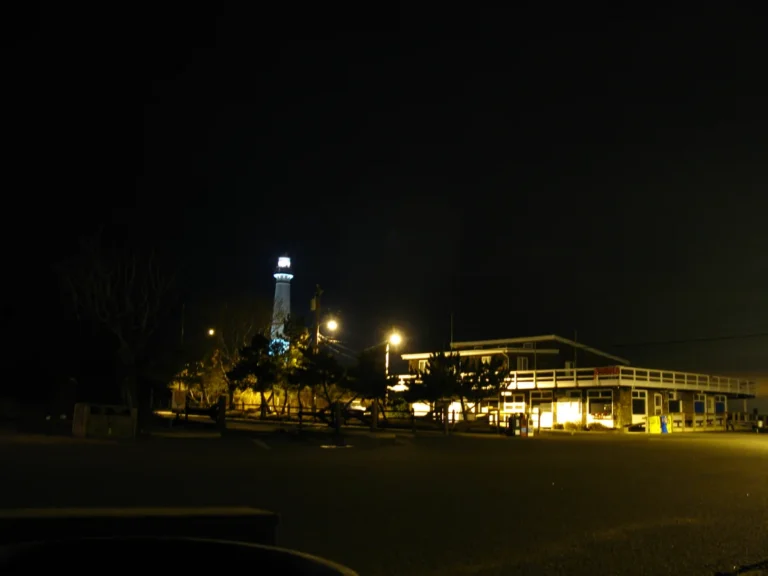

For 89 years, coastal observers, sailors, and night travelers documented an eerie, disorienting spectacle: phantom lighthouses seemed to materialize in the open ocean, casting beams of light back toward shore in defiance of geometry and reason.
89 Years of Mystery: The Haunting Legend of Phantom Lighthouses
The nighttime seascape has inspired countless tales of mystery, yet few visual phenomena have puzzled cognitive scientists as persistently as the illusion of phantom lighthouses. Beginning in 1937, when French maritime observers documented anomalous visual experiences off the coast of Brittany, observers have witnessed an impossible optical scene.
Standing in front of a coastal lighthouse at night with the physical tower directly behind them, observers suddenly perceive that the sweeping beam of light originates not from the land-based structure, but from a phantom lighthouse situated miles out in the dark ocean. To the observer, the beam appears to emanate from the water and shine directly back toward the coastline.
One of the most famous sites of this phenomenon is Lady Elliot Island, a coral cay at the southern tip of Australia’s Great Barrier Reef. The island’s 30-meter lighthouse generated such consistent apparitions that keepers, tourists, and mariners debated its origin for decades. Now, a pioneering study by researchers at the University of Melbourne has finally cracked the case.

The Melbourne Research Team and the MIT Press Study
The mystery was solved by an interdisciplinary team led by Professor Charles Kemp, Dr. Simon J. Cropper, and Weilun Xu from the University of Melbourne. Their findings were published in the MIT Press journal Open Mind: Discoveries in Cognitive Science (DOI: 10.1162/opmi.a.390).
Rather than attributing the apparition to atmospheric mirages, fata morganas, or humidity-induced refraction, the authors examined the problem through the lens of Bayesian inference and natural scene statistics in human vision.
In pitch darkness, the human visual system is stripped of familiar binocular disparity and texture gradient cues. To construct a coherent representation of space, the visual cortex must merge ambiguous sensory inputs with probabilistic internal expectations, or Bayesian priors, derived from a lifetime of evolutionary experience in natural environments.
«The phantom lighthouse illusion reveals how the human visual system resolves sensory uncertainty in darkness: relying on prior assumptions, it systematically underestimates distance and flips the apparent origin of light by 180 degrees.»
Dr. Charles Kemp, Professor of Cognitive Science at the University of Melbourne
The Bayesian Depth Trap: Why the Light Beam Reverses
A lighthouse beam is fundamentally a cylinder of concentrated photons traveling horizontally across the night sky. As the beam sweeps over an observer gazing out to sea, their eyes trace the illumination scattered by airborne aerosols.
The research team’s mathematical modeling revealed a systematic bias: the human brain severely underestimates the distance of remote portions of the sweeping light beam. What is physically a distant, parallel shaft of light is perceived as being significantly closer to the observer than it truly is.
Because of this profound distance underestimation, the horizontal beam appears tilted downward toward the ocean surface. When the visual cortex synthesizes this distorted geometry, it generates the only Bayesian conclusion that fits the data: the light must be radiating upward and outward from a source located on the sea. Thus, the mind invents a phantom lighthouse.
In visual psychophysics, this depth underestimation is termed nocturnal spatial compression. In the absence of terrestrial horizon lines, the visual cortex projects a three-dimensional light cone into a flattened, ambiguous plane, triggering the probabilistic Bayesian assumption that reverses the beam trajectory.
The phenomenon was first recorded off the coast of Brittany, France, where witnesses reported light beams emanating from the empty sea.
Deprived of stereoscopic depth cues in total darkness, the visual cortex relies on scene statistics, systematically underestimating distance to distant beam segments.
The researchers’ predictive mathematical model proved that the illusion reliably triggers when an observer stands approximately 67 meters in front of a 30-meter lighthouse.
Immersive VR experiments confirmed that downward beam curvature and reverse direction perception are universal features of human depth processing.
The 67-Meter Threshold and Virtual Reality Validation
The crowning achievement of the Melbourne study was establishing a predictive geometric model. Kemp and his colleagues calculated that for a typical 30-meter-tall lighthouse, the illusion does not trigger haphazardly; it peaks precisely when an observer is positioned roughly 67 meters in front of the tower.
To empirically test this prediction, the researchers constructed a high-fidelity virtual reality (VR) simulation replicating the nocturnal lighting geometry of Lady Elliot Island.
Experimental participants immersed in the VR environment demonstrated the exact perceptual reversal predicted by the model at the 67-meter threshold, verifying that the illusion is a universal property of human spatial perception. These findings connect closely with wider cognitive research into how the human brain constructs sensory apparitions and cognitive illusions under ambiguous conditions.
- The phantom lighthouse illusion is not caused by atmospheric mirages, temperature inversions, or sea spray, but by human cognitive Bayesian depth inference.
- The brain stubbornly places the light source out at sea even when observers are intellectually certain the real lighthouse stands directly behind them.
- The research was published in MIT Press Open Mind and provides valuable mathematical frameworks for autonomous LiDAR and computer vision engineering.
Broader Implications for Robotics and Machine Vision
Solving the 89-year-old enigma of phantom lighthouses carries implications extending far beyond maritime lore. It demonstrates that human perception is not a passive recording of reality, but an active, generative inference engine.
Understanding how the brain misinterprets depth in low-contrast, nocturnal conditions is crucial for refining computer vision architectures, autonomous navigation algorithms, and LiDAR processing systems operating in fog, rain, and darkness.
Thanks to Charles Kemp and his team, what was once considered a spooky coastal ghost story is now celebrated as an elegant demonstration of Bayesian cognitive science.