


Across social media platforms and fringe pseudoscientific forums, sensational claims about prehistoric civilizations repeatedly capture the public imagination with viral videos purporting to reveal suppressed skeletons of colossal humanoids and cyclopean monoliths. However, persistent ancient giant myths alleging that 30-foot titans once walked North America, Australia, and New Zealand long before Indigenous peoples are far from harmless folklore. As science writer Stephen Luntz demonstrated in his incisive investigative analysis for IFLScience, these assertions represent an insidious brand of pseudoarchaeology that combines nineteenth-century commercial swindles, geological ignorance, and deliberate colonial revisionism designed to dispossess First Nations and Indigenous communities of their sovereign ancestral heritage.
The Cardiff Giant: Anatomy of America’s Most Lucrative Archaeological Hoax
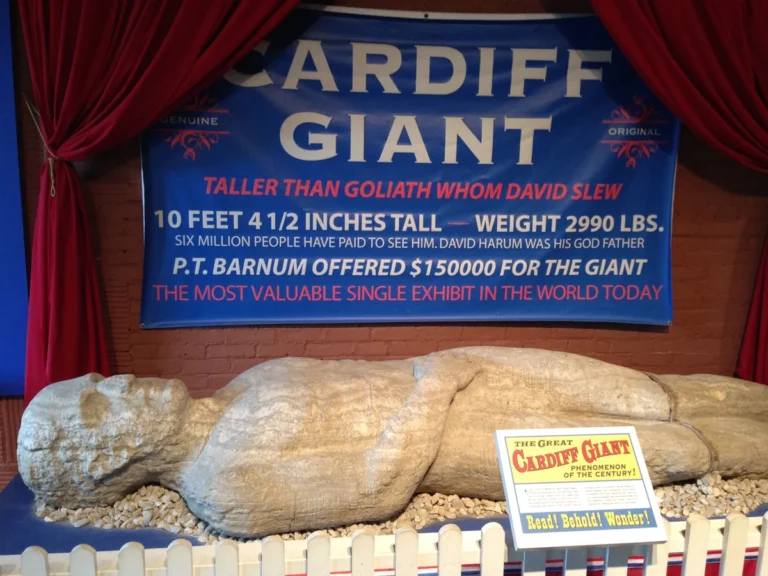
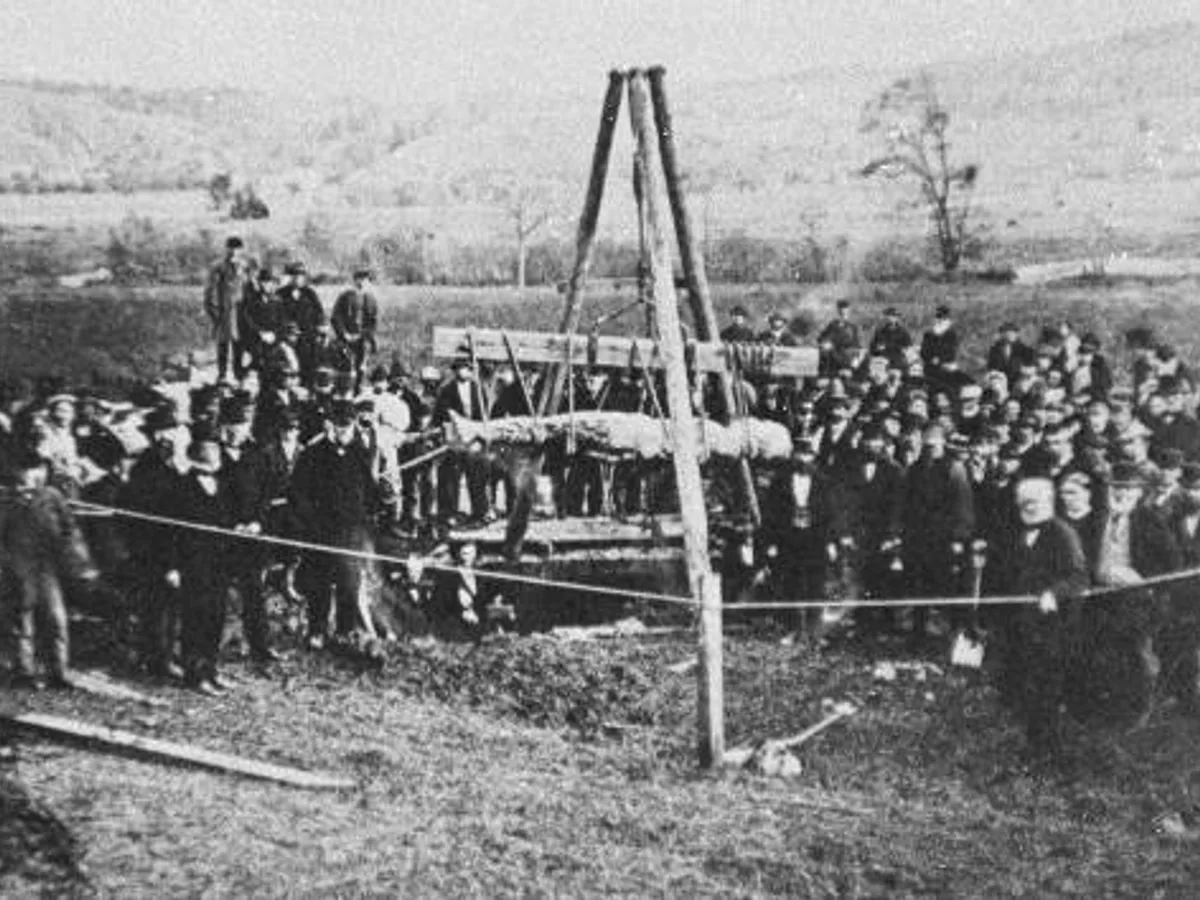
The history of archaeological frauds offers few episodes as audaciously orchestrated or socially revealing as the saga of the Cardiff Giant. On October 16, 1869, two well-diggers named Gideon Emmons and Henry Nichols were excavating near a barn on the farm of William «Stub» Newell in Cardiff, New York. Just three feet beneath the marshy clay, their shovels struck what appeared to be an enormous petrified human foot. Further digging uncovered a ten-foot, four-and-a-half-inch recumbent figure of a naked male giant with remarkably detailed toes, facial features, and subtle epidermal contours, lying in what looked like a posture of agonizing prehistoric demise.
Within hours, word of the miraculous discovery electrified upstate New York and soon resonated across the entire nation. Newell promptly erected a massive carnival tent over the trench, initially charging visitors 25 cents and soon raising the admission fee to 50 cents. Thousands of spectators, clergymen, and amateur antiquarians flocked to Cardiff, convinced that they were beholding tangible physical confirmation of Genesis 6:4 («There were giants in the earth in those days»). Local ministers declared the figure a petrified antediluvian human, and even several licensed physicians and local scholars hastily pronounced the gypsum colossus to be an authentic anatomical fossil preserved by subterranean mineral waters.
In truth, the entire spectacle was the brainchild of George Hull, a Binghamton cigar manufacturer and Newell’s cousin. An ardent freethinker and materialist, Hull had engaged in a fierce theological dispute two years earlier with a revivalist preacher who insisted upon the strict literal reality of biblical giants. Stunned by the dogmatic credulity of his contemporary society, Hull resolved to manufacture a giant that would simultaneously expose the gullibility of biblical literalists and reap a colossal fortune. He procured a five-ton block of gypsum from Fort Dodge, Iowa, shipped it to a Chicago stonecutter named Edward Burkhardt, weathered the sculpted stone with sulfuric acid, etched microscopic pores using bundles of lead needles, and buried the figure on Newell’s farm a full year before its staged uncovering.
The lucrative deception unraveled when Othniel Charles Marsh, a renowned Yale University paleontologist, inspected the site. Marsh needed only a brief examination to identify modern chisel gouges and pointed out that gypsum is a soft, soluble mineral that would have completely dissolved had it rested in New York’s moist soil for centuries. Despite Marsh’s unequivocal declaration of fraud, the craze reached peak absurdity when showman P.T. Barnum attempted to purchase the giant for $50,000. Rebuffed by Hull, Barnum simply hired a sculptor to produce a plaster replica, exhibited it in New York City, and brazenly claimed that Hull’s original was the fake and his own was the genuine giant—drawing even larger crowds eager to pay for a duplicate of a hoax.
Biomechanical Reality Check: Why 30-Foot Humans Cannot Exist in Nature
Although Hull’s trick was unmasked long ago, modern fringe theorists continue to revive claims of ancient human giants standing 20 or 30 feet tall (6 to 9 meters). Yet, any qualified comparative anatomist or biophysicist will confirm that such hominids are completely impossible under established physical laws. The fundamental barrier to supersized humanoids is the square-cube law, first formulated by Galileo Galilei in 1638: when an object or living organism increases in size, its surface area scales by the square of its dimensions, but its volume and mass scale by the cube.
If a modern human were proportionally scaled up to a height of 30 feet—a fivefold increase in height—the cross-sectional surface area of their bones and skeletal muscles would expand twenty-five times, while their overall body mass would surge by an astounding factor of 125. Rather than weighing 180 pounds, such an individual would weigh more than 22,000 pounds (over 10 metric tons). Human bones made of hydroxyapatite and collagen simply lack the compressive strength to withstand such stress; a 30-foot human attempting to stand upright would suffer catastrophic skeletal fractures under their own weight. To avoid crushing its own legs, such an organism would require elephantine, columnar limbs entirely lacking the slender articulation characteristic of bipeds.
Furthermore, the cardiovascular and metabolic challenges would prove immediately lethal. To pump oxygenated blood upward nearly three stories to reach the cranial cavity against gravity, the heart would need to generate tremendous hydrostatic pressure, requiring arterial walls so thick and rigid that capillary exchange would collapse. Thermoregulation poses an equally insurmountable hurdle: heat dissipation depends entirely on skin surface area, whereas internal heat production is determined by the total metabolic mass of bodily organs. A 30-foot endothermic hominid would suffer catastrophic hyperthermia, boiling its own brain tissues in minutes even in a frigid Pleistocene environment.
«Pseudoscientific claims concerning ancient giants or lost civilizations do not emerge in an intellectual vacuum. Behind nearly every fabricated giant narrative lies either barefaced financial exploitation or a far darker agenda aimed at stripping Indigenous peoples of their heritage, their achievements, and their historical moral rights to their land.»
Stephen Luntz, science journalist and contributing author at IFLScience
Geological Pareidolia: How Nature Creates Megalithic Illusions
When physical skeletal evidence inevitably fails to materialize, pseudoscientists invariably pivot toward claiming natural geological rock formations as the ruins of «cyclopean architecture». In New Zealand, this tendency is epitomized by persistent fringe conspiracies surrounding the so-called «Kaimanawa Wall». Located within the Kaimanawa Forest Park near Lake Taupo, this exposed cliff face displays rectangular stone blocks that, to an untrained eye, mimic megalithic cyclopean masonry erected by an enigmatic pre-Māori race of giant builders thousands of years ago.
However, comprehensive field research conducted by New Zealand vulcanologists and petrologists has completely dismantled these claims. The Kaimanawa structure is composed entirely of Rangitaiki ignimbrite—a dense volcanic pyroclastic rock formed approximately 330,000 years ago during a massive cataclysmic eruption of the Taupo Volcanic Centre. As the searing avalanche of pumice and volcanic ash cooled, contracted, and solidified, it developed orthogonal cooling joints and columnar cleavage planes. These natural planar fractures commonly produce perfectly straight, regular blocks across volcanic terrain worldwide, from the Giant’s Causeway in Northern Ireland to Devil’s Postpile in California.
The illusion of human agency is perpetuated by pareidolia, a well-documented psychological phenomenon wherein the human brain detects intentional designs, facial profiles, and architectural patterns within random natural stimuli. Fringe enthusiasts interpret mineral precipitation in rock fissures as «ancient mortar» and weathered sandstone boulders as «fossilized giant skulls». Unlike these optical fantasies, authentic archaeological discoveries consistently yield systematic cultural strata, calibrated radiocarbon dates, microscopic tool markings, and verified domestic refuse—hallmarks of human occupation that pseudoarchaeologists can never produce.
A ten-foot gypsum carving secretly buried in New York by George Hull to swindle tourists and mock literalist biblical interpretations of prehistoric giants.
The biomechanical impossibility of 30-foot humanoids: scaling an organism up multiplies weight by the cube while bone strength scales only by the square.
Natural cooling fractures in volcanic ignimbrite, such as New Zealand’s Kaimanawa Wall, misinterpreted by amateurs as cyclopean masonry of ancient titans.
Fabricating non-Indigenous giant builders to strip North American tribes, Australian Aboriginals, and Māori of their status as original inhabitants.
The Malicious Legacy: How Giant Myths Weaponize Racism and Dispossession
If claims regarding ancient giants were merely eccentric internet folklore, the scientific establishment might safely treat them with amused indifference. Tragically, pseudoarchaeology has historically functioned—and continues to operate—as an aggressive intellectual tool of colonial expansion, racial supremacy, and Indigenous dispossession. In nineteenth-century North America, this dynamic manifested in the pernicious «Mound Builder Myth». White settlers encountering the magnificent earthworks and pyramidal complexes of the Ohio and Mississippi river valleys (such as Cahokia) adamantly refused to acknowledge that ancestors of Native Americans possessed the engineering sophistication to erect them.
Instead, colonial ideologues fabricated a mythical lost race of «white giants» or heroic ancient wanderers who purportedly constructed the mounds before being violently exterminated by «savage» Native Americans. This toxic narrative served a direct, calculated political objective: it provided moral absolution for the brutal displacement of Indigenous nations, legitimizing the Indian Removal Act of 1830 and the horrors of the Trail of Tears. Settlers convinced themselves that they were not dispossessing the continent’s rightful inhabitants, but merely reclaiming lands from savages who had usurped the realm of their mythical forebears.
Identical revisionist motives persist today in Oceania. In Australia, fringe authors repeatedly promote fabricated narratives of ancient Phoenician explorers or giant white ancestors to undermine the undisputed truth that Aboriginal Australians have maintained continuous custodianship of their continent for more than 50,000 years. In New Zealand, theories of pre-Māori giant inhabitants are actively championed by fringe political groups seeking to invalidate the 1840 Treaty of Waitangi and revoke the status of Māori as the indigenous tangata whenua (people of the land). Pseudohistory thus becomes an insidious weapon aimed at rewriting civil rights and dismantling Indigenous land sovereignty.
- Biomechanical failure: gigantic upright skeletons violate fundamental laws of bone load-bearing and cardiovascular pressure;
- Reliance on alleged Smithsonian cover-up conspiracies rather than peer-reviewed stratigraphic documentation;
- Misidentifying Pleistocene megafauna fossils (mammoths, mastodons) as anatomical components of oversized humans;
- Absence of calibrated radiocarbon dates, microscopic tool-wear analysis, or associated paleobotanical evidence.
Why Ancient Giant Myths Continue to Thrive in the Digital Era
In an era characterized by satellite remote sensing, paleogenomics, and airborne LiDAR mapping capable of detecting buried settlements through dense rainforest canopies, pseudoarchaeology should logically have vanished. Instead, algorithms across major social media networks prioritize high-engagement sensationalism over nuanced scholarly discourse. Viral reels alleging that the «Smithsonian Institution destroyed thousands of giant skeletons» amass tens of millions of views, exploiting deep-seated public cynicism toward institutional authorities and academic consensus.
This ubiquitous rumor concerning the Smithsonian secretly dumping giant bones into the Atlantic Ocean originated from a 2014 satirical parody article published on the humor website World News Daily Report, yet millions of readers embraced it as unvarnished truth. Conspiracy theorists insist that mainstream scientists suppress giant humanoids to protect evolutionary orthodoxy. In reality, modern archaeology actively celebrates paradigm-shifting anomalies: the discovery of diminutive Homo floresiensis («the Hobbit») on Flores or archaic Denisovan fossils in the Tibetan Plateau instantly propelled researchers to global prominence, securing cover stories in Nature and multi-million-dollar research grants.
Dismantling pseudoarchaeology is ultimately a fight for genuine human historical dignity. When we supplant authentic prehistory with childish fables of 30-foot giants, we trivialize the authentic, monumental achievements of human ancestors: the brilliant voyaging technology of Polynesian navigators across the Pacific, the sophisticated urban planning of Cahokia, and the unparalleled ecological wisdom of Australian Aboriginal peoples. The true tapestry of human history is profoundly more intricate, awe-inspiring, and scientifically illuminating than any fabricated myth of ancient titans.