

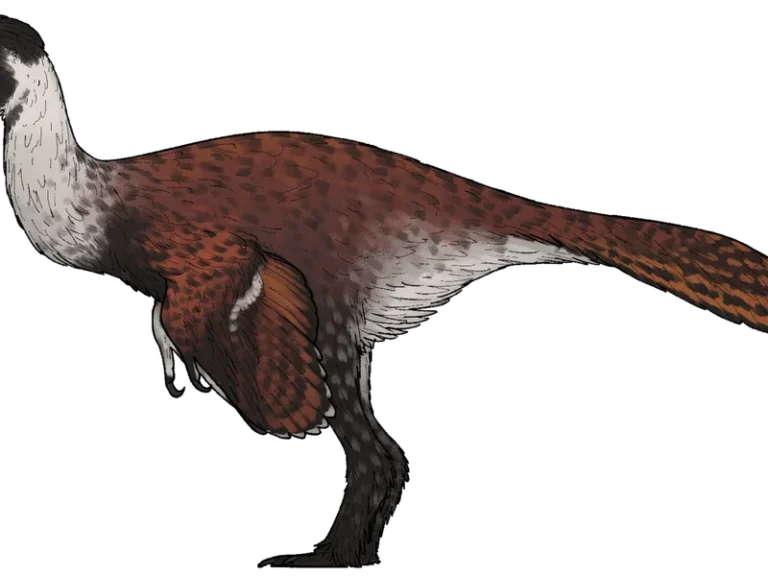

Deep within the fossil-rich strata of North America, an international team of paleontologists has unveiled an extraordinary prehistoric discovery: a diminutive, bird-like oviraptorosaur dubbed Infernogallus jamesi, popularised as a funky fruit-eating “hell chicken.” Weighing approximately 12 kilograms, this agile, feathered creature possessed a toothless rhamphotheca, prominent forward-angled eyes, and a highly specialised jaw apparatus that converged remarkably with the cranium of modern frugivorous parrots. Marking the first articulated caenagnathid skull ever unearthed, this specimen confirms that non-avian dinosaurs colonised specialized fruit-eating niches alongside the explosive rise of flowering angiosperm plants.
A Feathered Enigma of the Late Cretaceous: Introducing Infernogallus jamesi
The fossil beds of the Hell Creek Formation across Montana and the Dakotas are universally renowned for colossal apex carnivores like Tyrannosaurus rex and mighty armored ceratopsians. Yet it is the smaller, bird-like theropods that illuminate the true ecological complexity of the terrestrial realm immediately preceding the Chicxulub impact. The newly described taxon Infernogallus jamesi belongs to the Caenagnathidae, an enigmatic family of feathered oviraptorosaurs that long stood among the most poorly understood dinosaur clades.
For decades, caenagnathids were known almost entirely from fragmented remains—isolated fused lower jaws (dentaries), disconnected limb bones, or battered vertebrae. This fragmentary record fueled prolonged debates over their dietary habits, with many researchers categorizing them as opportunistic omnivores or carnivores hunting small reptiles and mammals. The discovery of holotype ROM VP 65050 in uppermost Maastrichtian strata completely transformed this paradigm, presenting science with the first exquisitely preserved, three-dimensional articulated skull in caenagnathid history.
With an estimated adult body mass of roughly 12 kilograms (comparable to a large wild turkey or a juvenile cassowary), Infernogallus was built for swift locomotion beneath the subtropical canopy. Its lightweight skeleton featured highly pneumatized vertebrae, slender forelimbs, and large, forward-directed orbital sockets that granted stereoscopic vision—essential for spotting ripe fruits amid dense vegetation.
Parrot-Like Biomechanics: Unlocking the Sliding Mandible Mechanism
The anatomical crux of the discovery centers upon the articulation of the jaw joint. Lead author Dr. Gregory Funston (Грегори Фанстон) and colleagues Dr. David Evans (Дэвид Эванс) and Dr. Thomas Dudgeon (Томас Даджен) subjected the fossil cranium to micro-computed tomography (micro-CT), generating dynamic kinematic models of the quadratomandibular articulation. The results revealed an astonishing deviation from typical theropod anatomy: the skull lacked the rigid, vertical scissor-like hinge seen in predatory relatives.
Instead, Infernogallus possessed an anteroposterior sliding jaw joint that permitted extensive longitudinal movement of the lower mandible forward and backward. This action was powered by a major reorganization of the jaw adductor musculature (musculus adductor mandibulae), whose origins migrated rostrally and laterally. As the jaws closed, the keratinous rhamphotheca slid rearward across robust palatal ridges, generating tremendous shearing forces capable of slicing tough husks and crushing plant fibers.
In modern fauna, this proal and propalinal chewing motion is nearly exclusive to specialized frugivorous birds such as psittacines (parrots). Just as the bizarre herbivorous Therizinosaurus adapted claws into vegetation-harvesting scythes, Infernogallus retooled ancestral theropod jaw apparatuses into precision fruit-processing mills.
Biomechanical modeling revealed longitudinal back-and-forth sliding of the mandible, enabling high-shear grinding of fibrous fruit skins.
The toothless rhamphotheca and mandibular morphology confirm an evolutionary adaptation to fleshy fruits and co-radiation with angiosperms.
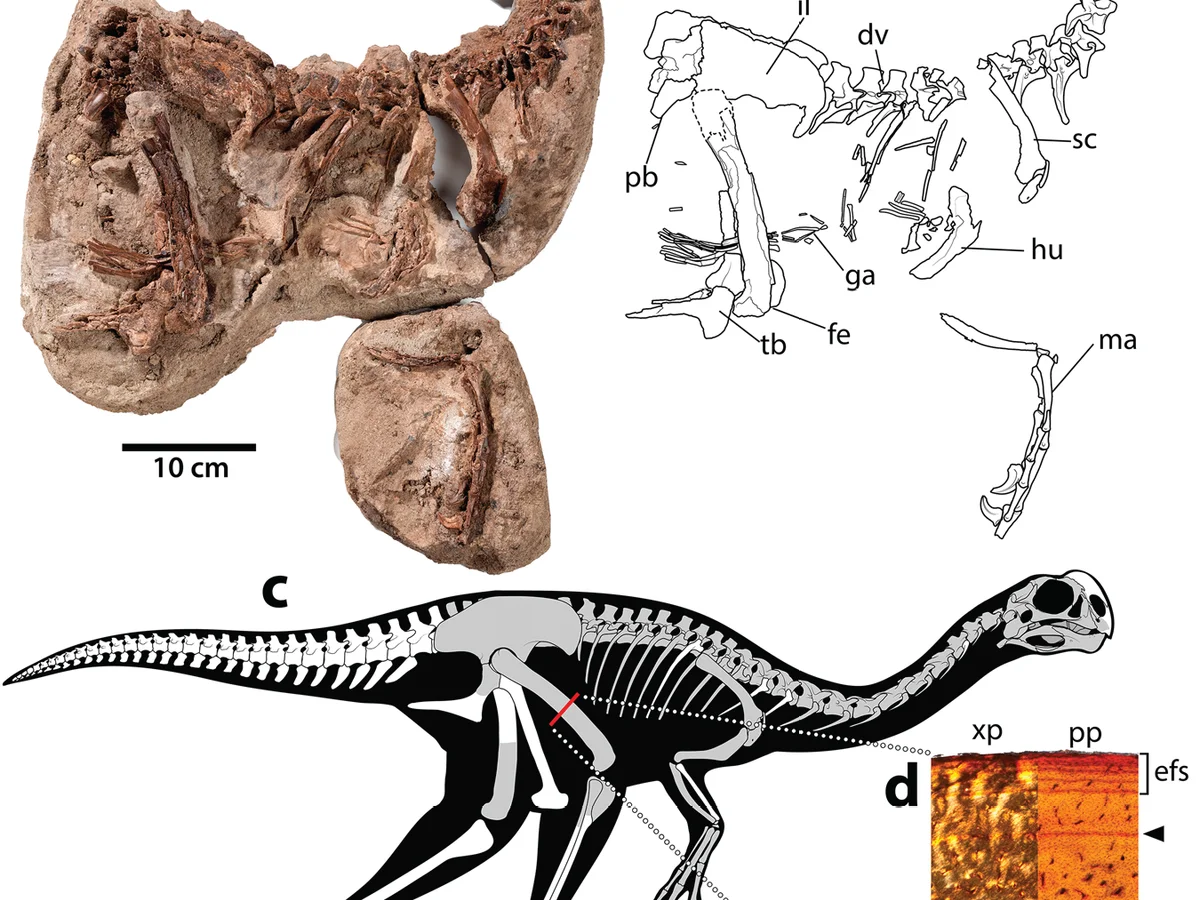
The specimen preserves the first complete, articulated caenagnathid skull, cervical and dorsal vertebrae, and limb bones of an adult 12 kg animal.
The discovery reveals sophisticated ecological niche partitioning within the Hell Creek Formation right before the K-Pg extinction event.
Specialized Frugivory and Coevolution with Early Flowering Plants
Confirming specialized frugivory in a non-avian dinosaur provides a pivotal missing link in evolutionary paleobotany and trophic ecology. During the Maastrichtian age (approximately 68 to 66 million years ago), angiosperms (flowering plants) were undergoing rapid diversification across North America. Forest canopies developed abundant, fleshy, lipid-rich fruits that relied on mobile vertebrates for endozoochorous seed dispersal.
Paleontologists previously presumed that early birds and primitive mammals were the primary architects of Cretaceous fruit dispersal. However, the findings from Funston et al. indicate that caenagnathids actively co-evolved with fleshy-fruited flora. Infernogallus likely fed upon ancestral magnoliaceous, lauraceous, and palm fruits, whose fibrous rinds posed formidable challenges to less specialized herbivores.
By shearing pulp and ingesting seeds intact, these feathered theropods served as vital dispersal vectors across riparian floodplains. This mutualistic relationship shaped ancient forest canopy architecture, laying ecological foundations that persisted up to the end-Cretaceous boundary.
«There is truly nothing else like Infernogallus in the modern world, but if I had to pick an analogue, I would describe it as a cassowary with the head of a parrot. If it were alive today, we would struggle to distinguish it from a large flightless bird: it bore a parrot-like head with a toothless beak, expansive eyes, and a dense coat of vibrant feathers.»
Dr. Gregory Funston (Грегори Фанстон), lead author and paleontologist at the Royal Ontario Museum
Anatomy of Holotype ROM VP 65050 and Taxonomic Significance
Housed at the Royal Ontario Museum in Toronto, holotype ROM VP 65050 is among the most complete caenagnathid specimens ever recovered. Delicate cranial elements—including the braincase, sclerotic eye rings, vomer, and delicate pterygoid struts—were preserved in pristine anatomical articulation without severe diagenetic crushing.
Osteohistological sectioning of the tibia revealed distinct lines of arrested growth (LAGs), proving definitively that the specimen was a mature adult rather than a juvenile of the sympatric giant caenagnathid Anzu wyliei, which tipped the scales at over 300 kilograms. Morphological phylogenetic analyses firmly established Infernogallus as a distinct genus within Caenagnathidae, distinguished by its abbreviated facial region and unique mandibular symphysis.
Furthermore, deep lateral pleurocoels within the cervical and dorsal series indicate an advanced avian-style pulmonary air sac network. Much like how avian cognitive power in crows is supported by hyper-efficient respiration, the metabolic machinery of Infernogallus was fueled by a continuous unidirectional airflow system, maintaining the high metabolic rates of an active endotherm.
- The investigation was led by Dr. Gregory Funston (Грегори Фанстон) and Dr. David Evans (Дэвид Эванс) from the Royal Ontario Museum alongside international co-authors.
- The generic name Infernogallus translates from Latin as “Hell chicken” (inferno for Hell Creek, gallus for chicken/fowl), nodding to its bird-like body plan.
- The specific epithet jamesi was named by co-author Dr. Thomas Dudgeon (Томас Даджен) in honour of his grandfather James William Boyd, who fostered his early scientific curiosity.
- High-resolution CT scanning demonstrated convergent reconfiguration of jaw adductor muscles with extant frugivorous parrots like the vulturine parrot.
The Hell Creek Paleoecosystem: Thriving Biodiversity on the Brink of Extinction
The unveiling of Infernogallus jamesi reframes our understanding of Late Cretaceous trophic dynamics. Historical models suggested that small herbivorous theropods were marginalized due to competitive displacement by juvenile hadrosaurs and ceratopsians. In contrast, the fossil demonstrates sophisticated ecological niche partitioning: while megaherbivores grazed on tough conifers and ferns, small caenagnathids occupied a distinct middle-canopy and understory foraging tier.
Crucially, this discovery directly refutes the archaic notion that non-avian dinosaur biodiversity was in gradual decline prior to the asteroid impact. The Hell Creek ecosystem was vibrant, complex, and capable of generating novel, highly specialized anatomical innovations right up until the catastrophic bolide collision.
Ongoing field investigations in the badlands of Montana and South Dakota promise to yield further postcranial material for Infernogallus. Stable carbon and oxygen isotope analyses are currently underway to map the precise seasonal dietary preferences and hydration sources of this legendary fruit-eating “hell chicken.”