

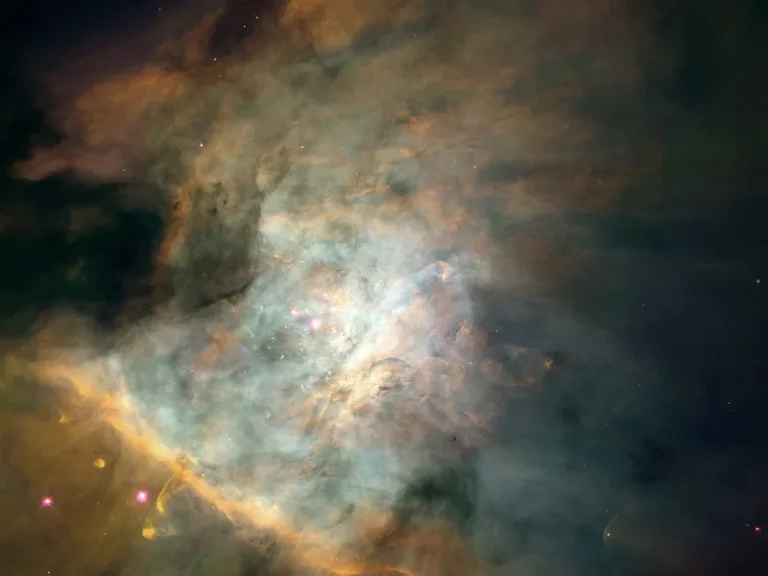

For decades, astrophysicists were baffled by a deep chronological contradiction at the core of the galaxy’s most famous stellar nursery: the planet-forming protoplanetary disks and the expanding gas bubble appeared dramatically younger than the cluster’s mature stars. Now, the Orion Nebula age paradox that puzzled astronomers for generations has finally found an elegant solution. An international team of astrophysicists led by Leiden University demonstrated that the cluster’s most massive and luminous star, Theta-1 Orionis C, was formed just 200,000 years ago through a violent stellar merger.
The Enigma of the Great Nebula: Why the Core Looked Drastically Younger Than Its Stars
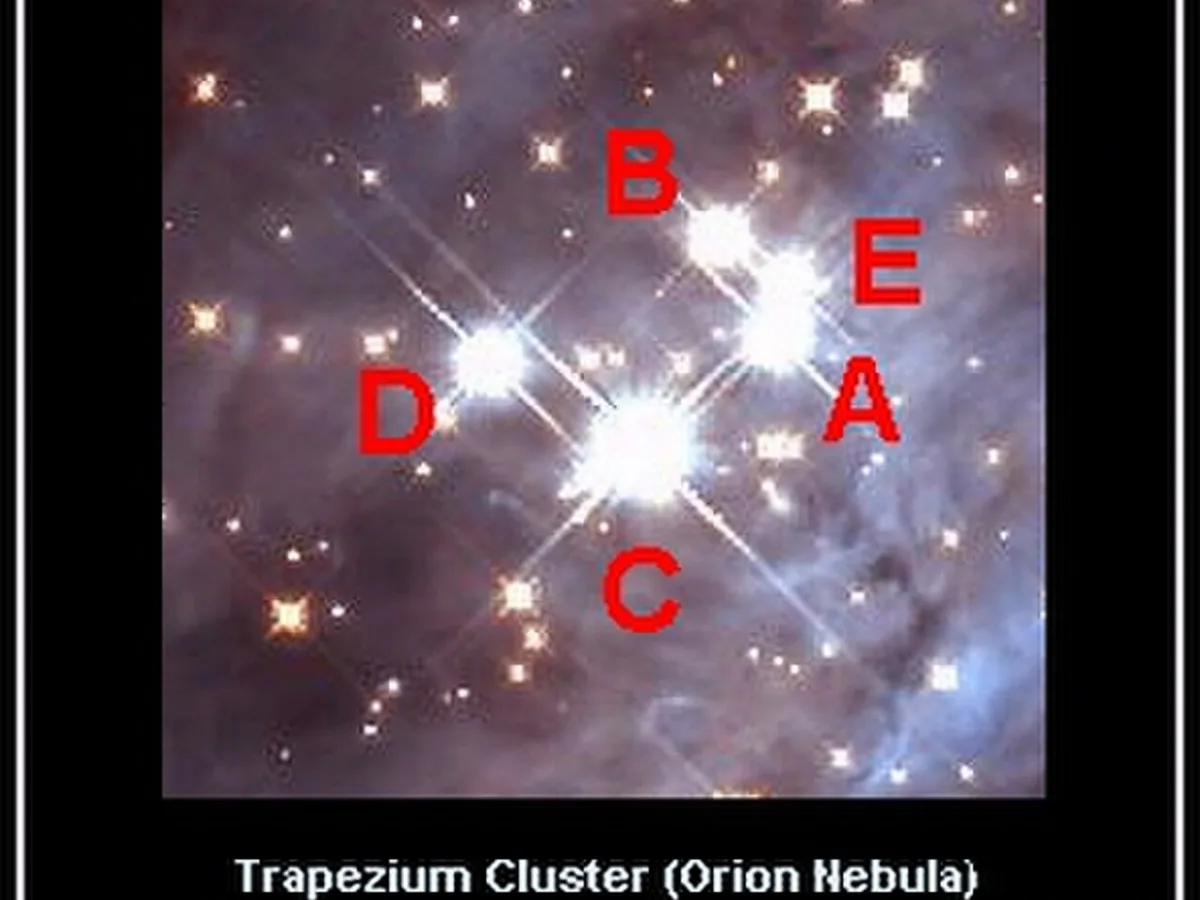
The Great Orion Nebula (Messier 42), situated just south of Orion’s Belt, is the most extensively observed stellar nursery in the Milky Way. Within its glowing gaseous expanses, thousands of young stars are emerging from turbulent molecular clouds. At the very center lies the Trapezium Cluster—a compact arrangement of four prominent, scorching massive stars of spectral types O and B whose extreme ultraviolet radiation lights up the surrounding nebula across dozens of light-years.
However, as high-resolution imagery from the Hubble Space Telescope and millimeter arrays accumulated, astronomers encountered a persistent mystery known as the ‘Orion age paradox’. Spectral dating of the cluster’s low- and intermediate-mass stars consistently revealed ages between 1 and 2.5 million years. Many of these young solar analogs are surrounded by dense protoplanetary disks, or ‘proplyds’, where new planetary systems are currently taking shape.
Conversely, the physical morphology of the surrounding H II gas cavity told a completely different chronological story. The massive blister of ionized gas excavated by intense stellar winds expands at a velocity indicating that the bubble opened only about 150,000 to 200,000 years ago. Had the cluster’s massive stars been blasting the cloud with their current luminosity for two million years, the surrounding gas would have been dispersed long ago, and the fragile protoplanetary disks would have been rapidly vaporized by external photoevaporation.
Head-On Stellar Collision: The Violent Genesis of Theta-1 Orionis C
Reconciling this chronological dilemma required an astrophysical mechanism capable of abruptly altering the radiation environment without changing the age of the wider stellar population. A research group led by Professor Simon Portegies Zwart at Leiden University deployed state-of-the-art direct N-body simulations to model the dynamical interactions of dense star clusters. In such packed environments, chaotic three-body encounters frequently destabilize binary orbits.
The simulations revealed that approximately 200,000 years ago, a catastrophic collision occurred at the very heart of the Trapezium. The primary powerhouse of the nebula, Theta-1 Orionis C (Theta-1 Ori C), an O7V supergiant exceeding 33 solar masses, did not form as a single star. Instead, it was originally a tight binary consisting of two lower-mass stars orbiting one another in an eccentric configuration.
A close gravitational encounter with a passing star rapidly drained angular momentum from the binary, causing their orbits to decay within a few thousand years. The two stars collided head-on, coalescing into a single, colossal O-type supergiant. This titanic merger unleashed enormous kinetic energy and restructured the radiative architecture of the entire star-forming cloud.
Most low-mass stars in the Trapezium cluster are 1 to 2 million years old, while the expanding nebula shell exhibits a dynamical age of merely 200,000 years.
Supermassive primary star Theta-1 Orionis C1 formed via the direct head-on collision and merger of a tight binary system in the crowded cluster core.
Fragile protoplanetary disks (proplyds) avoided early photoevaporation because the extreme ultraviolet flux only ignited relatively recently.
The collision model accurately reproduces both the complex 1,000-Gauss tilted magnetic dipole and the observed nitrogen excess in Theta-1 Orionis C.
Resetting the Clock and Shielding Emerging Planetary Systems
When two massive stars collide and merge, pristine hydrogen from their outer envelopes is driven deep into the convective core of the resulting object. In stellar astrophysics, this process acts as an immediate reset button on the star’s thermonuclear clock: the newly merged star emerges looking like a zero-age main-sequence star, sporting a blistering surface temperature of 39,000 Kelvin and shining 200,000 times brighter than our Sun.
It was this sudden burst of intense ionizing radiation 200,000 years ago that carved out the modern ionized cavity of M42 and created the youthful gas shell observed today. Prior to this event, the ambient radiation field was significantly milder, granting fragile protoplanetary disks sufficient time to consolidate planetesimals and build planet cores. Only after Theta-1 Orionis C was born did rapid photoevaporation begin, shaping the comet-like proplyd silhouettes captured by Hubble.
Furthermore, this merger model neatly resolves two enduring observational puzzles regarding Theta-1 Orionis C. The star possesses an unusually strong and tilted magnetic dipole field exceeding 1,000 Gauss, which is a known byproduct of the intense dynamo generation triggered during stellar collisions. High-resolution spectroscopy also confirms a notable surface enrichment of nitrogen, consistent with deep CNO-cycle processed material churned to the surface during the merger.
«The collision and merger of two massive stars in the cluster core effectively reset the evolutionary clock of the primary ionizing source. This explains why proplyds survived destruction and why the expanding gas cavity reflects an extremely young dynamical age.»
Dr. Simon Portegies Zwart, Professor of Computational Astrophysics at Leiden University
Implications for Star Clusters and the Search for Habitable Worlds
The resolution of the Orion Nebula age paradox carries profound implications for modern astrophysics. Classical theories assumed that star clusters form in a single, coordinated collapse where stars evolve in strict isolation. The Leiden study proves that crowded young clusters are dynamic cauldrons where direct stellar collisions are fundamental drivers of stellar and cluster evolution.
For planetary scientists studying the birth of solar systems, the delayed onset of extreme ultraviolet radiation offers a much more optimistic perspective on planet formation. Had extreme radiation bathed the cluster from day one, terrestrial and giant planet formation would have been severely hindered by premature gas stripping. The delayed ignition of the primary O-star provided a critical million-year grace period for rocky protoplanets to take shape.
Future observations using the James Webb Space Telescope’s infrared instruments will scrutinize the molecular outflows and shock structures surrounding the Trapezium core. By verifying the exact physical signatures of this cataclysmic merger, astronomers will gain unprecedented insight into the violent processes that sculpt stellar nurseries and shape the architecture of infant planetary systems.
- The Orion Nebula (M42) sits approximately 1,344 light-years from Earth, representing our closest massive star-forming region.
- Theta-1 Orionis C exceeds 33 solar masses and shines over 200,000 times brighter than the Sun, dominating the region’s radiation field.
- Direct N-body numerical simulations prove that dynamical collisions are inevitable in ultra-dense young stellar clusters.
- The findings fundamentally reshape how astronomers calculate protoplanetary disk survival times across dense galactic star clusters.
Stellar Wind Kinematics and the Triggered Star Formation Horizon
High-resolution spectral mapping of Balmer series transitions and forbidden [O III] lines reveals extreme kinetic momentum driven by the central star’s supersonic outflow. Theta-1 Orionis C expels dense terminal winds surpassing 1,000 kilometers per second, carving out a spherical shock front that clears the cluster core of ambient molecular gas.
This process triggers a localized dual evolutionary pathway. While inner proplyds face rapid photoevaporation, the outward-propagating shock front compresses peripheral cold molecular pillars, initiating secondary triggered star formation that gives rise to swarms of low-mass protostars and brown dwarfs.
Ultimately, the rejuvenated O-star faces a brief, violent future. Within 3 to 5 million years, Theta-1 Orionis C will exhaust its thermonuclear core fuel, culminating in an energetic Type II core-collapse supernova that will disperse the remnants of the Orion Nebula into interstellar space.