

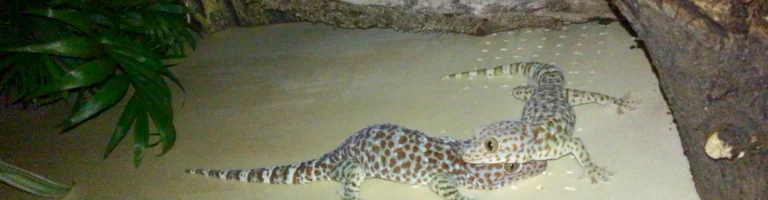

The effortless ability of the common gecko to sprint up polished vertical glass mirrors and hang suspended upside down from smooth ceilings has bewildered physicists and naturalists since the time of Aristotle. Breakthrough investigations in quantum biophysics conducted at the Max Planck Institute for Intelligent Systems and UC Berkeley have finally demystified this gravity-defying feat: the gecko relies neither on chemical glues, vacuum suction, nor static electricity, but rather exploits subtle quantum electrodynamic Van der Waals dipole forces through hundreds of millions of hierarchical nanostructures.
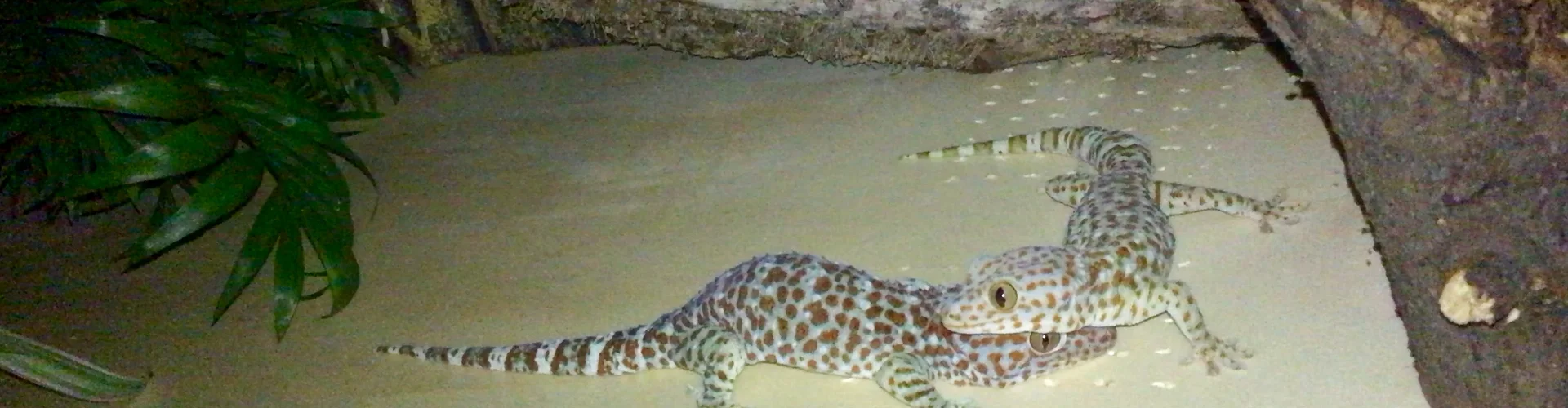
Aristotle’s Conundrum: Two Millennia of Scientific Bafflement
In the fourth century BCE, the pioneering Greek philosopher and polymath Aristotle documented in his treatises that the gecko possessed the confounding ability to “run up and down a tree in any way, even with the back downwards.” For more than twenty-three centuries, mainstream science struggled to produce an empirically verifiable physical explanation for this acrobatic marvel. Various intuitive hypotheses were proposed across the centuries: perhaps the lizard secreted an invisible adhesive chemical resin, functioned via micro-pneumatic suction cups, or generated colossal electrostatic charges across its specialized epidermal scales.
Yet, rigorous experimental trials in the late twentieth century systematically dismantled every conventional theory. The gecko adheres with undiminished tenacity to vertical glass panels inside a hard vacuum chamber (where suction cups are physically inoperative due to the absence of ambient barometric pressure). It traverses electrically grounded conductors and submerged surfaces without losing traction (excluding macro-electrostatic attraction), and leaves behind zero chemical residue on ultra-pure substrates (disproving glandular adhesive secretions). The definitive breakthrough arrived at the dawn of the 21st century, when a multidisciplinary team led by integrative biologist Dr. Kellar Autumn and biomechanical physicists at the Max Planck Institute deployed scanning electron microscopy (SEM) and atomic force microscopy (AFM), discovering that the gecko operates entirely within the domain of quantum electrodynamics. Epistemological and physical parallels abound in modern discovery: as explored on Vinegret.Net in our study of high-energy relativistic astrophysics and atomic field interactions, the fundamental laws of particle physics dictate macroscopic phenomena across the cosmos.
Hierarchical Nanoscale Architecture: Setae and Spatulae
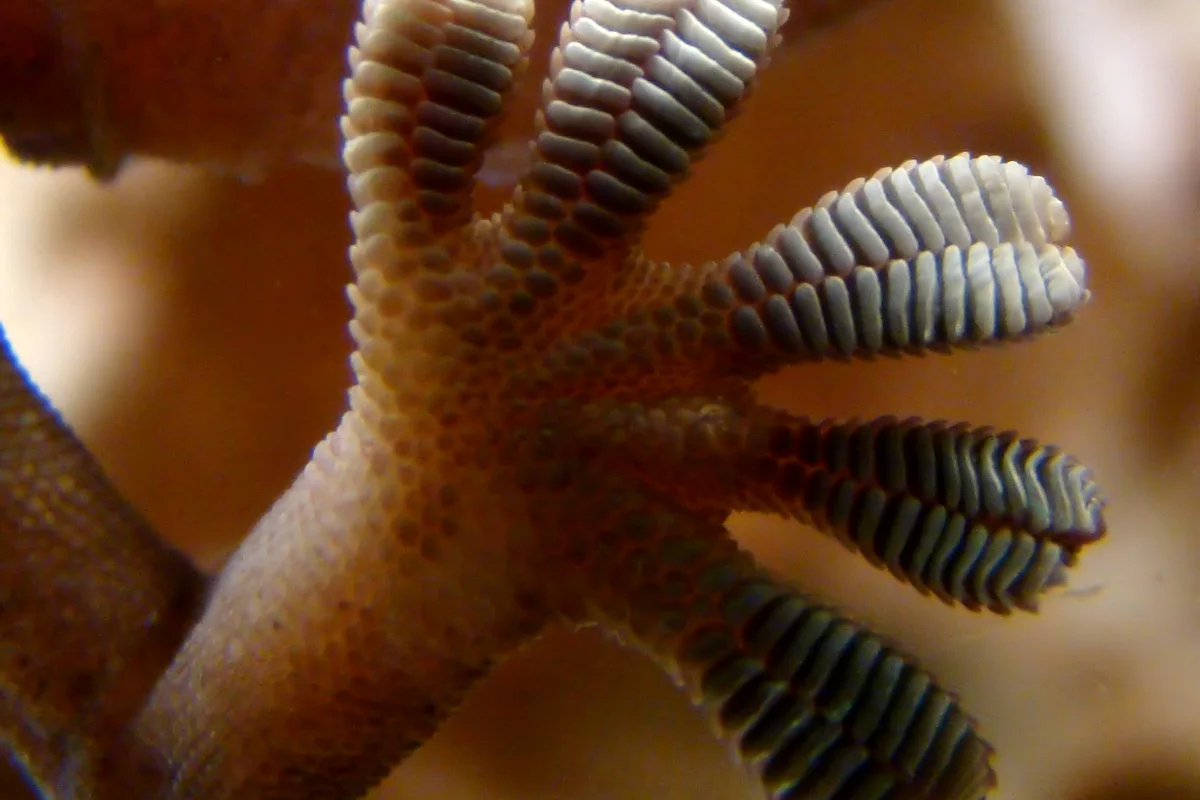
The secret behind the gecko’s adhesive prowess resides in an intricate, multi-tiered structural hierarchy on the underside of its toes. Visible to the naked eye are overlapping transverse ridges called scansors or lamellae. Under scanning electron microscopy, each square millimeter of a lamella is revealed to be carpeted with roughly 14,000 microscopic, flexible hairs composed of high-modulus beta-keratin, termed setae.
Each individual seta measures roughly 110 micrometers in length and 4.2 micrometers in diameter—roughly one-tenth the thickness of a single human hair. Crucially, the terminus of each seta branches into hundreds to thousands of hyper-flexible, triangular spatulate plates (spatulae). A single spatula measures approximately 200 nanometers in width and less than 10 nanometers in thickness. In aggregate, a single Tokay gecko (Gekko gecko) commands over one billion spatulae. This extraordinary fibrillar density allows the gecko’s foot to conform to any surface topology, accommodating microscopic peaks and valleys on an atomic scale.
Quantum Electrodynamics in Nature: Van der Waals Attraction
When an individual spatula makes physical contact with an opposing substrate, approaching within a sub-nanometer distance (less than 0.3 nanometers), quantum electrodynamics takes over. At this atomic scale, instantaneous fluctuations in electron density occur within the electron clouds of neutral atoms. These fluctuations create transient dipole moments, which electrostatically induce complementary dipoles in adjacent atoms of the substrate (whether glass, polished steel, or teflon). This intermolecular synchronization produces an attractive Van der Waals force.
While the Van der Waals interaction between a single pair of atoms is minuscule—measured in fractions of a picoNewton—the sheer multiplication of billions of intimate spatulate contacts produces an astonishing aggregate adhesion. The theoretical adhesive capacity of all four feet of an adult Tokay gecko exceeds 130 kilograms (nearly 290 pounds). This immense safety margin allows a 100-gram lizard to sprint across ceiling surfaces carrying heavy prey with complete mechanical security.
Hierarchical Fibrillar Nanocubes
Each gecko toe features millions of microscopic setae hairs that branch into hundreds of billions of spatulae nano-pads measuring barely 200 nanometers across.
Quantum Van der Waals Forces
Bringing spatulae within sub-nanometer proximity of surface atoms induces spontaneous electron cloud fluctuations, creating powerful electrostatic dipoles.
Angle-Dependent Mechanical Switch
Adhesion engages strictly at a 30-degree shear angle and disengages effortlessly in milliseconds as the toe angle shifts, enabling rapid locomotive sprinting.
Orbital and Surgical Applications
NASA biomimetic dry adhesives capture orbital space debris in the vacuum of low Earth orbit and provide non-toxic, stitch-free wound closure in cardiac surgery.
The 30-Degree Angular Mechanical Switch
If the gecko’s adhesive grip is so powerful, how does the animal detach its feet to sprint across vertical walls at speeds exceeding thirty strides per second? If its pads functioned like conventional duct tape, the lizard would remain permanently immobilized by its own adhesive force. The secret lies in a sophisticated, angle-dependent directional mechanical switch.
Micro-force sensor measurements revealed that gecko setae do not engage adhesion through vertical downward pressure. Instead, adhesion engages exclusively when the seta is dragged parallel to the substrate under a low shear angle of roughly 30 degrees. This lateral shear pulls the flexible spatulae flat against the substrate atoms, maximizing Van der Waals coupling. To release the foot, the gecko simply alters the peel angle above 30 degrees (approaching 90 degrees), much like peeling a strip of adhesive tape from its edge. The adhesive force plummets to near zero in milliseconds, demanding negligible muscular expenditure. Furthermore, the high elastic modulus of beta-keratin confers a self-cleaning property: foreign particulate contaminants are dynamically shed after just a few steps. This elegant structural efficiency mirrors engineering principles examined on Vinegret.Net in our coverage of advanced optical precision and nanomaterial engineering.
Biomimetic Frontiers: Orbital Robotics and Non-Invasive Surgery
Decoding the physics of gecko adhesion catalyzed a revolution in material science. Interdisciplinary engineering teams at Stanford University, NASA’s Jet Propulsion Laboratory (JPL), and the Max Planck Institute successfully synthesized biomimetic dry adhesives (popularly branded as Geckskin) fabricated from micro-molded polydimethylsiloxane (PDMS) and carbon nanotube arrays.
The aerospace sector has emerged as a premier beneficiary. In the vacuum of orbital space, traditional tapes fail due to volatile degassing, and magnetic grippers cannot adhere to non-ferrous composite materials. Robotic grappling arms fitted with gecko-inspired dry adhesive tiles have been deployed aboard the International Space Station, capable of capturing drifting satellite solar panels and orbital debris without imparting momentum. In translational medicine, biocompatible gecko-adhesive films are replacing invasive surgical sutures in delicate intestinal and cardiovascular procedures, bonding wet tissues securely without inducing toxic inflammatory reactions.
Scientific Epilogue: Evolution as the Supreme Nanotechnologist
The humble gecko stands as living proof that evolution is nature’s supreme nanotechnologist. By converting subtle quantum electrodynamic forces into formidable mechanical grip through exquisite architectural hierarchy, this unassuming reptile continues to guide 21st-century science toward lighter, cleaner, and vastly more capable technologies.