

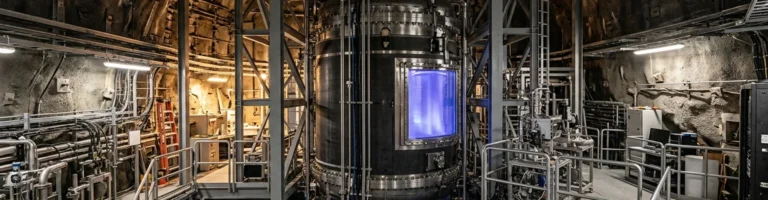

Nearly a mile beneath the Black Hills of South Dakota, in the subterranean caverns of the historic Homestake gold mine, operates the most sensitive radiation observatory ever engineered: the LUX-ZEPLIN (LZ) detector. Shielded from cosmic rays by 4,850 feet of solid rock, a massive titanium cryostat containing ten metric tonnes of hyper-purified liquid xenon conducts an unceasing search for the Universe’s greatest missing component—dark matter. New milestones published by the collaboration have established world-record limits on dark matter interactions, eliminating broad swaths of hypothetical particles and edging closer to physics’ ultimate frontier: the neutrino fog.
The Invisible Cosmic Framework: Why 85% of Universal Mass Remains Unseen
In the 1930s, Swiss astrophysicist Fritz Zwicky measured the orbital velocities of galaxies within the Coma Cluster and uncovered a baffling gravitational discrepancy: the visible baryonic mass of luminous stars and interstellar gas was utterly insufficient to hold the cluster gravitationally bound. Decades later, pioneering astronomer Vera Rubin corroborated this cosmic anomaly by measuring galactic rotation curves, demonstrating that stars in outer spiral arms orbit at velocities identical to those near the core, directly violating Newtonian expectations.
Modern precision cosmology under the standard Lambda-CDM paradigm confirms that conventional baryonic matter—everything composing atoms, stars, planets, and living organisms—makes up less than 5 percent of the energy density of the cosmos. Roughly 68 percent consists of dark energy, while the remaining 27 percent corresponds to cold dark matter (CDM), exerting five times the gravitational influence of all visible matter combined.
Dark matter neither emits, reflects, nor absorbs any frequency of electromagnetic radiation. It reveals itself strictly through gravitational clustering, creating an immense invisible scaffolding that seeded cosmic structure formation. For decades, the premier theoretical candidate has been the WIMP (Weakly Interacting Massive Particle), hypothetical relics forged during the primordial furnace of the Big Bang.
Engineering the LZ Observatory: Ten Tonnes of Ultra-Purified Liquid Xenon
To detect exceedingly rare WIMP interactions, physicists had to shield their equipment from ambient terrestrial and cosmic radiation. Located at the Sanford Underground Research Facility (SURF) in Lead, South Dakota, the detector sits 4,850 feet (1,478 meters) underground, where nearly a mile of rock attenuates the cosmic muon flux by a factor of several million. Inside a cavernous chamber, the apparatus is immersed in a 238-cubic-meter tank of ultrapure deionized water acting as an active Cherenkov muon veto.
The core instrument is a two-phase Time Projection Chamber (TPC) housed within double-walled cryostats fabricated from radio-pure titanium. The active target consists of 10 tonnes of liquid xenon maintained at cryogenic temperatures of -98 degrees Celsius (-144°F), capped by a thin layer of gaseous xenon. Xenon is the ideal detection medium due to its high atomic mass (A ≈ 131), dense stopping power (nearly 3 g/cm³), and exceptional scintillation efficiency.
Top and bottom arrays incorporate 494 ultra-low-background Photomultiplier Tubes (PMTs) designed to register single ultraviolet photons. The xenon underwent exhaustive purification via gas chromatography, slashing background radioactive krypton-85 to an astonishingly low concentration: less than one part per hundreds of trillions of xenon atoms.
The Homestake mine shields the detector beneath nearly a mile of rock, cutting cosmic noise millions of times.
An ultra-pure dual-phase cryogenic vessel at -98°C provides a massive target for rare particle collisions.
Time-separated scintillation signals permit sub-millimeter 3D reconstruction and background rejection.
Sensitivity has reached the threshold where background solar neutrinos begin mimicking dark matter recoils.
Dual-Flash Scintillation: Disentangling Nuclear and Electronic Recoils
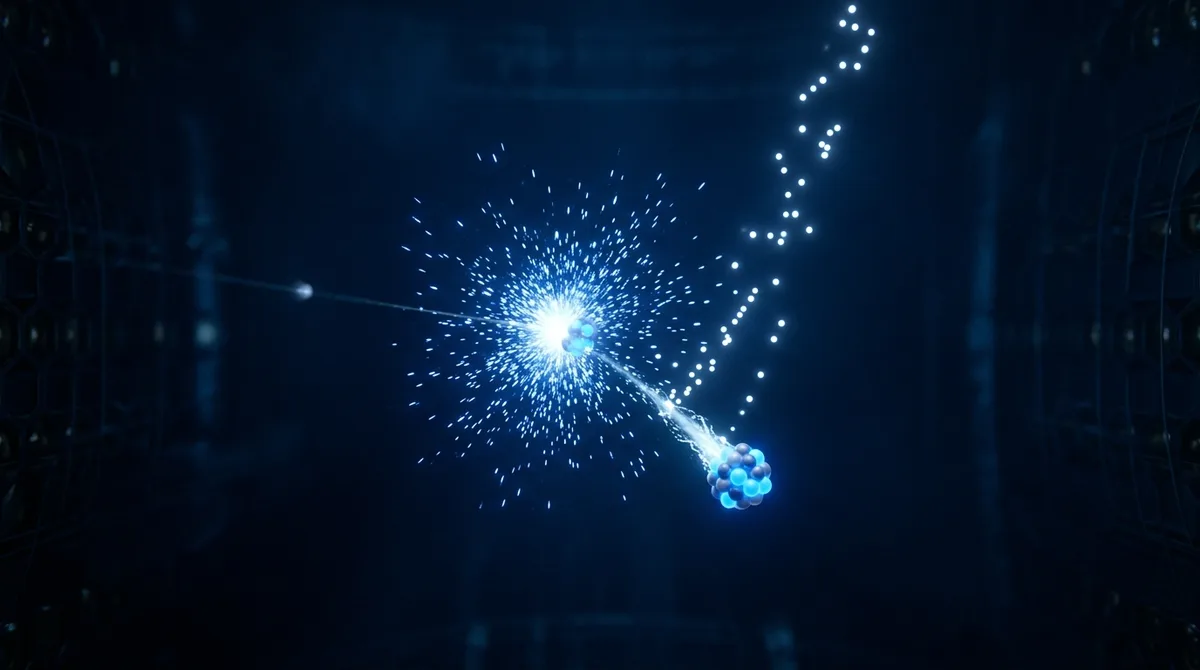
Event reconstruction within the LUX-ZEPLIN TPC hinges upon the precise temporal discrimination of two distinct optical signals, designated S1 and S2. When an incoming dark matter particle traverses the target volume and elastically scatters off a heavy xenon nucleus, it imparts kinetic energy via a nuclear recoil.
The recoiling nucleus immediately excites and ionizes surrounding xenon atoms, generating a prompt burst of 175-nanometer vacuum ultraviolet scintillation—the S1 signal detected by the PMT arrays. Simultaneously, free ionization electrons are liberated. A uniform electric drift field of hundreds of volts per centimeter pulls these electrons upward through the liquid column toward the liquid-gas interface.
Upon reaching the extraction region, a stronger electric field extracts the electrons into the gaseous xenon, inducing intense secondary electroluminescence—the S2 signal. The microsecond time delay between S1 and S2 pinpoints the exact Z-coordinate depth of the interaction, while the S2 photon footprint on the top PMT array reveals precise X-Y planar coordinates. Crucially, the ratio of S2 to S1 provides an unambiguous discriminant, distinguishing true nuclear recoils from background electronic recoils caused by gamma rays.
«We have engineered the quietest radiation environment on planet Earth. If WIMPs exist within the mass ranges predicted by supersymmetry, the LUX-ZEPLIN detector possesses the precision to capture their very first terrestrial nuclear recoil.»
Dr. Hugh Lippincott, Spokesperson for the LUX-ZEPLIN Collaboration, UC Santa Barbara
Unprecedented Sensitivity Limits and Entering the Neutrino Fog
Recent data releases from the LUX-ZEPLIN collaboration after hundreds of live days of exposure demonstrated world-leading exclusion limits on spin-independent WIMP-nucleon cross-sections. While no definitive excess of dark matter signals was observed, the unprecedented lack of background interference allowed physicists to constrain particle interaction probabilities to levels never before achieved.
These rigorous constraints have excluded vast parameter spaces predicted by canonical Minimal Supersymmetric Standard Model (MSSM) theories across particle masses spanning gigaelectronvolts to teraelectronvolts. Consequently, theoretical physicists are pivoting toward broader candidates, including ultralight axions, dark photons, sterile neutrinos, and primordial black holes.
Furthermore, LZ’s sensitivity curve is now rapidly descending toward the long-anticipated “neutrino fog”—the physical threshold where coherent elastic neutrino-nucleus scattering (CEvNS) from solar, atmospheric, and diffuse supernova neutrinos produces nuclear recoils indistinguishable from WIMP collisions. Piercing this fog will necessitate sophisticated directional detection and statistical modeling.
- Dark matter constitutes 85% of all matter in the Universe, yet never interacts directly with light.
- Located at the Sanford Underground Research Facility (SURF) in Lead, South Dakota, USA.
- Background radioactive krypton-85 has been reduced to less than 1 atom per hundreds of trillions.
- Next-generation plans envision the unified 60-tonne XLZD detector to deliver a final verdict.
The Path Forward: Project XLZD and the Ultimate WIMP Verdict
The LUX-ZEPLIN experiment is slated to collect data through 1,000 live days, pushing cross-section sensitivity limits even further. However, the international scientific community has already commenced planning the ultimate dark matter observatory: merging the LZ and European XENONnT collaborations into the unified XLZD consortium.
The planned XLZD facility will deploy over 60 tonnes of liquid xenon in a subterranean chamber, effectively serving as the definitive test of the thermal WIMP paradigm. Beyond dark matter searches, this multi-tonne observatory will investigate neutrinoless double-beta decay in xenon-136, a rare decay process that could demonstrate whether neutrinos are Majorana fermions and help resolve why matter triumphed over antimatter in the early Universe.
The deep underground endeavor beneath South Dakota exemplifies humanity’s grandest scientific irony: to decipher the immense macrocosm of galactic structures, researchers must construct the world’s quietest quantum traps deep in the subterranean heart of the Earth.