

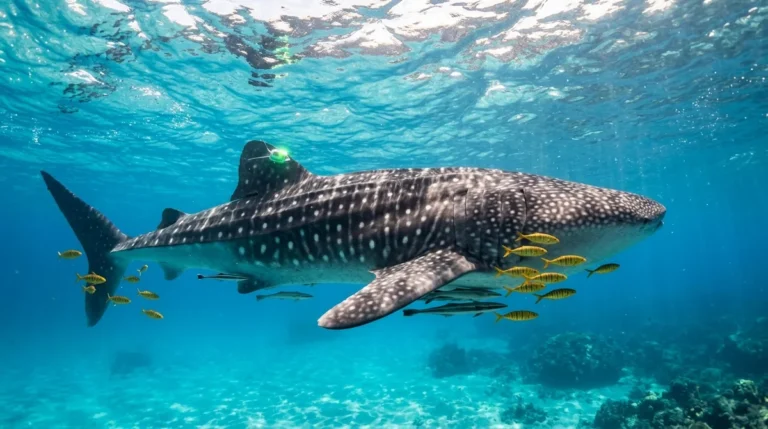

The global ocean holds countless unsolved mysteries, yet no marine creature has ever showcased such extraordinary navigational stamina and geographical range. An international research consortium spearheaded by the Guy Harvey Foundation, the Guy Harvey Research Institute (GHRI) at Nova Southeastern University, and Mexican conservation organization Ch’ooj Ajauil AC has revealed the findings of an unprecedented nine-year satellite telemetry study following an adult male whale shark named Milo. Over more than 3,400 tracked days, the eight-meter ocean giant logged over 54,700 kilometers (more than 34,000 miles), shattering the world record for the longest continuous movement track ever documented for any shark species in history.
Milo’s Historic Odyssey: Five Fin Transmitters Deployed Across Nearly a Decade
Milo, an eight-meter male whale shark (Rhincodon typus), was first tagged with a satellite-linked transmitter in August 2017 in the nutrient-dense waters off the Yucatán Peninsula near Isla Mujeres, Mexico. During that era, satellite tag retention on large pelagic elasmobranchs was notoriously brief: his initial dorsal fin transmitter shed after merely two weeks due to fierce hydrodynamic drag.
However, marine biologists leveraged a fundamental evolutionary feature: whale sharks possess spot and stripe patterns on their flanks that are as uniquely identifying as human fingerprints. Utilizing the Wildbook for Whale Sharks global photographic database, researchers repeatedly relocated Milo during seasonal feeding aggregations and affixed updated Argos satellite transmitters.
In total, researchers successfully refitted Milo with new transmitters five separate times—in 2018, 2020, 2023, and July 2026. This technical perseverance produced the longest individual life-history track ever assembled for a free-swimming whale shark in scientific literature.
A Colossal Oceanic Trajectory: From the Mexican Caribbean to Massachusetts
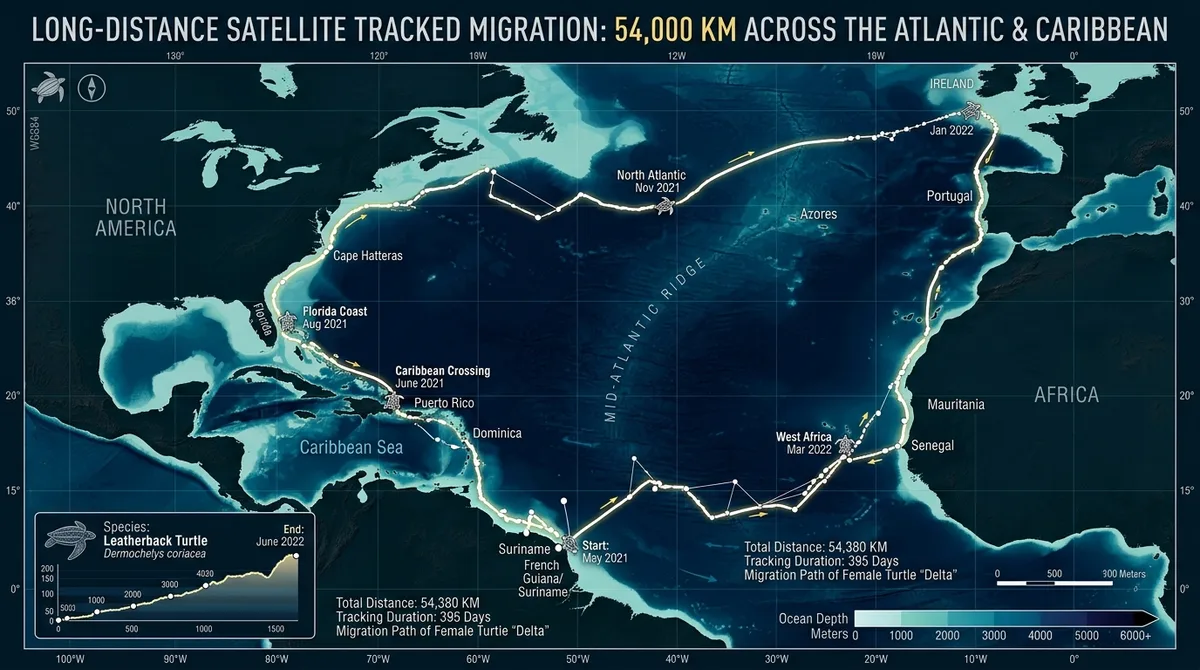
The geographic breadth of Milo’s journey spans across vast ocean realms. While he regularly returned to his core summer feeding habitat off the Mexican Caribbean, his expansive oceanic travels reached thousands of kilometers into open water.
Satellite tracking revealed extensive trans-basin movements: Milo repeatedly traversed the Gulf of Mexico, navigated past the Florida Straits, encircled Cuba and the Bahamas, penetrated deep into the open Sargasso Sea east of Bermuda, and rode the Gulf Stream north into the cold waters off the coast of Massachusetts.
His long-term track exhibited a clear alternation between two behavioral regimes: rapid nomadic transit periods, where the shark covered up to 70 kilometers per day in linear transit, interspersed with multi-month stationary residency periods where he remained within localized upwelling zones rich in zooplankton.
The all-time world record for shark telemetry, captured across more than 3,400 tracking days over 9 years.
Unique spot pattern photographic identification allowed researchers to re-tag Milo across multiple feeding seasons.
Extreme vertical dives into the twilight zone enable foraging on mesopelagic biomass and core thermoregulation.
Milo navigated waters of over 10 nations, providing empirical proof for international pelagic protection corridors.
Extreme Bathypelagic Dives: Deep-Sea Foraging and Thermal Balancing
Beyond horizontal distances, depth sensors aboard Milo’s tags recorded astonishing vertical diving profiles. Although whale sharks are famed surface filter-feeders, scooping krill, fish spawn, and copepods with wide cavernous mouths, Milo routinely descended beyond 1,000 to 1,200 meters into the bathypelagic realm.
At these extreme depths, water temperatures plummet close to freezing and hydrostatic pressure exceeds 100 atmospheres. Biologists hypothesize these deep dives serve dual physiological functions: foraging within the dense biomass of the mesopelagic deep scattering layer (the twilight zone), and dumping excess metabolic heat accumulated during prolonged surface basking in tropical seas.
Milo’s deep-ocean navigation mirrors breakthroughs in abyssal ecology, such as when scientists discovered that dark oxygen on the ocean floor represents an alternative source of life, highlighting how little humanity yet understands about the biogeochemical dynamics of the deep sea.
«Milo’s telemetry dataset has completely revolutionized our understanding of whale shark spatial ecology. Marine science traditionally viewed these animals as regional residents tethered to seasonal coral spawning and coastal foraging reefs. Nine years of continuous tracking have proved that whale sharks are indefatigable trans-oceanic wanderers connecting multi-basin marine corridors from the Caribbean to the high-seas North Atlantic.»
Rafael de la Parra Venegas, Executive Director and Lead Marine Biologist at Ch’ooj Ajauil AC
Conservation Mandates: Establishing Transboundary Marine Corridors
Whale sharks are classified as Endangered on the IUCN Red List of Threatened Species. Global populations have suffered catastrophic declines exceeding 50% over the last 75 years, driven by historical targeted fisheries, incidental net entanglement, and lethal vessel strikes by commercial container shipping.
Historically, marine protected areas (MPAs) have been demarcated as narrow 12-nautical-mile coastal reserves confined within single nations. Milo’s 54,700-kilometer track conclusively demonstrates the inadequacy of static, isolated borders: during his migrations, he crossed the exclusive economic zones of more than ten sovereign nations and spent extensive periods in unregulated international waters.
These empirical findings provide critical justification for establishing dynamic, multilateral Marine Protected Area Corridors. Conservation biologists are now actively lobbying for mandatory seasonal vessel speed caps and shipping rerouting across critical whale shark migratory bottlenecks in the Gulf of Mexico and Caribbean basin.
- Milo is an 8-meter adult male whale shark first fitted with a satellite tag in Mexico in 2017.
- His 9-year trek spanned 34,000 miles (54,700 km), traversing the Caribbean, Gulf of Mexico, and North Atlantic.
- Migration speeds reached 70 km/day during rapid transit phases, interspersed with seasonal stationary residency.
- Telemetry data directly supports international policies mandating vessel speed limits along whale shark travel lanes.
Milo’s Lasting Legacy and the Future of Pelagic Telemetry
Milo’s decade-long chronicle stands as a triumph of minimally invasive, persistent field biology. No animal was harmed, and the resulting empirical telemetry library represents a historic benchmark in marine megafauna conservation.
With Milo still actively transmitting data, researchers are preparing to deploy similar multi-year tags on cohorts of juvenile whale sharks. This will determine whether these trans-oceanic pathways are hardwired through genetic navigation or refined through experiential learning over decades.
Every kilometer logged by Milo is an undeniable testament to the deep interconnectedness of the global ocean, reminding humanity that protecting marine wilderness requires global cooperation that transcends geopolitical boundaries.