

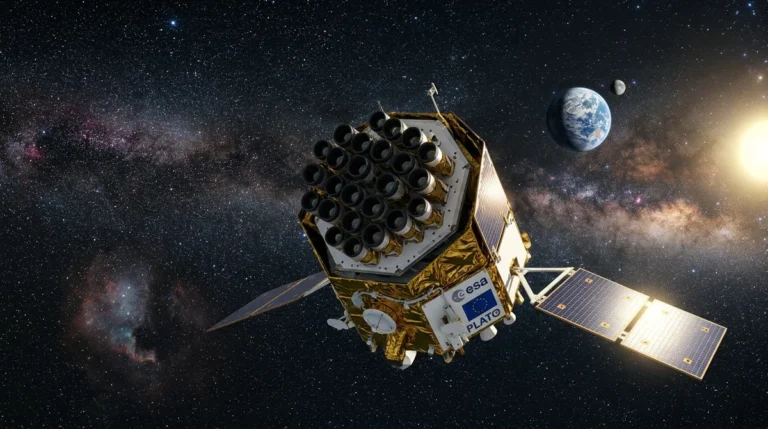

Over three decades of intensive exoplanet exploration, astronomers have confirmed more than 5,500 alien worlds, yet astronomy’s ultimate prize—a genuine twin of Earth orbiting a Sun-like star—remains undiscovered. Almost all known potentially habitable exoplanets orbit dim, volatile red dwarfs whose ferocious coronal mass ejections can strip planetary atmospheres bare. To crack this cosmological mystery, the European Space Agency (ESA) has completed assembly of the PLATO (PLAnetary Transits and Oscillations of stars) space observatory. Powered by an unprecedented array of 26 synchronized cameras, this deep-space explorer will travel to Sun-Earth Lagrange Point 2 (L2) to monitor hundreds of thousands of bright yellow stars and discover Earth-sized worlds hosting liquid oceans.
Architectural Triumph: Why the PLATO Observatory Uses 26 Synchronized Eyes
Unlike traditional space telescopes such as Hubble or the James Webb Space Telescope, which employ a single large primary aperture to observe narrow cosmic fields, PLATO utilizes an innovative multi-telescope architecture. Its thermally stabilized optical bench hosts 26 independent refractive cameras, each featuring a 120 mm aperture and an ultra-wide field of view.
The instrument payload is organized into four subsets of six “normal cameras” offset by small angles, creating an expansive composite field of view spanning over 2,200 square degrees—thousands of times broader than Kepler’s field. Two additional “fast cameras” provide high-cadence photometry and act as precision fine-guidance sensors locked onto bright reference stars.
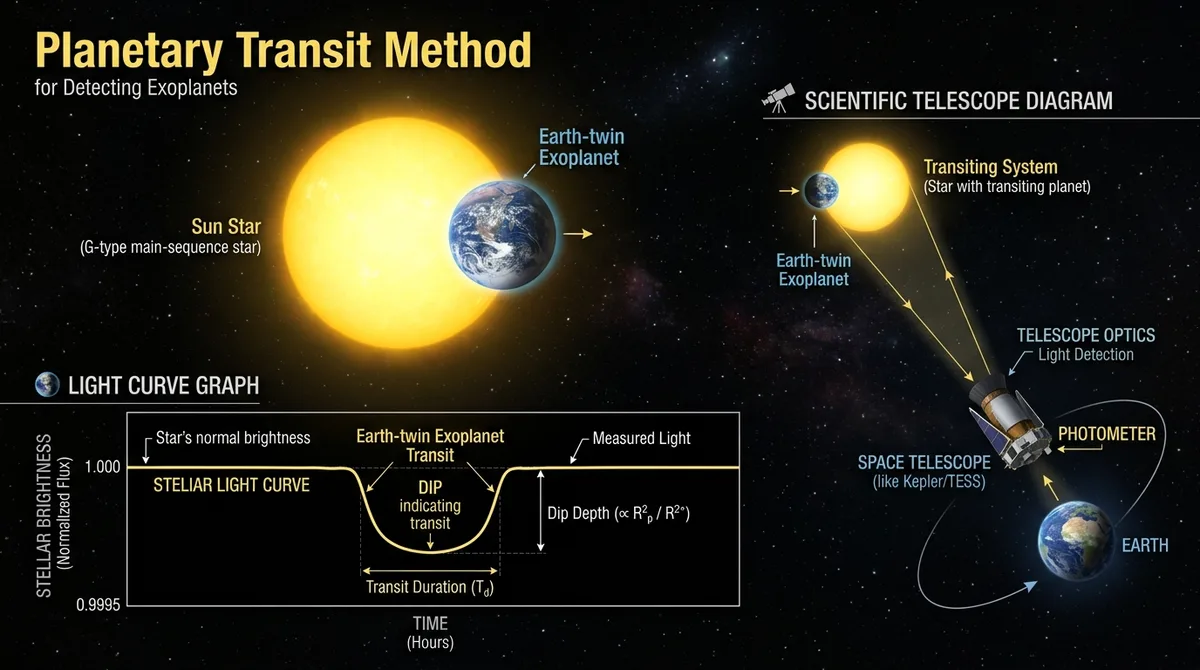
This multi-camera configuration yields an exceptional signal-to-noise ratio. By aggregating photometric streams from dozens of charge-coupled device (CCD) detectors boasting a combined resolution exceeding one gigapixel, PLATO can detect minute stellar flux dips as tiny as a few hundredths of a percent when an Earth-sized rocky sphere crosses the stellar disk.
Solving Kepler’s Blind Spot: Continuous Monitoring of One-Year Habitable Orbits
Why do existing exoplanetary archives skew heavily toward scorched “hot Jupiters” and red dwarf systems? The explanation lies in observational cadence constraints. Surveys like NASA’s TESS observe celestial sectors for only 27 consecutive days, biasing discoveries toward planets with orbital periods of less than a month.
To definitively validate an exoplanetary candidate via transit photometry, astronomers require a minimum of three consecutive, periodic transit dips. For a terrestrial world situated within the habitable zone of a G-type yellow dwarf (a star like our Sun), the orbital period is approximately 365 Earth days. Consequently, an observatory must track the same stellar cohort continuously for at least three full years.
PLATO is purpose-built to conquer this formidable timeline. The observatory will fix its gaze on two expansive fields in the northern and southern celestial hemispheres for two to three years each, uninterruptedly measuring the brightness of over 200,000 bright F-, G-, and K-dwarf stars.
A modular payload of 24 normal and 2 fast telescopes covers a colossal field of view exceeding 2,200 square degrees.
Focusing on bright G-dwarfs avoids the lethal flares and atmospheric stripping common around red dwarf stars.
Multi-year staring observations capture the three consecutive transits required to confirm true Earth-like orbits.
Acoustic stellar pulsation data determines planetary radii to within 3% and stellar system age to within 10%.
Asteroseismology: Probing Stellar Interiors to Unlock Precise Planetary Ages
PLATO’s second scientific breakthrough is its capability to conduct high-precision asteroseismology—measuring acoustic oscillations vibrating through stellar interiors. Turbulent convection within stellar plasma creates sound waves that cause subtle, rhythmic pulsations across the star’s surface.
By analyzing the micro-frequencies of these stellar acoustic modes, astrophysicists can calculate stellar mass and radius with unprecedented accuracy down to 1–2%. Because exoplanetary transit depths only measure planet size relative to host star radius, PLATO will establish exoplanet radii to within an astounding 3% margin of error.
Crucially, asteroseismology reveals stellar age to within 10% precision. This metric is paramount for astrobiology: a juvenile planet of 500 million years may still be a sterile, vulcanized hellscape, whereas a mature system aged 4 to 5 billion years has enjoyed sufficient geological epochs to evolve a self-sustaining biosphere, mirroring Earth’s history.
«The Kepler mission proved that planets are more common than stars across our galaxy. But Kepler focused on dim, distant targets whose planetary atmospheres cannot be characterized by spectrometers. PLATO completely changes the landscape: we are pointing 26 ultra-sensitive optical cameras at bright, nearby stars identical to our Sun, searching for worlds with one-year orbital periods capable of sustaining complex biology.»
Heike Rauer, Lead of the PLATO Mission Consortium and Director of the DLR Institute of Planetary Research
Lagrange Point 2 Orbit and Synergies with James Webb and the ELT
PLATO is scheduled to launch aboard an Ariane 6 launch vehicle from Europe’s Spaceport in Kourou, French Guiana. The spacecraft will journey to the Sun-Earth Lagrange Point 2 (L2), situated 1.5 million kilometers behind Earth’s night side.
From this gravitationally stable vantage point, free from terrestrial thermal interference and orbital eclipses, PLATO will maintain uninterrupted 24/7 photometric surveillance across 365 days a year.
Because PLATO targets bright nearby stars (visual magnitudes between 4 and 11), its planet discoveries will become premier targets for transmission spectroscopy using JWST and the upcoming Extremely Large Telescope (ELT) in Chile. Astronomers will probe alien atmospheres for oxygen, methane, ozone, and water vapor—mirroring how modern astrophysics uncovers planets around enigmatic stars, such as when astronomers confirmed how a phoenix planet was reborn from the ashes of a dead star.
- Launches aboard an Ariane 6 rocket to the Sun-Earth L2 Lagrange Point, 1.5 million km from Earth.
- Features an ultra-sensitive gigapixel optical sensor array combining dozens of charge-coupled devices.
- Target catalog encompasses more than 200,000 bright nearby dwarf stars across northern and southern skies.
- Discovered Earth twins will serve as prime targets for atmospheric biosignature characterization by JWST and ELT.
A Giant Leap Toward Answering Humanity’s Oldest Question
Are we alone in the cosmos? Until now, humanity has lacked the technological instrumentation to discover an authentic twin of our own solar architecture: an unperturbed yellow star hosting a temperate terrestrial planet on a 365-day orbit.
ESA’s PLATO mission will resolve this fundamental existential question. Its empirical statistical census will reveal whether Earth is an ultra-rare galactic miracle or whether our galaxy teems with millions of temperate oceanic worlds cradling clouds, continents, and life.
The discoveries logged by this multi-camera European observatory will lay the groundwork for future direct exoplanet imaging missions, defining the trajectory of interstellar exploration for the coming century.