


Across the observable universe, there are hundreds of billions of galaxies, trillions of stars, and an astronomical abundance of potentially habitable terrestrial exoplanets. Given that our universe has existed for roughly 13.8 billion years, any technological civilization emerging even a mere million years before humanity would have had ample cosmic time to colonize the Milky Way and populate interstellar space with colossal astroengineering megastructures. Yet, the night sky presents an eerie, deafening silence. Physicist Enrico Fermi’s haunting question—”Where is everybody?”—finds its most unsettling resolution in Robin Hanson’s Great Filter hypothesis: along the developmental trajectory from primordial soup to star-faring species, there exists an insurmountable barrier that eliminates intelligent life.
The Drake Equation and the Kardashev Scale: The Magnitude of the Cosmic Mystery
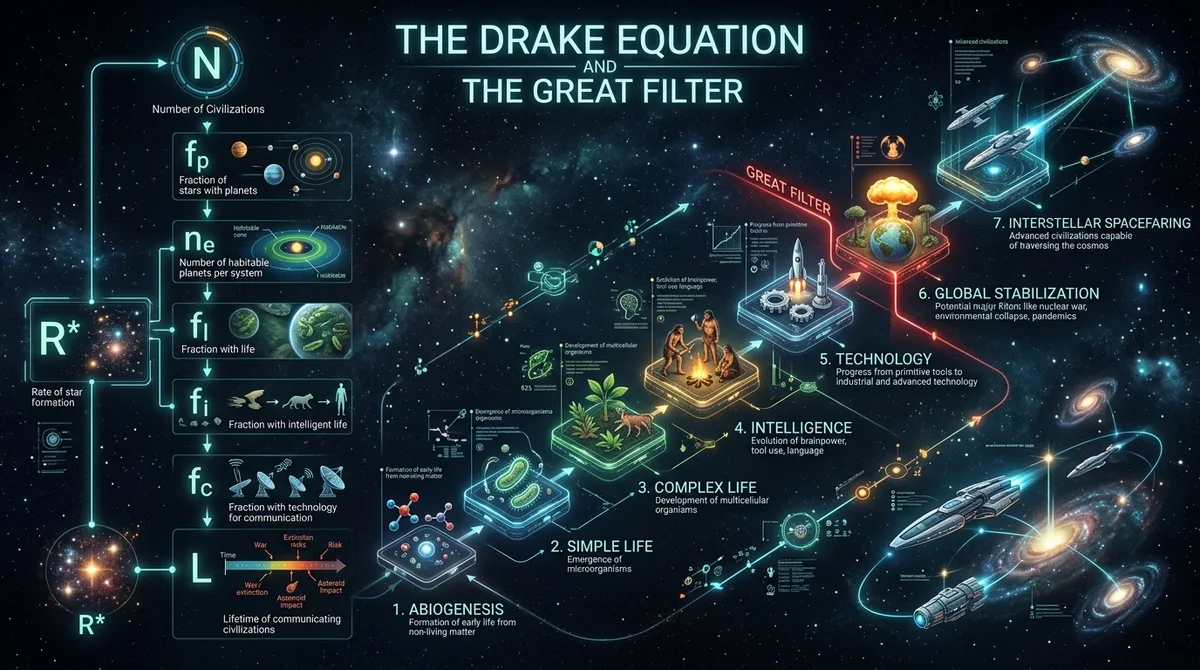
In 1961, astrophysicist Frank Drake formulated his probabilistic equation to estimate the number of active, communicative civilizations within our galaxy. Even when adopting conservative parametric estimates—concerning stellar formation, planetary habitability, and biological biogenesis—the mathematics suggests the Milky Way should be teeming with technological civilizations. Furthermore, Soviet astrophysicist Nikolai Kardashev categorized civilizations by energy consumption: planetary (Type I), stellar (Type II), and galactic (Type III).
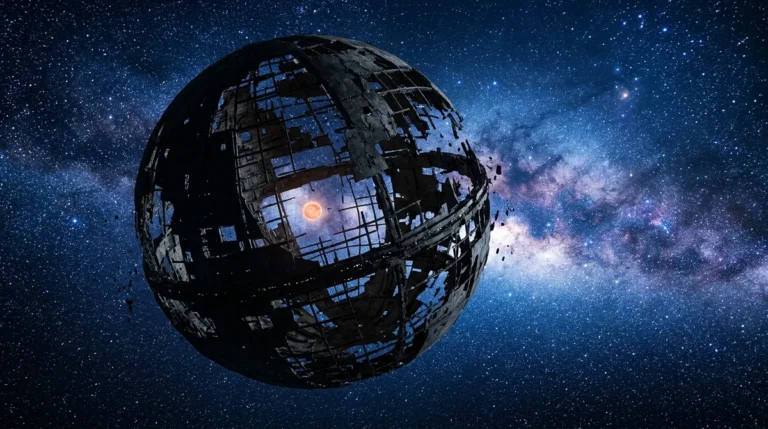
A Type II civilization possesses the technological capacity to construct Dyson swarms—vast megastructures capturing the entire radiant energy output of their host star. Such feats of cosmic engineering cannot be concealed: thermodynamics dictates that they must radiate immense quantities of waste heat in the mid-infrared spectrum. However, deep-space surveys conducted by space telescopes like WISE and JWST, examining hundreds of thousands of galaxies, have found no conclusive signatures of Type II or Type III activity.
This profound dissonance between the high statistical likelihood of intelligent life and the absolute absence of detectable technological evidence is famously recognized as the Great Silence or the Fermi Paradox.
The Great Filter Hypothesis: Deadly Hurdles on the Evolutionary Ladder
In 1998, economist and futurist Robin Hanson proposed the Great Filter hypothesis, offering a rigorous and chilling framework to resolve the Fermi Paradox. Hanson deconstructed the timeline of life into nine discrete evolutionary milestones: spanning the emergence of a stable planetary environment, abiogenesis (the dawn of self-replicating genetic molecules), cellular compartmentalization, tool use, and culminating in interstellar colonization.
According to Hanson, at least one of these transitional steps must represent a nearly insurmountable statistical precipice. The probability of crossing this bottleneck is so infinitesimally small that out of billions of cosmic cradles, virtually no species survives. This logical deduction presents humanity with a stark and defining existential question: is the Great Filter behind us, or does it lie ahead?
With trillions of planets and billions of years, the universe should be populated; the deafening cosmic silence requires explanation.
An evolutionary barrier so improbable that nearly every biological line is extinguished before achieving interstellar transit.
The endosymbiotic merger creating the mitochondrion happened only once in 4.5 billion years, suggesting life’s bottleneck is behind us.
If the filter lies ahead, catastrophic risks like unaligned AI or engineered pathogens destroy civilizations before spaceflight.
The Optimistic Scenario: The Filter Lies in Our Evolutionary Past
If humanity is destined to endure and expand into the cosmos, the Great Filter must be situated in our distant biological past as a sequence of improbable miracles. The first prime candidate is abiogenesis itself—the transition from prebiotic chemistry to the first functional RNA and cellular structures. Despite decades of advanced chemical synthesis, science has not succeeded in creating life from non-living matter from scratch.
An even more compelling candidate is eukaryogenesis—the birth of complex cells bearing nuclei and organelles. On Earth, simple single-celled prokaryotes (bacteria and archaea) dominated for nearly two billion years without evolving anatomical complexity. That plateau was only broken when a solitary, freak endosymbiotic merger occurred: an archaeon engulfed an alpha-proteobacterium, creating the mitochondrion. This singular biochemical leap occurred exactly once in Earth’s 4.5-billion-year history.
Other candidate filters include the development of sexual reproduction, true multicellularity, and the emergence of high-level abstract cognition capable of technological innovation. If any of these leaps represents a statistical impossibility, Earth is an ultra-rare sanctuary, and humans are astronomically fortunate survivors.
«The silence of the cosmos is not an invitation to idle philosophical musing; it is potentially the most harrowing warning signal for humanity’s own survival. If billions of years have yielded no observable Dyson spheres and no galactic empires, a fatal bottleneck—the Great Filter—must exist. And if it does not lie safely behind us in our evolutionary history, it lies inevitably in our near future.»
Dr. Robin Hanson, Research Associate at the Future of Humanity Institute, Oxford University
The Pessimistic Scenario: The Extinction Cliff Awaits Us
Conversely, if biogenesis and the evolution of intelligence are common planetary phenomena, the mathematical conclusion is merciless: the Great Filter awaits us in our immediate technological future. At this juncture, a civilization develops technologies capable of total existential annihilation before developing multiplanetary resilience.
Potential man-made filters include rogue artificial general intelligence (AGI), global thermonuclear conflict, synthetic biological pathogens designed with pandemic transmissibility, or catastrophic planetary ecological collapse. If emerging technological species inevitably invent the mechanisms of their own destruction within a few centuries of their industrial revolutions, it fully explains the cosmic graveyard around us.
Oxford philosopher Nick Bostrom encapsulated this bleak reality with his famous maxim: “No news is good news for humanity.” Discovering independent complex fossils on Mars or Europa would be the most terrifying scientific discovery in history: it would prove that biological filters are trivial to cross, confirming that the Great Filter lies ahead in the technological phase.
- Kardashev Type II civilizations would radiate detectable waste heat, yet extensive infrared sky surveys remain completely void.
- Eukaryogenesis on Earth required nearly 1.8 billion years, indicating that cellular complexity may be an exceptionally rare cosmic event.
- Nick Bostrom’s thesis: discovering fossilized complex life on Mars would strongly imply that the lethal filter lies in our technological future.
- Overcoming a future filter demands transforming humanity into a multi-planetary species and systematically managing existential risks.
The Path Forward: Transcending the Existential Threshold
Grasping the implications of the Great Filter imposes a profound duty upon modern science and global governance. Humanity cannot afford complacent self-indulgence. To navigate the treacherous existential bottlenecks of the twenty-first century, our species must actively mitigate civilizational vulnerabilities.
Establishing self-sustaining off-world settlements on the Moon and Mars, enforcing rigorous safety protocols around autonomous frontier intelligence and dangerous bioengineering, and transitioning toward durable circular energy systems are not mere idealistic pursuits. They represent the indispensable survival prerequisites for Homo sapiens to overcome the Great Filter and inherit the stars.