

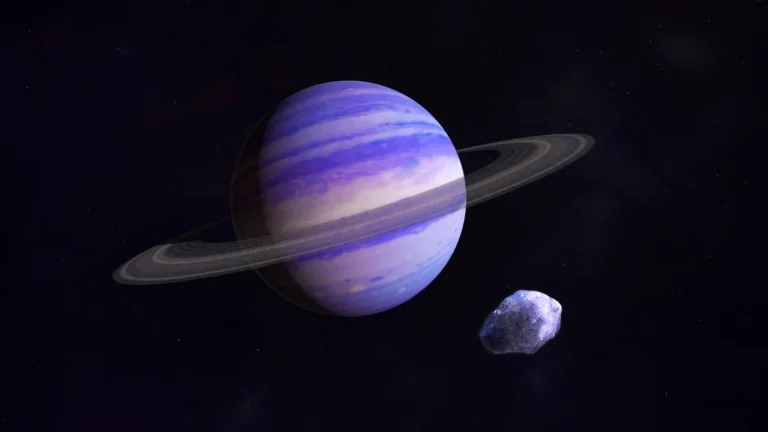

Drifting across the deep expanse of our galaxy, far removed from the warmth of any parent star, wander hundreds of billions of sunless worlds. These rogue planets (free-floating planets), violently ejected by gravitational chaos from their nascent planetary nurseries eons ago, hurtle through the interstellar void at dozens of kilometers per second. Until recently, direct characterization remained virtually impossible because they emit no light and never transit a host star. Now, in a historic astronomical achievement, researchers harnessed simultaneous space- and ground-based parallax to directly measure the mass and distance of an isolated rogue planet — confirming that starless wanderers vastly outnumber the shining stars of the Milky Way.
Gravitational Billiards: How Rogue Worlds Are Born
Within the dense protoplanetary disks of young stars, the rapid growth of gas and ice giants unleashes violent dynamical instability. As embryonic protoplanets migrate through gas and dust, mutual gravitational resonances pump their orbital eccentricities to catastrophic limits.
Through gravitational slingshot interactions, lighter planets (Earth- to Saturn-mass objects) are ejected beyond their host star’s gravitational grip. Deprived of stellar irradiation, their atmospheres collapse into ice sheets as they embark on an unending journey through galactic arms.
Gravitational Microlensing: Nature’s Cosmic Magnifying Glass
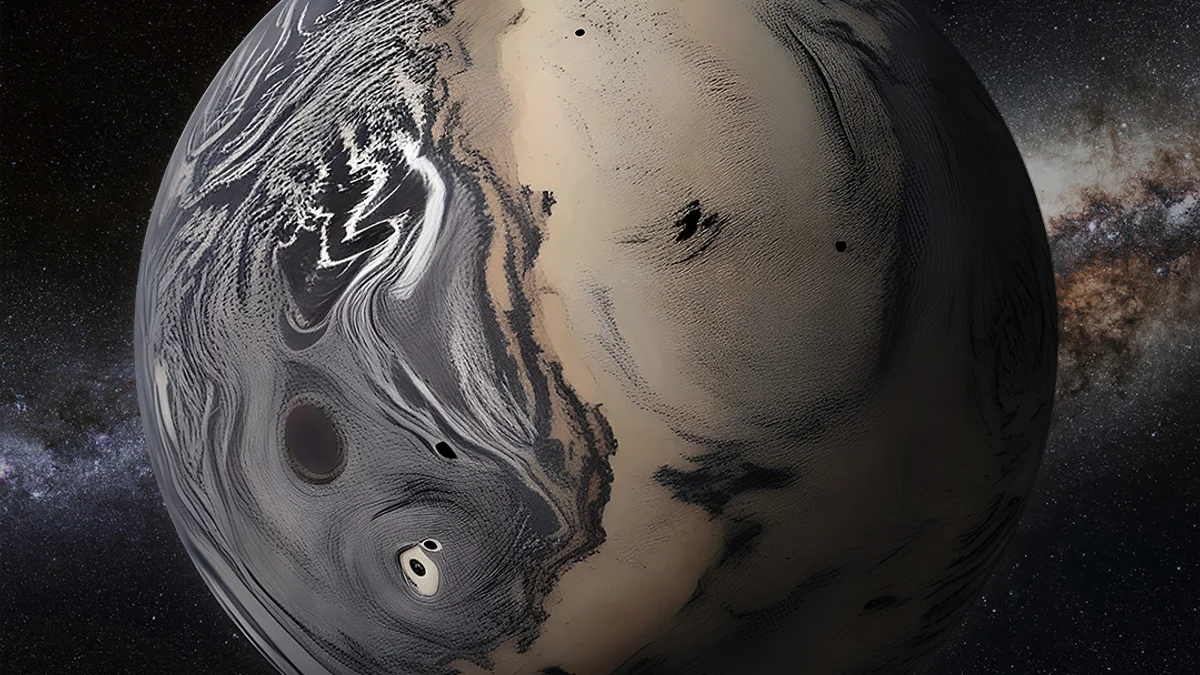
Lacking stellar illumination, rogue planets are completely invisible to standard spectroscopy or transit detection methods. The sole observational tool capable of unveiling them is gravitational microlensing, predicted by Albert Einstein’s general theory of relativity.
When a starless planet crosses precisely between Earth and a distant background star, its gravitational field bends and magnifies the background star’s photons. To observers on Earth, this manifests as an ephemeral brightening event lasting from several hours to a few days.
Free-floating planets vastly outnumber the illuminated stars of the Milky Way.
Gravitational fields bend background starlight, producing characteristic brightening curves.
Simultaneous space-ground observations directly cracked the mass calculation of rogue worlds.
Tidal friction sustains liquid oceans beneath moon ice crusts for over 4 billion years.
Event KMT-2024-BLG-0792: Breaking the Mass Degeneracy
A historic impediment of microlensing was parameter degeneracy: a short magnification burst could represent either a lightweight planet traveling slowly and nearby, or a massive high-velocity star passing far away.
The breakthrough occurred through synchronized observations uniting ground-based networks (KMTNet and OGLE) with the European Space Agency’s Gaia space telescope. Separated by 1.5 million kilometers at the Sun-Earth L2 Lagrange point, Gaia observed the event from a distinct angle, recording a measurable parallax offset in light curve timing and shape.
This geometric triangulation solved the gravitational equation: the object weighs approximately 0.22 Jupiter masses (comparable to Saturn), floating at a distance of 9,780 light-years toward the Galactic Bulge.
«We intuitively imagine planetary architectures as clockwork systems tethered to shining suns. In truth, planetary infancy is a game of ruthless gravitational billiards: for every world that secures a stable orbit, dozens are violently hurled into eternal galactic exile. The Milky Way is populated by vast, invisible armadas of rogue worlds.»
Dr. Suhyeon Choi, Senior Astrophysicist at Korea Astronomy and Space Science Institute (KASI)
Habitability Without Sunlight: Tidal Heating in Subsurface Oceans
While the atmospheric surface of a rogue planet cools toward cosmic microwave background baselines, astrobiological simulations reveal that habitability is far from precluded. Research from Ludwig-Maximilians-Universität München demonstrates that moons orbiting free-floating gas giants can retain liquid oceans for up to 4.3 billion years.
Persistent tidal dissipation driven by the giant planet’s gravitational tides heats the moon’s silicate mantle, powering deep hydrothermal vents. A thick ice crust paired with a dense hydrogen atmosphere acts as an impenetrable shield against cosmic radiation, nurturing chemotrophic life in the interstellar dark.
- Event KMT-2024-BLG-0792 yielded the first precise mass triangulation of a Saturn-mass free-floating world.
- Space-ground parallax baseline spanning 1.5 million km resolved the mathematical degeneracy.
- Astrophysical models confirm that starless exomoons can sustain hydrothermal biospheres without solar light.
- The Nancy Grace Roman observatory is projected to discover thousands of rogue exoplanets.
The Nancy Grace Roman Space Telescope Frontier
NASA’s upcoming Nancy Grace Roman Space Telescope will revolutionize rogue planet astronomy. Equipped with a high-resolution Wide Field Instrument, Roman will continuously survey hundreds of millions of stars in the galactic bulge.
Astrophysicists anticipate cataloging thousands of free-floating terrestrial worlds, decisively testing the hypothesis that starless Earth-mass planets outnumber stars across the galaxy by a factor of three or more.