

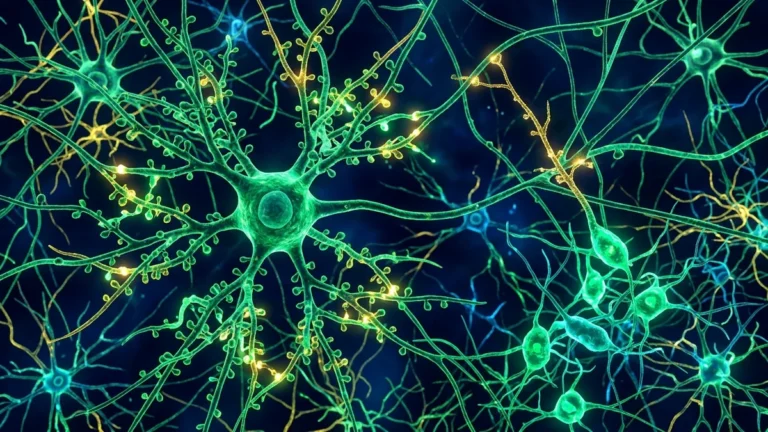

For most of the 20th century, academic neuroscience adhered to a dogmatic postulate: central nervous system architecture was regarded as immutable once adulthood was achieved, with neuronal loss deemed irreversible. However, the discovery of ongoing adult neurogenesis and the elucidation of Brain-Derived Neurotrophic Factor (BDNF) revolutionized modern neurology. The human brain exhibits lifelong neuroplasticity — retaining the innate biological capacity to remodel neural circuits, sprout dendritic spines, and establish functional synapses at any age under targeted biochemical stimuli.
Overturning Dogma: Neurogenesis in the Dentate Gyrus
In the late 1990s, seminal research by Peter Eriksson and Fred Gage conclusively proved that thousands of new functional neurons are generated daily in the human adult hippocampus. This adult neurogenesis takes place within the subgranular zone of the dentate gyrus, a critical hub for episodic memory formation and cognitive pattern separation.
These newly minted neural progenitor cells mature and functionally wire into established cortical networks over several weeks. However, their long-term survival is contingent upon trophic support and challenging cognitive stimulation; unexercised neurons undergo rapid apoptosis.
BDNF: The Master Biochemical Fertilizer of Synaptogenesis
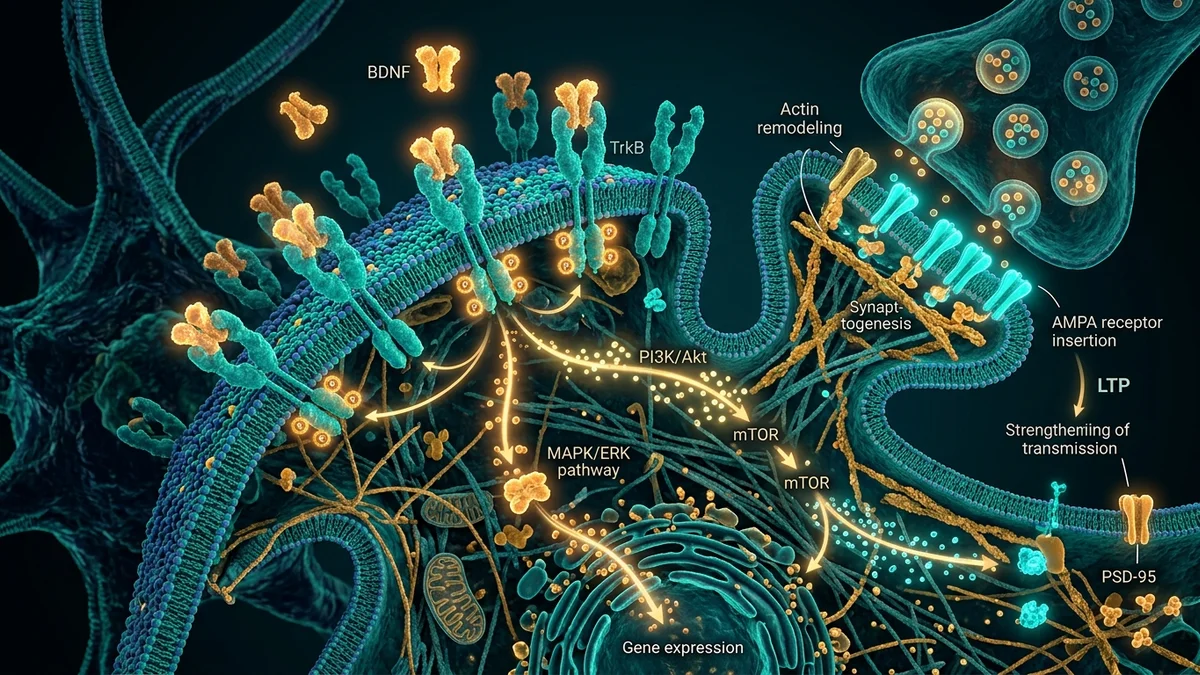
Brain-Derived Neurotrophic Factor (BDNF) is a vital signaling protein of the neurotrophin family. Upon binding to its high-affinity receptor tropomyosin receptor kinase B (TrkB) on the neuronal plasma membrane, BDNF triggers downstream signaling cascades including MAPK/ERK and PI3K/Akt pathways.
These cascades upregulate gene transcription responsible for synaptogenesis, axonal elongation, and long-term potentiation (LTP) — the cellular foundation of learning. Chronically depleted BDNF levels are universally observed in major depressive disorders, neurodegenerative pathologies, and age-related cognitive decline.
New functional neurons are generated continuously within the hippocampal dentate gyrus.
A potent neurotrophic peptide that accelerates synaptogenesis via TrkB phosphorylation.
Synchronous neuronal activation physically strengthens synaptic clefts and dendritic spines.
Exercise-derived irisin and lactate boost hippocampal BDNF synthesis by 200–300%.
Synaptic Remodeling: Hebbian Plasticity and Dendritic Spines
The governing paradigm of neuroplasticity is encapsulated by Donald Hebb’s axiom: “Neurons that fire together, wire together.” Repeated synchronous activation between synaptic partners physically restructures the synaptic cleft.
Post-synaptic dendritic spines enlarge, AMPA and NMDA glutamate receptor densities multiply, and action potential transduction velocities dramatically increase. Conversely, idle pathways undergo synaptic pruning, as microglial cells systematically eliminate inefficient connections to conserve metabolic energy.
«The adult brain is not a hardwired machine. It is a dynamic, living ecosystem that remodels itself with every targeted motor and cognitive effort. Synaptic circuits are physically rebuilt whenever you push through cognitive friction. The indispensable molecular catalyst for this continuous reinvention is BDNF.»
Dr. Michael Merzenich, Professor Emeritus at UCSF, Pioneer in Cortical Plasticity Research
Biochemical Triggers of BDNF: Muscle Irisin and Lactate
Aerobic cardiovascular exercise and high-intensity interval training represent the most potent known endogenous stimuli for BDNF synthesis. Active skeletal muscles release the myokine irisin and circulating lactate into systemic blood flow.
Traversing the blood-brain barrier, circulating lactate and irisin stimulate hippocampal PGC-1α and FNDC5 protein expression, triggering a 200–300% surge in local BDNF synthesis. Even a single 30-minute bout of zone-2 aerobic conditioning primes the cerebrum for accelerated plasticity.
- Engage in 150 minutes of moderate-to-vigorous aerobic exercise weekly to elevate baseline BDNF.
- Challenge motor learning: practice table tennis, juggling, or intricate dance choreography.
- Prioritize 7.5–8 hours of uninterrupted sleep: slow-wave sleep is essential for synaptic pruning and memory consolidation.
- Execute deep-focus work in 45–60 minute blocks free from distractions to harness acetylcholine-mediated plasticity.
Protocols for Lifelong Cognitive Super-Plasticity
Merely repeating familiar cognitive routines does not maintain cortical flexibility. Meaningful neuroplastic change requires “cognitive friction” — an uncomfortable, effortful mental state that stimulates noradrenaline and acetylcholine release.
Mastering musical instruments, acquiring complex languages, learning complex motor arts (such as dance or martial arts requiring balance and spatial orientation), and practicing time-restricted feeding synergistically foster cognitive reserve, conferring robust resilience against neurodegenerative decline.