

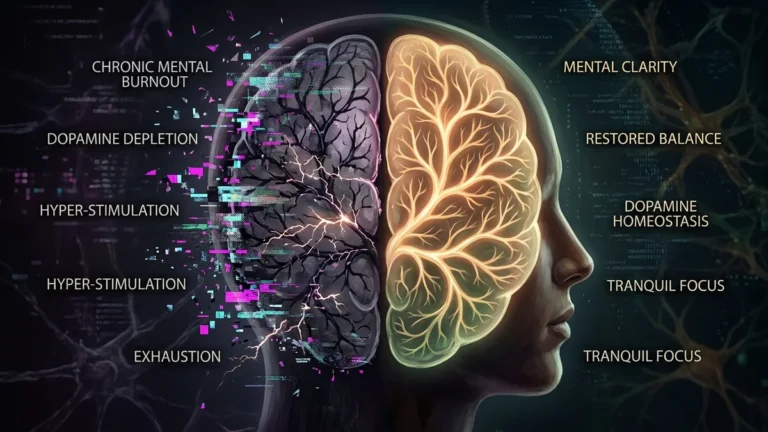

In an era of hyper-connectivity, frictionless notifications, and infinite social media feeds, the human brain is grappling with an evolutionary mismatch: chronic exposure to supernormal sensory stimuli. Continuous micro-doses of cheap gratification drain the mesolimbic reward system. What society conventionally labels as “laziness” or “lack of willpower” is recognized in modern neuroscience as dopamine desensitization and D2 receptor downregulation — a physical state that robs the mind of its capacity to find satisfaction in meaningful, effortful accomplishments.
The Anatomy of Craving: The Mesolimbic Pathway and Anticipation
Contrary to widespread popular myths, dopamine is not released when a reward is consumed. Dopamine neurons in the ventral tegmental area (VTA) project into the nucleus accumbens primarily during the search, anticipation, and prediction of a reward. This primal circuitry evolved to drive ancestral foraging across harsh environments.
In contemporary life, the exact same neurocircuitry is hijacked by algorithmic notifications and high-velocity digital content. Evolution built our reward architecture for scarce, hard-earned triumphs — not for artificial spikes every few seconds.
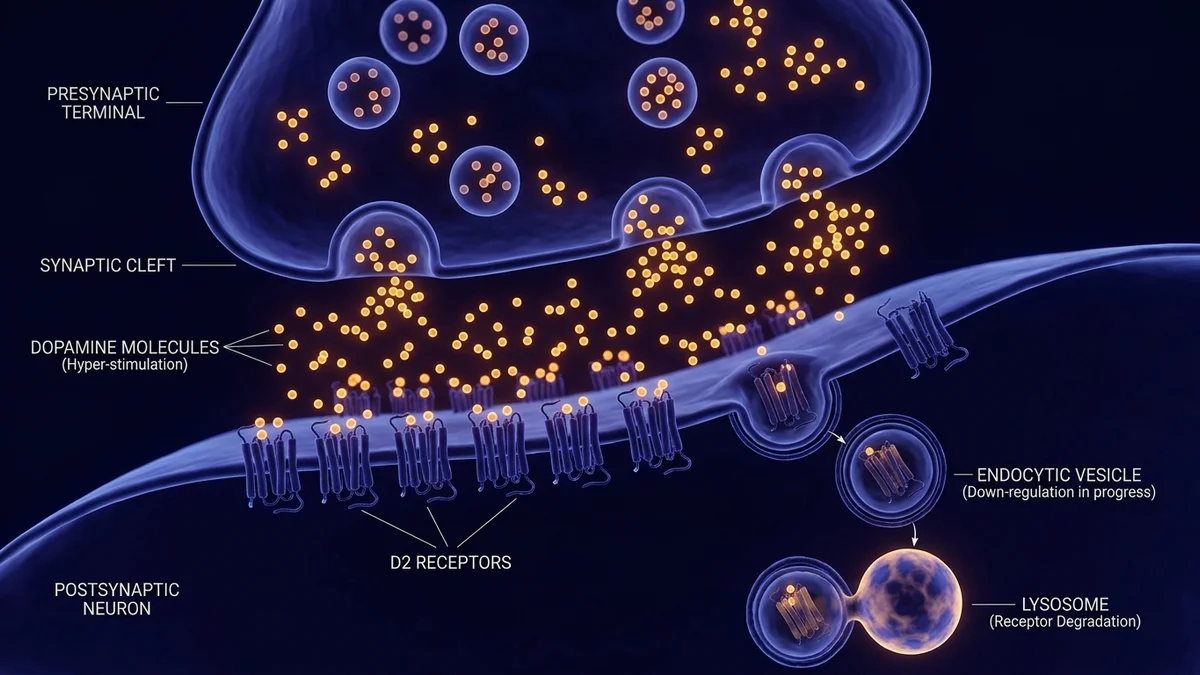
Mechanisms of D2 Downregulation: Why Drive and Willpower Collapse
When the synaptic cleft is flooded with sustained, excessive concentrations of dopamine, cellular homeostatic mechanisms intervene. Post-synaptic neurons trigger endocytosis — internalizing surface D2 receptors to attenuate the toxic excitatory cascade.
Consequently, baseline tonic dopamine levels plummet well below physiological norms. The individual enters a chronic dopamine deficit state: high-value long-term tasks (academic reading, deep work, physical training) feel excruciatingly tedious because they cannot surpass the newly elevated threshold of synaptic activation.
Dopamine encodes yearning, anticipation, and reward prediction rather than passive pleasure.
Neurons internalize receptor sites to protect against pathological overstimulation.
Every artificial dopamine spike triggers an equal and opposite rebound into anxiety and craving.
Receptor density recovers back toward baseline within 3 weeks of deliberate sensory fasting.
The Pleasure-Pain Balance: Homeostatic Neuroadaptation
Neuroimaging investigations confirm that pleasure and pain are co-processed within overlapping neural networks that function like a teeter-totter. Every rapid surge of artificial dopamine is swiftly counterbalanced by a compensatory tilt toward dysphoria, restlessness, and anxiety.
This neuroadaptation explains compulsive behavioral cycles: individuals reflexively pursue another round of digital stimulation to escape the neurochemical dip, further entrenching receptor downregulation.
«Dopamine is not the molecule of reward itself; it is the molecule of anticipation, craving, and pursuit. When the brain is bombarded with supraphysiological stimuli, it protects neurons from excitotoxicity through the only mechanism available: downregulating D2 receptors. The inevitable consequence is anhedonia — a neurochemical inability to experience joy from ordinary life.»
Dr. Anna Lembke, Professor of Psychiatry at Stanford University School of Medicine, Author of Dopamine Nation
Prefrontal Hypofrontality and Executive Dysfunction
As the mesocortical dopamine pathway becomes depleted, the prefrontal cortex (PFC) — the neurological governor of impulse control, executive function, and long-term planning — loses effective top-down regulation over limbic impulses.
This condition, clinically termed hypofrontality, manifests as fragmented attention spans, brain fog, and emotional volatility. The fatigued brain shifts into an emergency conservation state, resisting cognitive strain.
- Establish a digital-free morning buffer: avoid smartphones for 60–90 minutes after waking.
- Decouple behavioral cues: eliminate dual-stimulation habits, such as watching screens while eating.
- Implement a weekly 24-hour Digital Sabbath completely disconnected from algorithm-driven feeds.
- Utilize deliberate cold exposure (1–2 minutes of cool showering) to elicit a sustained 250% increase in baseline dopamine without a compensatory crash.
Evidence-Based Protocol: Fasting for D2 Receptor Upregulation
Neuroplasticity ensures that this receptor depletion is fully reversible. Restoring physiological D2 density requires a period of systematic sensory recalibration — an intentional dopamine fast spanning 14 to 30 days.
Functional neuroimaging shows that 3 weeks of conscious digital moderation restores D2 receptor density by 65–80%. Foundational pillars of neurorecovery include slow-wave sleep optimization, high-intensity aerobic exercise, cold water immersion, and deliberate periods of unstimulated contemplation.