

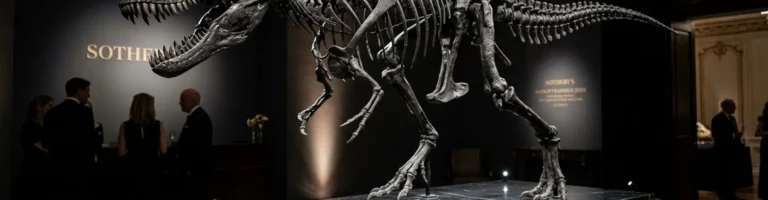

In October 2026, Sotheby’s auction house in New York unveiled one of the most anatomically pristine predatory dinosaur skeletons discovered: a Nanotyrannus lancensis specimen nicknamed “Jodi”, estimated between $6 million and $9 million. The impending commercial transfer has reignited fierce global debate between paleontologists validating a distinct dwarf apex predator taxon and proponents of ontogenetic T. rex synonomy.
Exceptional Preservation: Recovery from the Hell Creek Formation
Jodi was excavated from private ranch lands in eastern Montana within sandstone strata of the terminal Maastrichtian Hell Creek Formation (dating to roughly 66.5 million years ago). Rapid burial in low-energy fluvial overbank deposits prevented post-mortem scavenging and secured exceptional permineralization.
Fossil preparators invested over 14,000 technician hours exposing the specimen. Across 191 preserved bones, standouts include a completely uncrushed cranium with intact dentition, an undisturbed pelvis, and elongated cursorial hindlimbs contrasting sharply with the robust pillars of adult megatheropods.
Forelimb Disparity: Grasping Weapons Versus T. Rex Vestiges
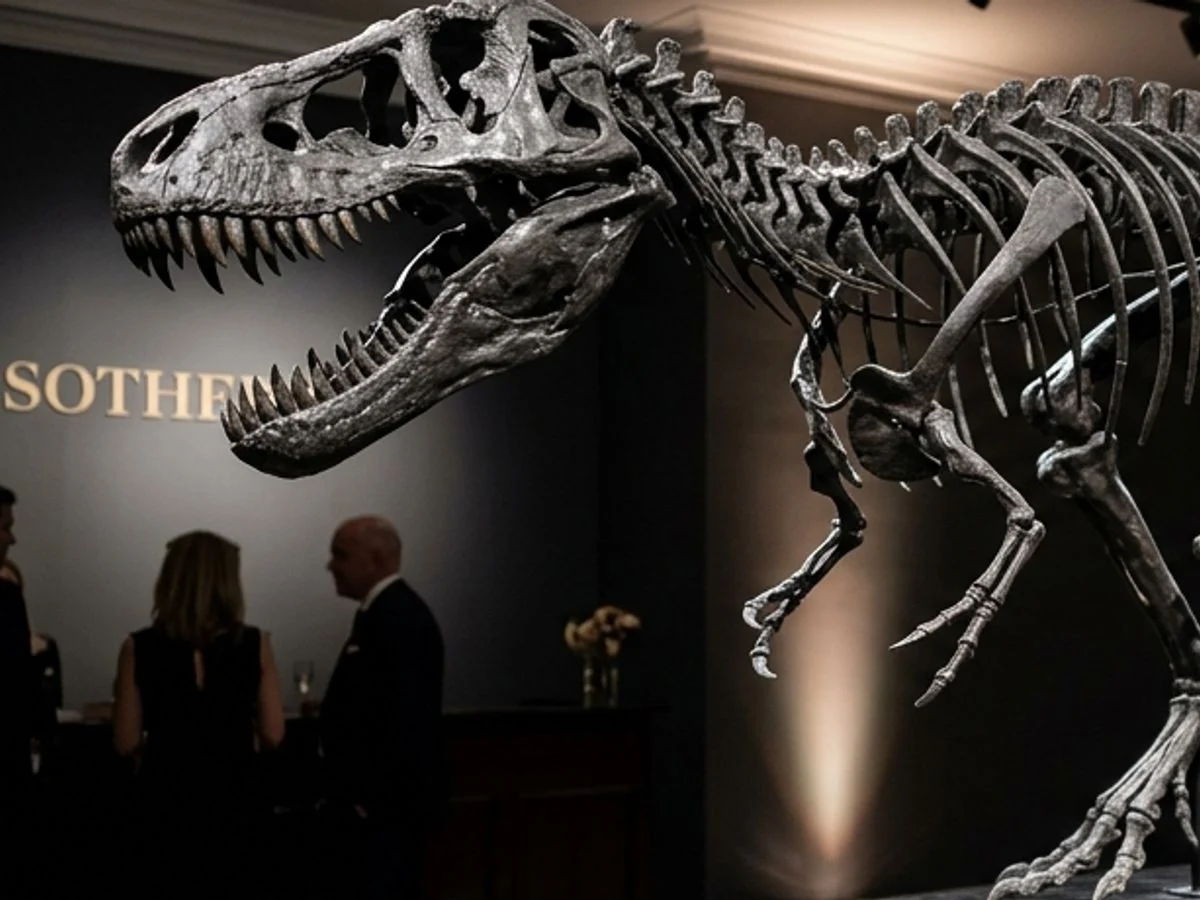
A central morphological dispute centers on forelimb proportions. Relative to total body length, Jodi’s manual and brachial elements are substantially longer, more heavily ossified, and more mechanically mobile than those of a 12-meter adult Tyrannosaurus rex.
The humerus possesses expansive deltopectoral crests for powerful adductor musculature, while recurrent ungual phalanges provided formidable prey-securing mechanics. Comparative biomechanics suggests Nanotyrannus deployed active predatory forelimb grasping, unlike the vestigial limbs of giant tyrannosaurs.
Pristine articulated skeleton recovered from Montana’s Hell Creek Formation.
High-profile Sotheby’s auction spotlighting commercial fossil trends.
Substantially larger and more robust arms than adult Tyrannosaurus rex.
Lines of arrested growth verify a skeletally mature adult animal, not a juvenile.
Bone Histology: External Fundamental Systems Refute Juvenile Status
Critics long argued that all putative Nanotyrannus fossils merely represented juvenile T. rex specimens frozen in exponential growth phases. However, high-resolution micro-CT histological sections of Jodi’s cortical bone revealed an External Fundamental System (EFS)—a diagnostic structural band of avascular bone formed exclusively upon skeletal maturation.
Cortical growth rings indicate Jodi died between 14 and 17 years of age. A juvenile T. rex of comparable size would exhibit osteocyte lacunae and rapid radial plexiform vascularization typical of exponential mass acquisition.
«Specimen Jodi preserves 191 articulated skeletal elements with over 80% anatomical completeness. Histological thin-sections of the mid-diaphyseal femur show tightly compressed lines of arrested growth (LAGs), proving this animal was a fully mature adult weighing approximately one ton, not a rapidly growing juvenile T. rex.»
Dr. Nicholas Longrich, Evolutionary Paleontologist, University of Bath
Niche Partitioning: Agile Cursorial Hunter in Megafaunal Ecosystems
Locomotor reconstructions confirm Nanotyrannus occupied an ecological niche distinct from mega-tyrannosaurs, operating as a high-velocity pursuit predator targeting sub-adult hadrosaurs and pachycephalosaurs.
While adult T. rex relied on crushing bite forces exceeding 35,000 Newtons and lacked sprinting velocity above 25 km/h, the gracile 900–1,200 kg Nanotyrannus attained pursuit velocities of 45–50 km/h propelled by elongated arctometatarsalian feet.
- Presence of an External Fundamental System (EFS) in midshaft cortical bone.
- High dental alveolus count in the dentary (up to 16-17 teeth vs 11-12 in adult T. rex).
- Hyper-elongated cursorial metatarsals optimized for sustained sprint locomotion.
- Narrower binocular stereoscopic convergence angle indicative of active ambush pursuit.
Scientific Ethics: Private Auctions Threaten Public Research Access
Jodi’s public auction has reignited concerns regarding the commodification of vertebrate paleontology. The Society of Vertebrate Paleontology (SVP) issued warnings that critical holotypes acquired by private collectors risk disappearing from peer-reviewed scientific investigation.
Nevertheless, museum consortia across North America and Europe are aggregating philanthropic funds to place competing bids, seeking to preserve Jodi permanently in public research archives.