

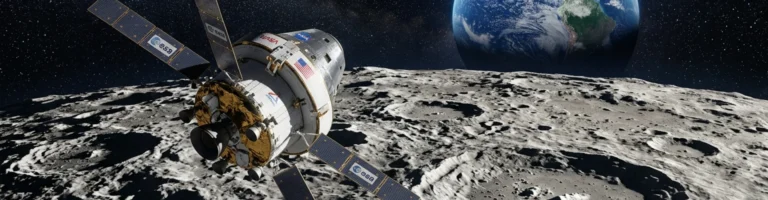

In October 2026, NASA officially released an unprecedented archive of scientific data from Artemis II, humanity’s first crewed lunar mission in over fifty years. Exceeding 800 gigabytes, the comprehensive public repository incorporates more than 11,000 ultra-high-resolution photographs captured by the crew aboard the Orion spacecraft, 8.5 hours of inflight observational audio recordings, direct optical tracking of lunar meteoroid impact flashes, and detailed radiation dosimetry from deep space.
The Historic Return of Humans to Deep Space
Launching on the Space Launch System (SLS) mega-rocket in April 2026, Artemis II ended a 54-year hiatus in human lunar exploration that had persisted since Apollo 17 in 1972. The crew of the Orion spacecraft «Integrity» comprised Commander Reid Wiseman, Pilot Victor Glover, Mission Specialist Christina Koch, and Canadian Space Agency (CSA) Mission Specialist Jeremy Hansen.
Flying a lunar free-return trajectory that arched 7,400 kilometers above the cratered far side, the four astronauts shattered the all-time human distance record from Earth, venturing beyond 400,000 kilometers into interplanetary space.
A Planetary Data System (PDS) Treasure Trove
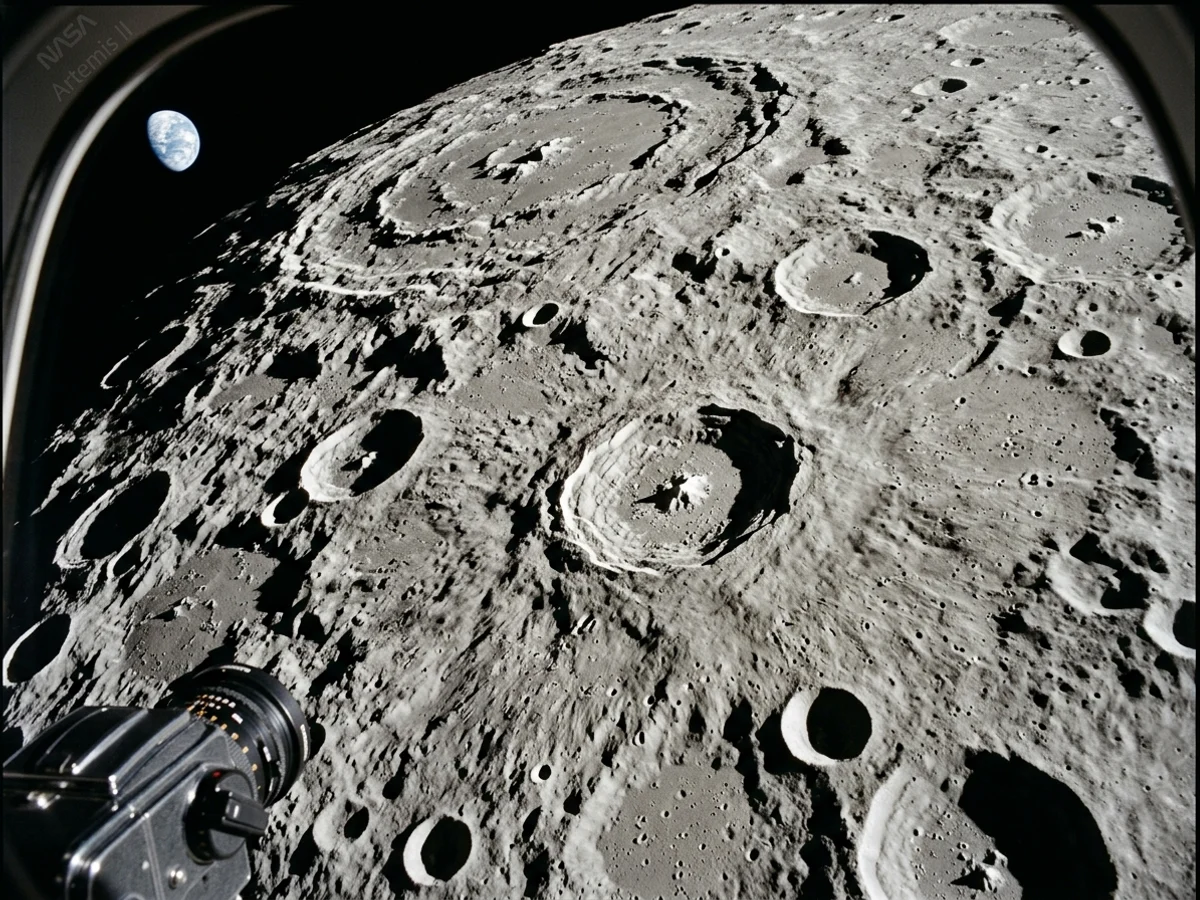
The newly published dataset represents one of the largest single lunar science releases in modern history, hosted openly on NASA’s Planetary Data System (PDS). It encompasses calibrated RAW camera files from onboard Nikon and Hasselblad bodies, 4K/60fps video streams, and panoramic external inspection arrays mounted on Orion’s European Service Module.
Among the most compelling assets are 521 minutes of voice recordings, documenting real-time geological observations of prominent features such as Mare Moscoviense, Tsiolkovskiy crater, and the vast South Pole–Aitken basin.
Unrestricted global access to 11,000 calibrated images and lunar surface spectra.
Direct optical detection of hypervelocity meteoroid collisions on the lunar night side.
Orion’s advanced polymer materials reduced deep-space ionizing radiation exposure by 25%.
High-precision far-side and polar imagery informs future crewed landing site safety.
Detecting Far-Side Impact Flashes and Debris Flux
One of the serendipitous discoveries involved the optical detection of hypervelocity meteoroid impact flashes. As Orion swept over the unilluminated lunar night side, sensitive crew-operated cameras captured brief, luminous pinpricks produced by micro-space debris striking airless regolith at speeds upwards of 60 km/s.
These observations furnish astronomers with updated empirical measurements of the local micrometeoroid flux, a vital design parameter for shielding future surface habitats and the Lunar Gateway space station.
«Trained human eyes paired with professional telephoto optics observe subtleties in regolith morphology, mineral coloration, and dynamic illumination that robotic sensors often flatten. The Artemis II dataset provides a foundational benchmark for final site selection on Artemis III.»
Reid Wiseman, Commander of NASA’s Artemis II Mission
Deep Space Radiation Dosimetry and Crew Shielding
The archive also details comprehensive findings from Orion’s Radiation Area Monitors (RAMS) and active hybrid dosimeters. Traversing the Van Allen radiation belts and operating in the unshielded cosmic ray environment, Orion evaluated new hydrogen-rich shielding configurations.
The empirical data demonstrated that secondary particle generation was suppressed, keeping cumulative crew radiation dosages 25% lower than pre-flight conservative models anticipated.
- Encompasses 521 minutes of continuous real-time astronaut geological commentary.
- Established an all-time crewed distance record from Earth exceeding 400,000 kilometers.
- Yields empirical micrometeoroid collision rates vital for Lunar Gateway engineering.
- Fully accessible to international researchers via the NASA Planetary Data System.
Paving the Ground for Artemis III South Pole Landings
Photometric surveys conducted by Christina Koch and Victor Glover of low-angle illumination near Shackleton and Faustini craters have been integrated into landing site targeting for Artemis III. These maps identify permanent sunlight plateaus adjacent to permanently shadowed ice deposits.
«Our observations provide the practical roadmaps that will guide Artemis III astronauts down into the treacherous terrain of the lunar south pole», remarked mission specialist Jeremy Hansen.
A New Paradigm of Open Lunar Exploration
Releasing over 800 GB of pristine raw data highlights NASA’s commitment to open, collaborative exploration. Research institutions worldwide now possess direct access to the primary observational foundations of the Artemis generation.
The success of Artemis II confirms that humans can safely navigate the deep-space radiation regime, setting the operational stage for sustainable lunar settlement and eventual crewed expeditions to Mars.