

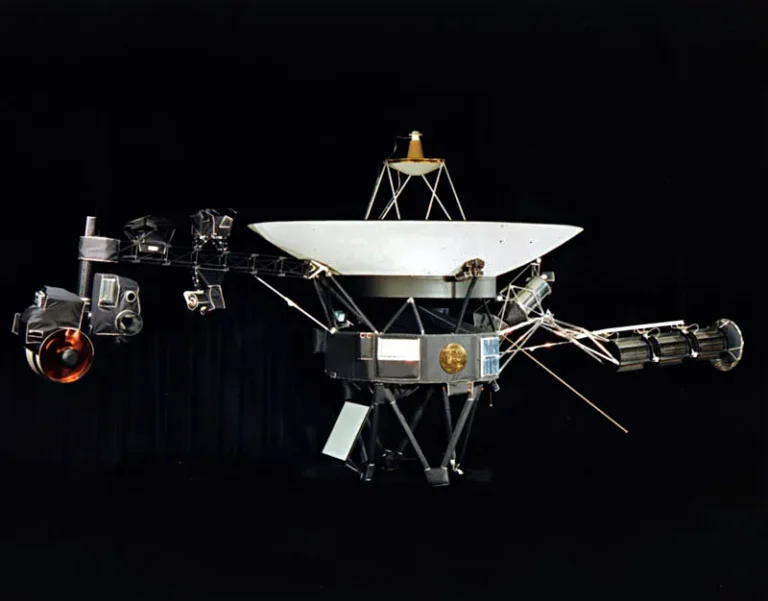

The Voyager 1 spacecraft, currently drifting through interstellar space at an incredible distance of over 24 billion kilometers from Earth, has faced another existential threat. The fuel tubes for the thrusters responsible for keeping the probe oriented became critically clogged. To save the mission, engineers at NASA’s Jet Propulsion Laboratory (JPL) executed an incredibly complex remote operation to switch to a backup set of thrusters. This maneuver required a delicate balancing of the spacecraft’s remaining energy to avoid freezing the probe in the cold expanse of space.
The Anatomy of the Problem: Why the Probe’s “Arteries” Are Clogging
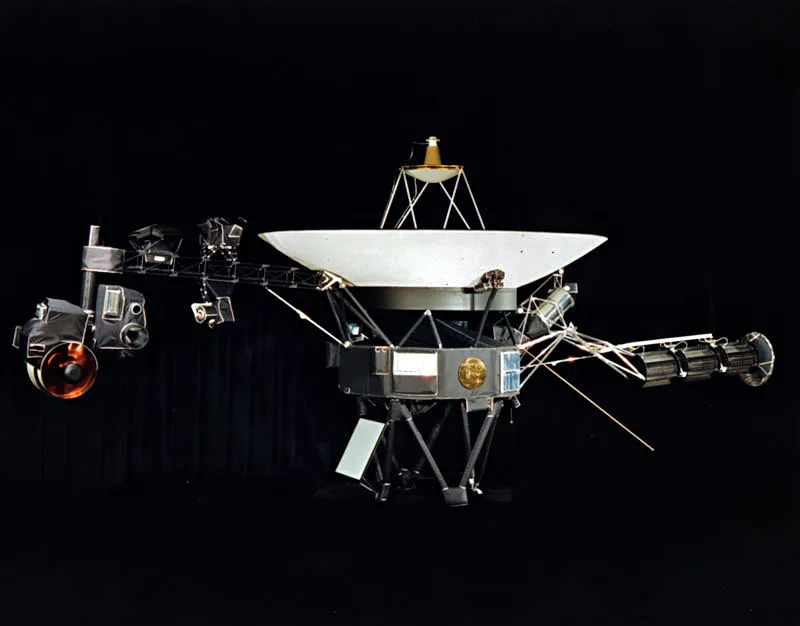
Launched in 1977, Voyager 1 uses small thrusters to maintain its orientation in space. This is vital so that the probe’s main antenna remains pointed directly at Earth, ensuring communication with the Deep Space Network. Without this link, the spacecraft would become an unresponsive piece of metal.
The thrusters run on hydrazine fuel. Over the decades of flight, a rubber diaphragm inside the fuel tank has slowly degraded, releasing silicon dioxide. This byproduct began settling in the tiny fuel tubes (capillaries), narrowing their internal cross-section. By 2024, the clogging had reached a critical level: in some tubes, the opening had narrowed from an initial 0.25 mm to a catastrophic 0.035 mm.
An Energy Crisis at the Edge of the Solar System
The solution might seem obvious—switch to another set of thrusters (the spacecraft has three branches of thrusters: two for trajectory correction and one for attitude control). However, in its 47th year of flight, Voyager 1 is suffering from a severe power shortage. The radioisotope thermoelectric generators (RTGs), powered by the decay of plutonium-238, lose wattage every year.
“All the decisions we will have to make going forward are going to require a lot more analysis and caution than they once did”
Suzanne Dodd, Voyager project manager at NASA’s Jet Propulsion Laboratory
To fire up the backup thrusters, they first needed to be heated. But there was no spare power available on board to turn on the heaters. Turning on additional systems without shutting down others would have overloaded the power grid and triggered an emergency shutdown of the entire spacecraft.
A Delicate Deep-Space Operation
After extensive analysis, NASA engineers made a risky decision: temporarily turn off one of the probe’s main heaters for up to an hour to free up enough power for the backup thruster heaters. This was a massive gamble, as in the freezing interstellar environment, any loss of heat could lead to irreversible freezing and damage to the fragile electronics.
The operation was conducted in several stages:
- August 2024: Risk assessment and running simulations on Earth.
- September 2024: Sending the command to turn off the main heater and turn on the thruster heaters. Given the distance, it took the signal 22.5 hours to reach Voyager one way.
- Receiving Confirmation: Another 22.5 hours later, engineers received telemetry confirming that the switch was successful and the spacecraft had not frozen.
What Does This Mean for the Mission’s Future?
The successful switch to the less-clogged trajectory correction thrusters (which will now be used for attitude control) has granted the Voyager 1 mission a few more years of life. This incredible technical achievement stands as a testament to the supreme quality of the original 1970s engineering and the ingenuity of today’s NASA specialists.
The spacecraft continues to transmit unique scientific data from interstellar space, where no human-made object has ever flown before. But as energy resources inexorably dwindle, scientists will have to make increasingly difficult decisions to keep humanity’s greatest explorer alive.
К слову об экстремальных условиях в космосе: недавно мы рассказывали, how the lava exoplanet HD 3167 b maintains its gas envelope against the laws of physics.
Sources: Official press release by NASA JPL.
Read also:
Parkinson’s Disease Can Be Detected by Belly Button Smell: New Discovery