



Dark energy may not require exotic particles, hidden dimensions, or a rewrite of the Standard Model, according to a new theoretical framework published in The Astrophysical Journal. Researchers argue that the accelerated expansion of the universe could emerge naturally from well-established quantum interactions.
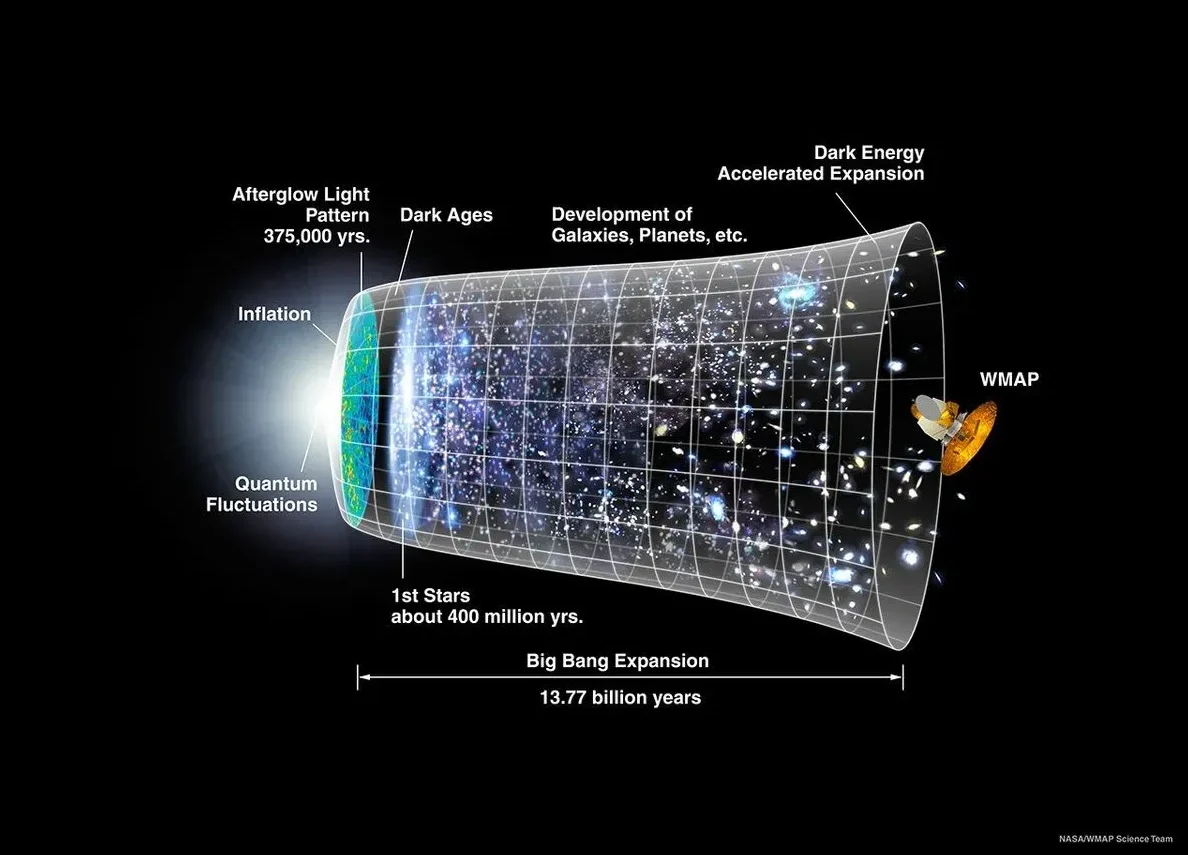
Since the late 1990s, astronomers have known that the cosmos is not merely expanding in the aftermath of the Big Bang—its expansion is speeding up. To explain this cosmic acceleration, cosmologists proposed dark energy, a mysterious component acting like antigravity that accounts for roughly 70 percent of all matter and energy in the universe.

Why Vacuum Energy Was Called Physics’ Worst Prediction
For nearly three decades, physicists have struggled to identify what dark energy actually is. One of the earliest and most intuitive proposals linked it to vacuum energy—an underlying background energy woven into empty space itself.
In quantum field theory, even seemingly empty spacetime teems with “virtual” particles flickering in and out of existence at microscopic scales. Because energy gravitates, their collective presence should exert a gravitational influence on the cosmos. On paper, it looked like an elegant bridge between the largest force in the universe and the smallest scales of reality.
Yet when physicists calculated the expected vacuum energy density, they hit a catastrophic wall. Standard estimates produced a number roughly 120 orders of magnitude larger than what astronomers observe in space—a discrepancy of a 1 followed by 120 zeros. Known as the cosmological constant problem, this gap drove decades of speculation about unknown physics, much like modern experiments testing gravity and fundamental physical interactions.
Dark energy makes up almost 70 percent of the total matter-energy content driving cosmic acceleration.
Naive quantum field theory calculations overestimated vacuum energy by 120 orders of magnitude.
Quantum chromodynamics governs quarks and gluons bound together by the strong nuclear force.
The observed energy scale emerges directly from known physical constants without artificial tuning.
How Quantum Chromodynamics Reframes the Cosmic Vacuum
The new research revisits this long-standing paradox using advances in quantum chromodynamics (QCD), the established theory describing how quarks and gluons interact via the strong nuclear force. Rather than treating vacuum energy as a simple sum of free-particle fluctuations, the authors examined the intricate structure of the QCD vacuum coupled with gravity.
In QCD, the vacuum is far from featureless emptiness—it is shaped by complex topological properties and gluon condensates. When these non-trivial quantum effects are evaluated within an expanding spacetime, the resulting energy density aligns remarkably closely with the dark energy scale measured by modern cosmology.
“The idea that the quantum vacuum as described by QCD could have the right properties to account for the accelerated expansion of the universe is very intriguing,”
Dong Ha Lee, lead author and Ph.D. researcher at the University of Sheffield, UK
Bad News for Time Machines and Exotic Cosmology
Over the years, cosmologists have proposed dozens of speculative explanations for dark energy, ranging from hypothetical scalar fields and undiscovered particles to modifications of Einstein’s general relativity. Some ideas read like pure science fiction, invoking negative-energy particles that could theoretically permit wormholes, faster-than-light travel, or time machines.
If the QCD vacuum hypothesis holds up under further scrutiny, those extravagant alternatives may turn out to be unnecessary. Instead of rewriting physics from scratch, the universe’s greatest mystery could be rooted in the same strong nuclear force that holds atomic nuclei together—complementing other efforts to probe extreme physical environments, from cosmic scales down to extreme scientific frontiers on Earth.
“Our theoretical framework suggests no new particles may be required at all. The characteristic energy scale predicted from the QCD vacuum and gravity comes out close to the observed dark-energy scale today without having to introduce an ad hoc new field or a new parameter.”
Dr. Ariel Zhitnitsky, co-author at the University of British Columbia (UBC), Canada
UBC researcher Dr. Ludovic Van Waerbeke emphasized in a university statement that the most striking outcome of the study is seeing the observed dark-energy scale emerge naturally from known physical constants, without any additional fitting parameters.
Testing the Hypothesis With Euclid and Vera C. Rubin
Any compelling cosmological theory must ultimately face precision astronomical data. The research team now plans to refine its mathematical calculations so the model can yield sharp, testable predictions for how cosmic expansion evolves across different epochs.
- ESA’s Euclid Space Telescope: Designed specifically to map the dark universe, Euclid is scheduled to deliver its first major cosmology insights next year.
- Vera C. Rubin Observatory: Surveying billions of galaxies from Chile, the observatory will measure cosmic structure growth and expansion history with unprecedented precision.
- Next-Generation Benchmarks: Comparing these observations against QCD-derived expansion curves will determine whether standard particle physics truly explains dark energy.
Dark energy may not be a mysterious fifth force or a sign of exotic new particles, but an emergent consequence of quantum chromodynamics and gravity. Upcoming observations from Euclid and the Vera C. Rubin Observatory will soon put this Standard Model explanation to the test.