

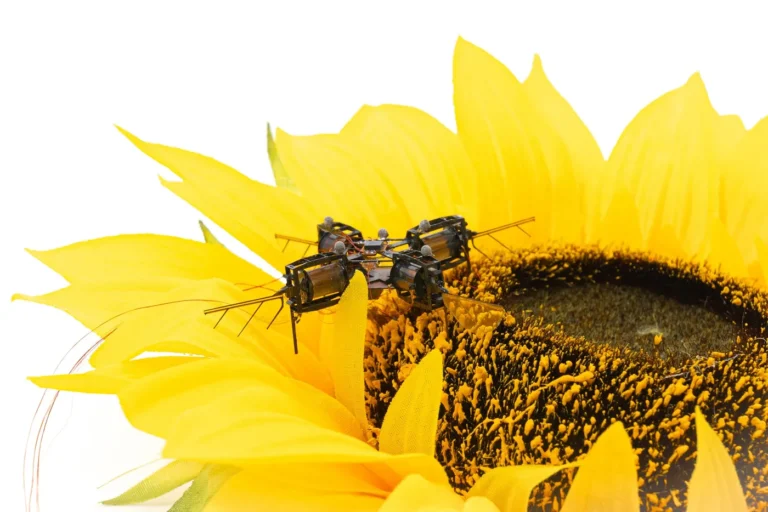

A micro-scale aerial vehicle no larger than a standard bumblebee darts between greenhouse foliage, effortlessly counteracts turbulent air drafts, and touches down with pinpoint accuracy onto the center of a blossoming yellow sunflower. While this scene might seem like a dark chapter lifted directly from dystopian science fiction, it is a tangible milestone achieved by robotics engineers at the Massachusetts Institute of Technology (MIT). Yet beneath this exhilarating mechanical triumph lies an unsettling philosophical question: are autonomous flying robots offering a dangerous technological band-aid for an Earth where living pollinators are being pushed to extinction?
MIT’s Engineering Marvel: The First Aerial Microrobot With an Onboard Brain
For decades, developing insect-scale flying robots has been obstructed by an unforgiving physics limitation. Conventional avionics, microprocessors, and guidance sensors weighed far too much for featherweight wings capable of lifting only a gram or two. Consequently, previous iterations of «robobees» functioned merely as tethers: reliant on thin external power cables or guided by external laboratory motion-capture camera arrays and high-powered desktop computers.
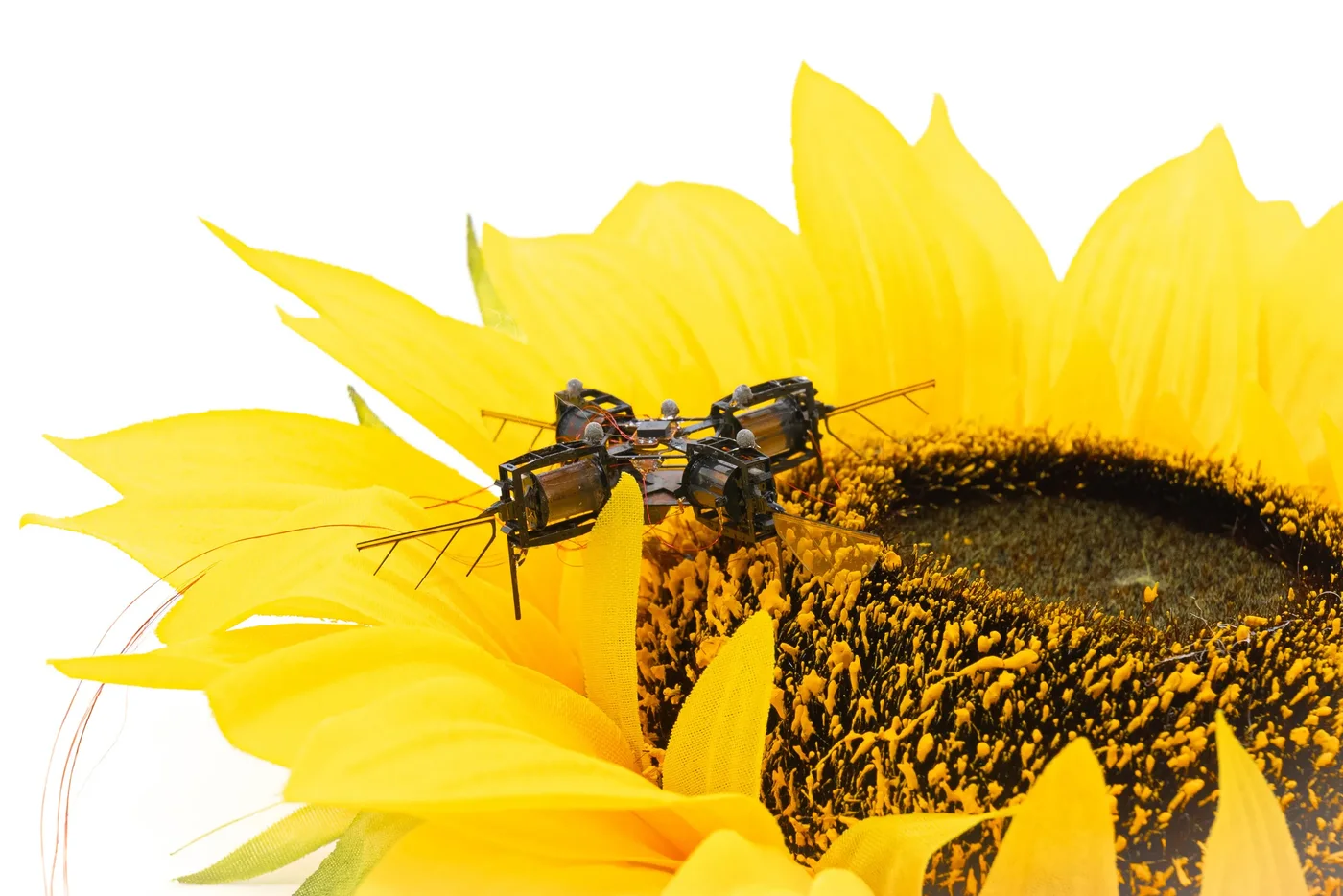
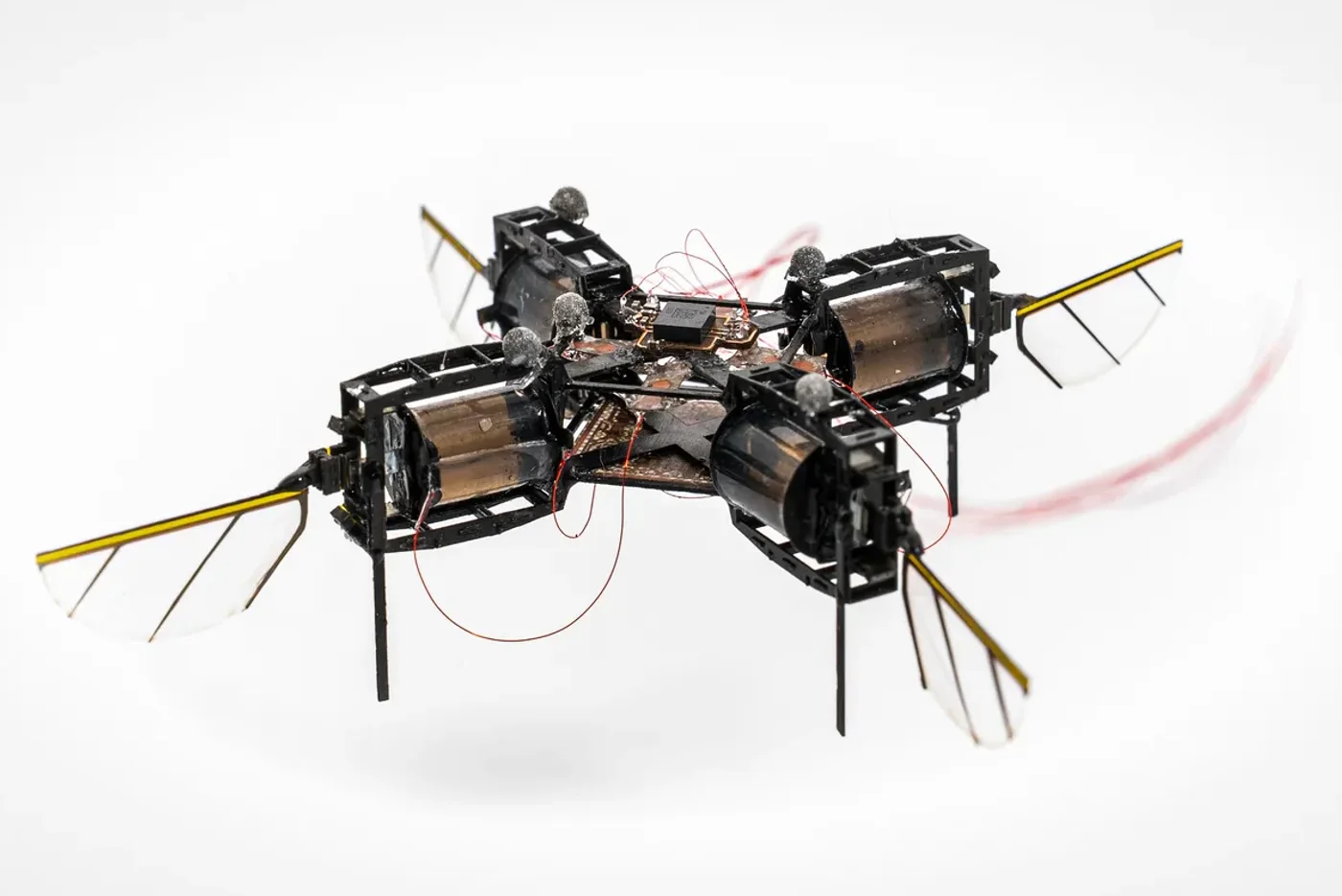
A team of MIT researchers led by Kevin Chen, Associate Professor in the Department of Electrical Engineering and Computer Science, has shattered this paradigm by demonstrating the first sensory and compute-autonomous insect-scale aerial robot. Weighing a total of 1.29 grams, the microrobot carries an ultralight onboard avionics package weighing an astonishing 244 milligrams — lighter than a standard paperclip.
This miniature avionics suite integrates an onboard microcontroller running custom flight-control algorithms, an optical-flow sensor tracking velocity relative to the ground, a micro-LiDAR time-of-flight distance sensor, and an inertial measurement unit (IMU). As a result, the artificial insect senses its environment, maintains balance, and steers autonomously toward target flowers without any external camera infrastructure.
Soft Artificial Muscles: Biomimetic Resilience at Micro-Scale
To generate sufficient lift to carry this onboard computer brain, the engineering team bypassed conventional rotary electric motors, which suffer severe efficiency degradation at millimeter scales. Instead, MIT engineers developed dielectric elastomer actuators — soft artificial muscles fabricated from alternating elastomeric layers and carbon nanotube electrodes.
Under high-voltage electrical fields, the soft polymers contract and expand rapidly, driving the flapping wings at frequencies exceeding 400 beats per second, closely mimicking the aerodynamics of a bumblebee. By optimizing actuator geometry with a 50% increase in size, the team achieved a 46% increase in lift force, providing the vehicle with the exact power surplus needed for autonomous navigation.
Furthermore, these compliant artificial muscles exhibit extraordinary physical resilience. Unlike brittle micro-gearboxes, the soft robot can collide with glass walls, tumble, and recover in mid-air without structural failure, presenting promising use cases in confined space exploration, pipeline inspection, and disaster response.
«This is the first demonstration of an aerial microrobot that is sensory and compute autonomous, carrying its own guidance electronics and sensors.»
Kevin Chen, Associate Professor in MIT’s Department of Electrical Engineering and Computer Science
The Technofix Illusion: Why Robotic Drones Cannot Replace Living Bees
In popular media coverage, breakthroughs like MIT’s autonomous microrobot are frequently heralded as potential saviors for agriculture, suggesting that fleets of robotic pollinators could seamlessly step in to fertilize commercial orchards if honeybees disappear. However, science editor Josh Davis and leading agroecologists emphasize that relying on artificial bees is a perilous techno-fix illusion.
The scale of natural pollination defies mechanical replication. A single healthy honeybee colony contains between 30,000 and 60,000 workers that collectively visit millions of blossoms each day across dozens of square kilometers, interpreting complex floral scents, pollen viability, and ultraviolet nectar guides. Deploying drone swarms across global crop fields would demand hundreds of millions of robotic units, vast mining of lithium and rare-earth elements, and would generate massive microplastic and electronic debris across agricultural soils.
More fundamentally, bees and other pollinators are an irreplaceable keystone of planetary ecology. Insects comprise over two-thirds of all terrestrial animal species, underpinning food webs for birds, bats, reptiles, and mammals. A silicon microbot can deposit pollen grains, but it cannot feed insectivorous birds, cycle soil nutrients, or maintain the living tapestry of global ecosystems.
The avionics package integrates a microcontroller, optical flow sensor, and micro-LiDAR without external cameras.
Compliant carbon nanotube actuators beat over 400 times per second, absorbing collisions without damage.
Over 75% of flying insect biomass has vanished over 30 years from pesticides, habitat loss, and climate instability.
Robotic drones cannot support global food chains or substitute for living biosphere biodiversity.
The Real Insect Apocalypse: Preserving Life Over Machines
Peer-reviewed ecological surveys indicate that flying insect biomass has plummeted by more than 75% across European nature reserves over the past three decades. The culprits behind this crisis are well-documented: pervasive neonicotinoid pesticides, intensive industrial monocultures, habitat loss, and climate destabilization.
Pouring capital into artificial robotic pollinators while failing to curtail toxic chemical agriculture represents a profound societal failure. Restoring wildflower corridors, transitioning toward regenerative farming, and enforcing pesticide bans cost a fraction of high-tech alternatives while safeguarding real ecological resilience.
MIT’s flying microrobots stand as an inspiring triumph of miniature robotics and physical engineering with genuine utility in search-and-rescue, environmental monitoring, and micro-inspection. But they must remain tools of scientific exploration — not a monument to human failure to protect a living biological heritage that took over one hundred million years to evolve.
- The MIT microrobot weighs just 1.29 grams, making it the lightest compute-autonomous flapping-wing craft ever built.
- Its optical-flow visual guidance algorithm mimics the neural velocity processing found in biological fruit fly retinas.
- Over 80% of major agricultural food crops worldwide rely directly on insect pollination for yield and fruit quality.
- The global economic value of natural insect pollination services is estimated at over $500 billion annually.