

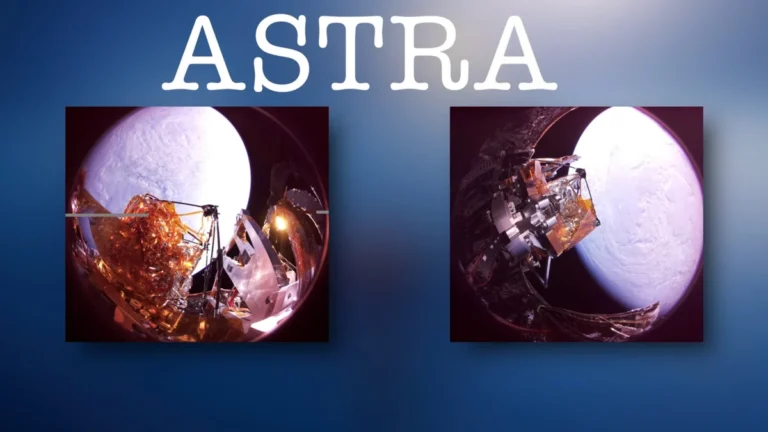

A monumental milestone in space exploration and automated orbital engineering has officially been achieved: an autonomous robot built structure in space with zero real-time human physical intervention. The experimental ASTRA (Autonomous In-Space Tensioned Reflector Assembly) payload, conceptualized and engineered by researchers at the California Institute of Technology (Caltech) under DARPA’s NOM4D program, successfully constructed a structural radio antenna perimeter truss hundreds of kilometers above Earth. This triumphant achievement fundamentally redefines the architecture of spaceflight, dismantling the physical constraints historically imposed by rocket payload fairings.
How an Autonomous Robot Built a Structure in Space: The Mechanics of ASTRA
Since the dawn of the Space Age, aerospace engineers have operated under a brutal design compromise: everything launched into orbit must fit inside the cylindrical confines of a rocket fairing, typically no wider than 3 to 5 meters. Deployable systems like the origami-folded sunshield of the James Webb Space Telescope require decades of testing, astronomical budgets, and present severe mission-critical risks—if a single deployment cable snaps or a hinge binds, billions of dollars can be lost in an instant.
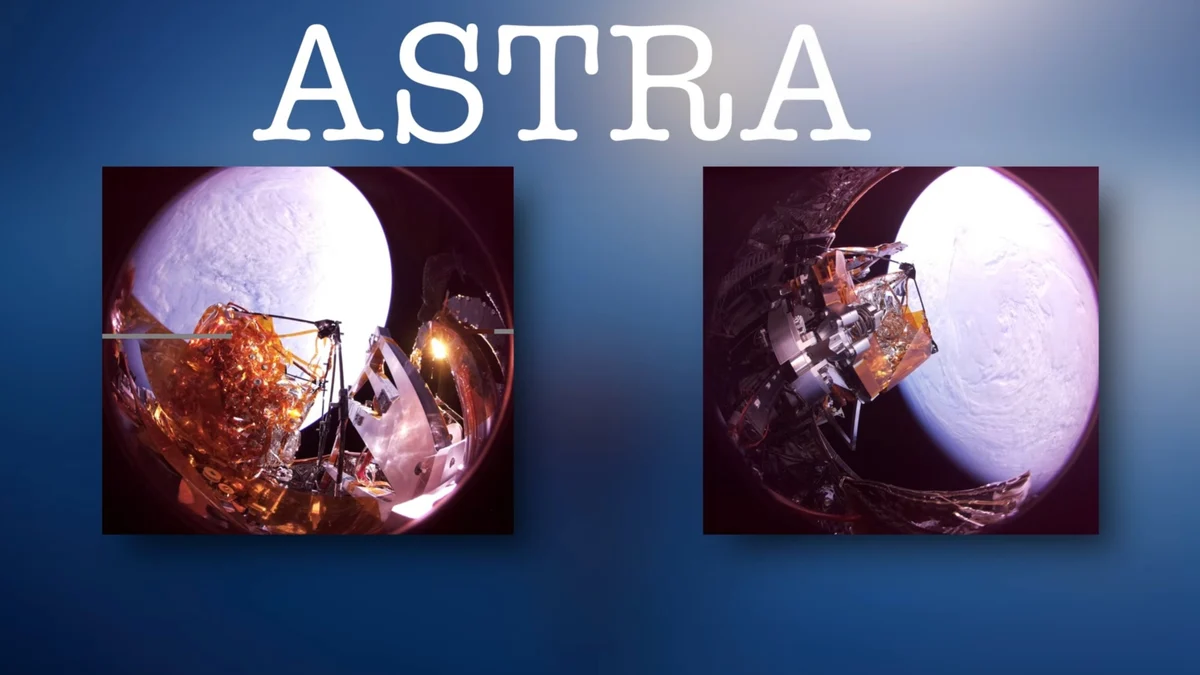
The ASTRA (Autonomous In-Space Tensioned Reflector Assembly) demonstration adopted a radically different paradigm. Rather than folding an enormous structure on Earth, Caltech engineers designed a miniature autonomous manufacturing and assembly payload occupying roughly one cubic meter. Launched on March 30, 2026, aboard Momentus Inc.’s Vigoride 7 orbital service vehicle as part of the SpaceX Transporter-16 rideshare, the payload contained carbon-fiber composite truss tubes, aluminum joiner nodes, and a Kapton reflective polymer film stored within motorized dispensers. Using a precision robotic arm, the system methodically retrieved individual components and fastened them into rigid truss bays, demonstrating that true uncrewed in-space manufacturing is now a functional reality. This mirrors our previous reporting on how scientific research aboard orbital platforms is pushing human capability beyond terrestrial limits.
The construction took place under harsh orbital conditions characterized by intense vacuum and orbital thermal swings exceeding 150 degrees Celsius between solar illumination and Earth eclipse. According to mission leaders, the robotic manipulator executed its mechanical assembly routine completely autonomously via onboard algorithms, with ground engineers reviewing high-definition telemetry and verification imagery during scheduled daily communication windows.
DARPA NOM4D Initiative: Shifting from Earth Fabrication to In-Orbit Assembly
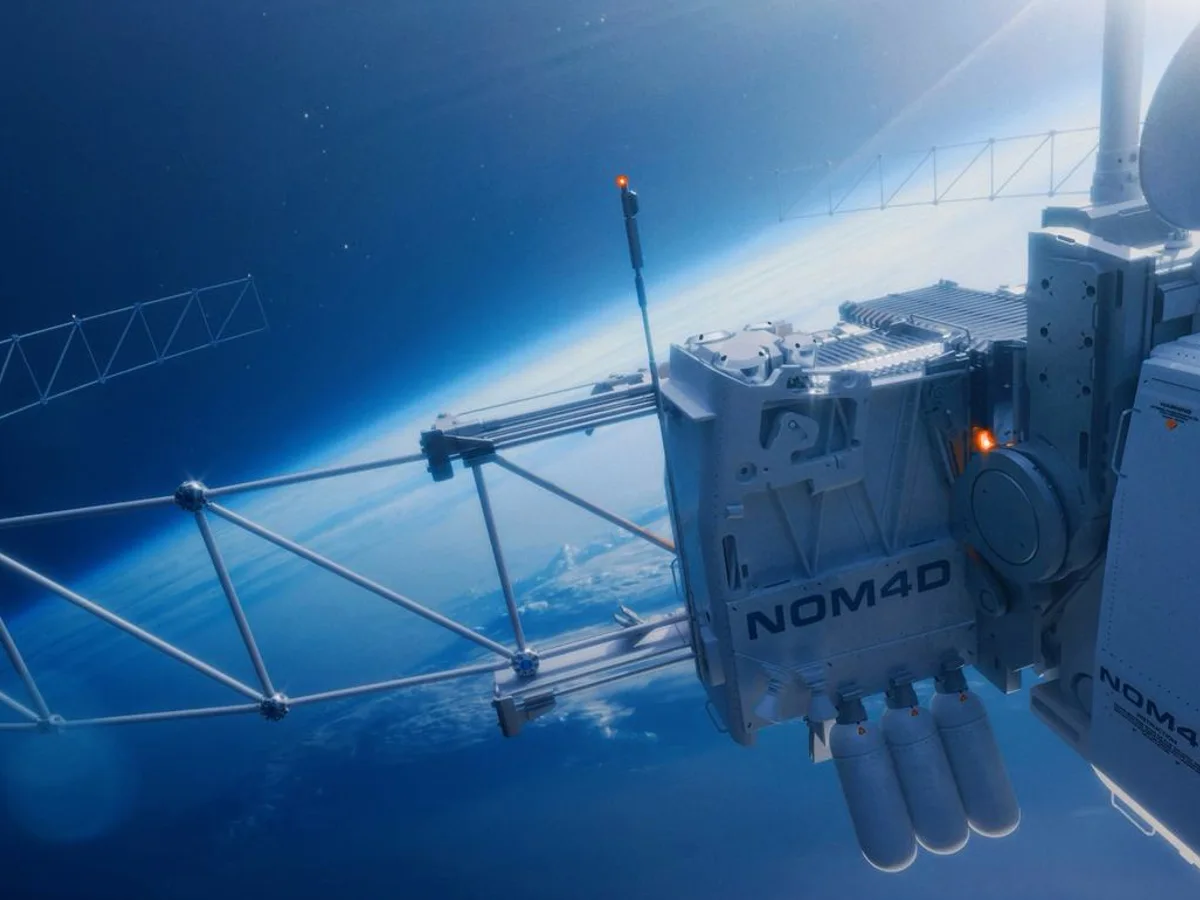
The success of ASTRA marks a key validation for Phase 3 of the Defense Advanced Research Projects Agency’s (DARPA) NOM4D (Novel Orbital and Moon Manufacturing, Materials, and Mass-efficient Design) initiative. The core vision of NOM4D is to pioneer a fundamental industrial transition: cease building fragile structures on Earth and instead launch compact, dense raw materials to be manufactured directly in orbit.
Conventional satellites must be heavily reinforced to survive the punishing acoustic and vibrational g-forces of launch (often 10–12 g). This forces spacecraft frames to be heavy, thick, and inefficient. In the vacuum of microgravity, however, those terrestrial load requirements vanish. In-space robotic assembly enables the creation of ultra-lightweight, gossamer-thin structures spanning hundreds of meters or even kilometers while requiring only a fraction of the mass. As detailed in the official press release on the California Institute of Technology (Caltech) news portal, this breakthrough paves the way for new structural concepts.
Momentus Inc.’s Vigoride 7 space tug provided essential bus services, including solar power, avionics, thermal dissipation, and space-to-ground communications. This collaborative success between academic institutions, commercial space logistics, and defense research demonstrates that automated in-space manufacturing is ready for operational scaling.
«The ASTRA mission provides definitive proof-of-concept that we are no longer bound by the dimensions of a rocket fairing. Autonomous robotic builders can construct infrastructure of virtually unlimited scale in microgravity, laying the foundation for a true orbital industrial revolution.»
Sergio Pellegrino, Professor of Aerospace and Civil Engineering at Caltech and ASTRA Principal Investigator
Overcoming Microgravity Dynamics: Inertia, Thermal Expansion, and Kapton Tensioning
Operating a construction robot in low-Earth orbit introduces profound physical challenges distinct from terrestrial robotics. In microgravity, any mechanical force exerted by a robotic wrist to snap a truss into place produces an equal and opposite reaction that threatens to rotate the host spacecraft or displace the structure.
To mitigate this issue, Caltech engineers engineered specialized dual-locking end effectors and sophisticated reaction-damping control loops. The robotic arm navigated components at deliberate speeds of only a few millimeters per second, virtually eliminating inertial shocks. Furthermore, tapered interlocking pins allowed components to seat smoothly despite thermal contraction or expansion induced by rapid day-night orbital cycling.
Tensioning the reflective Kapton membrane posed an equally demanding problem. In space, ultra-thin polymer films readily accumulate static charges and crumple. ASTRA’s micro-winch tensioning apparatus successfully pulled the reflective film flat against the perimeter truss, maintaining millimeter-precise parabolic focal geometry.
The robotic builder retrieved parts from dispensers and fastened truss bays using preprogrammed kinematics without real-time joystick control from Earth.
Constructed from carbon-fiber tubes and aluminum nodes to achieve exceptional structural rigidity with virtually negligible launch weight.
Tapered joints and precision tensioners preserve structural alignment across punishing temperature extremes from −100°C to +120°C.
Engineered specifically to scale into automated swarms capable of constructing kilometer-wide space solar power stations and giant telescopes.
Space Solar Power and Giant Orbital Telescopes: The Future of ASTRA Technology
The long-term significance of ASTRA extends far beyond a 1.4-meter antenna prototype. This technology forms the structural backbone for Caltech’s visionary Space Solar Power Project (SSPP). The SSPP initiative aims to assemble kilometer-scale solar energy harvesting constellations in geosynchronous orbit that capture unfiltered solar radiation 24/7 and beam clean electrical energy to Earth via microwave phased arrays.
No currently planned heavy-lift launch vehicle—not even SpaceX’s Starship or Blue Origin’s New Glenn—possesses a payload volume capable of launching a pre-assembled kilometer-wide solar array. In-space robotic fabrication from modular, stackable components is the only viable path to realizing space-based base-load clean energy.
Additionally, ASTRA-style autonomous construction opens the gateway to next-generation space telescopes with apertures measuring 30 to 100 meters across. Such monumental observatories will enable direct optical resolution of terrestrial exoplanets, atmospheric biosignature spectroscopy, and unprecedented imaging of the universe’s earliest cosmological structures.
- Shattering fairing bottlenecks: in-space robotic assembly enables structures dozens of times larger than any launcher payload envelope.
- Payload mass optimization: launching high-density modular raw components drastically reduces launch costs per square meter of deployed antenna.
- Eliminating single-point deployment failures: modular latching avoids the brittle failure modes of multi-hinge deployment systems.
- Catalyst for space solar power: directly validates the construction methodology required for gigawatt-scale orbital solar energy collectors.