

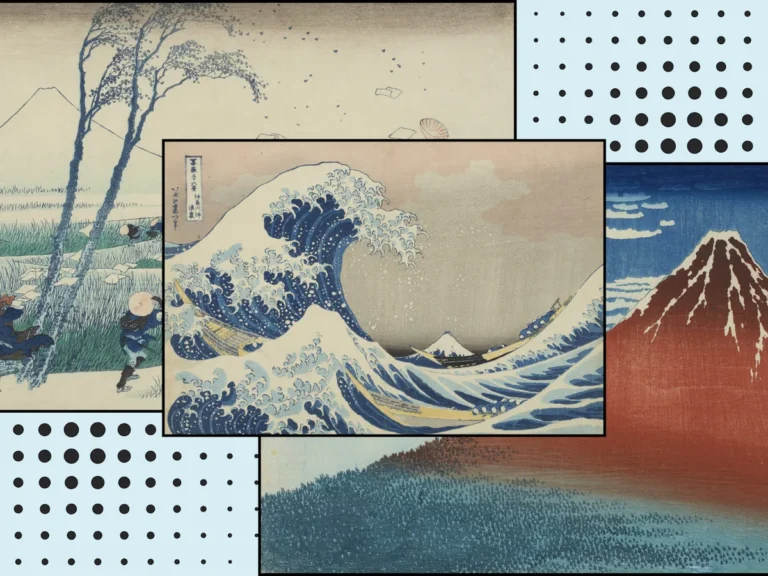

Katsushika Hokusai’s Under the Wave off Kanagawa — globally celebrated as The Great Wave — is arguably the most recognizable woodblock print ever created, replicated on countless posters, apparel, and digital media. Yet in popular culture, this masterwork is almost invariably severed from its artistic home: Hokusai never conceived it as an isolated catastrophe, but as one integral panel in a sweeping monumental series of 46 prints honoring sacred Mount Fuji.
Behind the Legend: The Genesis of Thirty-Six Views of Mount Fuji
In the late 1820s, Edo-period print master Katsushika Hokusai was enduring one of the bleakest chapters of his long life. Nearing his seventieth birthday, he had suffered a debilitating stroke, lost his second wife, and was saddled with ruinous gambling debts incurred by his wayward grandson. Amidst financial desperation and artistic isolation, visionary publisher Nishimuraya Yohachi (head of the revered Eijudo publishing house) proposed an ambitious landscape commission.
Originally titled Thirty-Six Views of Mount Fuji (Fugaku Sanjurokkei) and published between 1830 and 1833, the project triggered an immediate sensation among urban residents of Edo (modern-day Tokyo). Demand for the prints was so voracious that Nishimuraya commissioned Hokusai to design an additional ten views, known among connoisseurs as ‘Ura-Fuji’ (reverse or back views of the mountain). Consequently, the complete series comprises not 36, but exactly 46 exquisite polychrome woodblock prints.
Across all 46 prints, Mount Fuji functions as the immutable spiritual anchor of the Japanese cosmos. As revealed by scholarly investigations into iconic masterworks of art history, visionary creators embedded deep metaphysical codes within their compositions, harmonizing tempestuous natural forces with the serene eternity of the cosmos.
Prussian Blue: A Chemical and Commercial Revolution in Ukiyo-e
The phenomenal visual impact of Thirty-Six Views was propelled by a cutting-edge technological import: synthetic Prussian blue (ferric ferrocyanide), known colloquially in Japan as ‘berorin ai’ (Berlin indigo). Prior to its commercial arrival, traditional ukiyo-e artisans relied on vegetable-derived indigo or dayflower extract, pigments notoriously susceptible to oxidation, fading, and muddy blending.
Smuggled through the strictly regulated trading port of Nagasaki by Dutch and Chinese merchants, synthetic Prussian blue offered unprecedented chemical stability and radiant saturation. Hokusai capitalized on this medium by mastering ‘bokashi’ — the demanding technique of hand-wiping moist pigments across carved cherrywood blocks to achieve fluid tonal gradations, capturing deep ocean abysses, foam-tipped swells, and early-morning alpine skies.
In Under the Wave off Kanagawa, Hokusai layered Prussian blue over softer natural indigo, forging a three-dimensional sculpture of turbulent seawater. The claw-like talons of the surging wave reach menacingly toward vulnerable oshiokuri-bune cargo boats racing to deliver fresh fish to Edo’s bustling Nihonbashi market. Yet the compositional nucleus is not the wave, but distant Mount Fuji, whose snow-dusted cone perfectly mirrors the cresting contours of the surrounding swell.
«All that I have produced before the age of seventy is not worth taking into account. At seventy-three I have learned a little about the real structure of nature, animals, plants, trees, birds, fishes and insects. When I am eighty I shall have made still more progress; at ninety I shall penetrate the mystery of things.»
Katsushika Hokusai, preface to One Hundred Views of Mount Fuji (1834)
The Sacred Axis: How Viewing All 46 Prints Reshapes the Narrative
When viewed in isolation, Western audiences almost reflexively interpret The Great Wave as a terrifying disaster narrative — a testament to man’s tragic helplessness before the indifferent fury of nature. Viewing the complete suite of 46 prints comprehensively shatters this melodramatic reading. Contextualized within the entire corpus, the wave represents not a fatal cataclysm, but a rhythmic pulse within the everyday life of the archipelago.
Across companion prints, life proceeds in harmonious, humorous, and labor-intensive tranquility: coopers shave staves for a colossal sake barrel that frames Fuji through its rim; peasants haul timber; sawyers sweat over enormous logs; straw-hatted pilgrims wind up rocky volcanic paths; children fly kites over riverbeds. Fuji is ubiquitous — appearing as a tiny distant triangle on the horizon or filling the frame as a radiant giant in Fine Wind, Clear Morning (popularly celebrated as Red Fuji).
In Shinto spirituality and Edo-period folklore, Mount Fuji was worshipped as the dwelling of the goddess of immortality (the Fuji-ko pilgrimage movement). The rowers huddled in the cargo boats beneath the Great Wave are not frozen in panic; they are hunkered down in practiced unison, leaning into their oars, placing their collective faith in the ocean and the eternal deity presiding over the horizon.
Enormous public demand prompted publisher Nishimuraya to expand Hokusai’s series with 10 additional ‘Ura-Fuji’ (back view) prints.
Hokusai embraced imported synthetic ‘berorin ai’ pigment, unlocking deep chromatic gradations and enduring brilliance in ukiyo-e.
Mount Fuji anchors every print in the cycle, uniting serene village routines with the tempestuous maritime surge of Kanagawa.
Hokusai’s dynamic compositions transformed Western painting, inspiring Monet, Van Gogh, and Debussy’s orchestral masterpiece La Mer.
Treasures of the Iuchi Collection: Revelations at Tokyo’s NMWA
Our modern appreciation of Hokusai’s virtuosity was dramatically enriched by the rediscovery and public exhibition of the famed Iuchi Collection, held on deposit at The National Museum of Western Art in Tokyo (NMWA). This extraordinary repository preserves rare early-state impressions printed before the wooden matrices suffered edge wear or recarving.
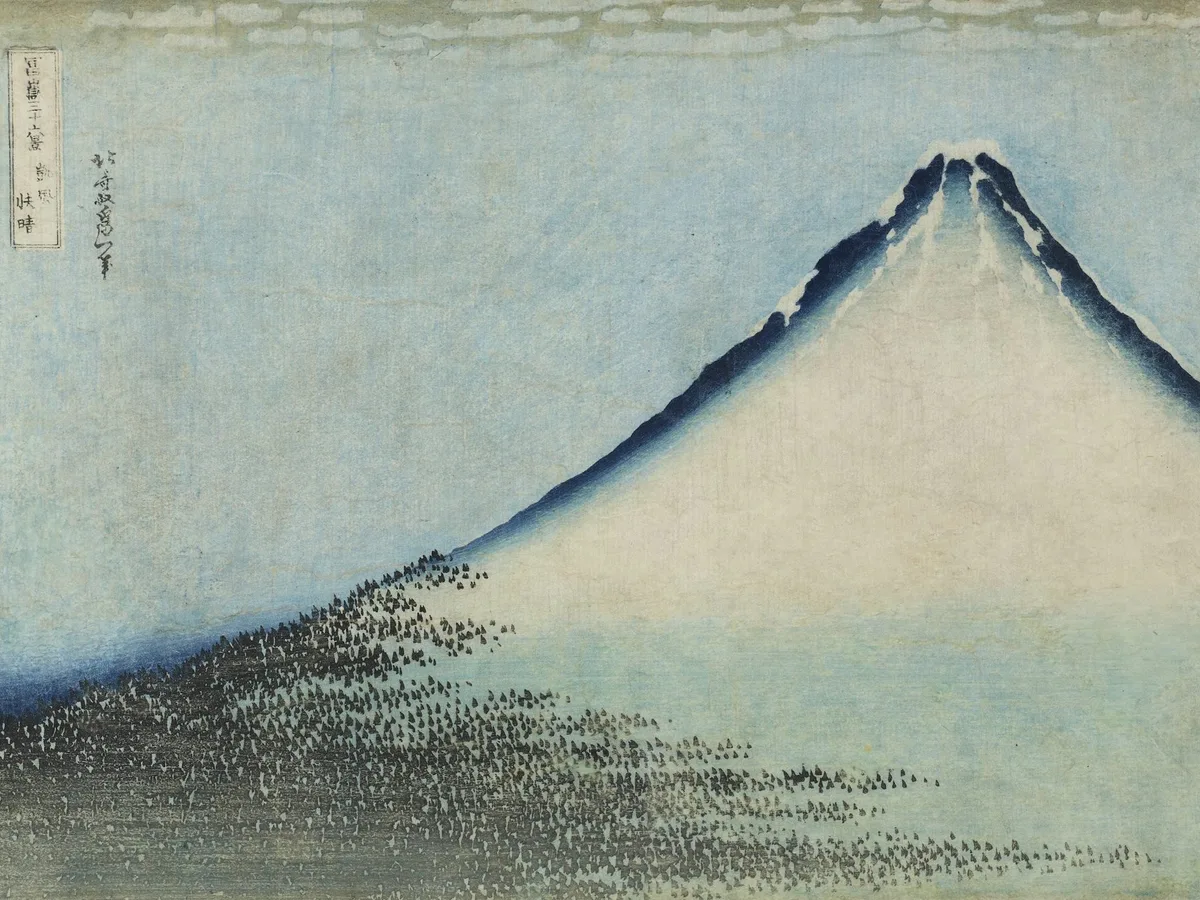
The exhibition stunned scholars by showcasing Fine Wind, Clear Morning in its ultra-rare ‘Blue Fuji’ variation. Unlike the widely reproduced later printings featuring rust-red slopes, the pristine Iuchi impression features delicate ultramarine and turquoise glazes, capturing the chilling, ethereal glow of dawn immediately before sunrise strikes the peak.
Such revelations confirm that Hokusai and his master printers constantly adjusted color schemes throughout production runs, altering the emotional resonance of individual sheets. This fluid craftsmanship elevated commercial block printing into the realm of fine art, ensuring every surviving impression possesses its own distinct personality.
- Total Print Count: 46 sheets (36 original compositions + 10 supplemental ‘Ura-Fuji’ designs).
- Publication Dates: 1830–1833 (Hokusai was between 70 and 73 years of age).
- Primary Pigment: Imported Prussian blue (berorin ai), combined with natural indigo and vegetable dyes.
- Sheet Format: Horizontal oban dimensions (approx. 25 × 38 cm / 10 × 15 inches), carved on wild cherrywood (yamazakura).
- Printing Technique: Multi-block polychrome woodcut (nishiki-e) utilizing wet-brush bokashi tonal shading.
Japonisme and the Birth of Western Modernism
When the Meiji Restoration opened Japan to global commerce in the mid-19th century, Hokusai’s woodcuts poured into Europe, igniting the fervent aesthetic revolution known as Japonisme. The radical visual grammar of The Great Wave and its sister prints liberated Western artists from the constraints of Renaissance perspective.
Impressionist and Post-Impressionist titans including Claude Monet, Edgar Degas, and Vincent van Gogh avidly collected Hokusai’s prints, emulating his cropped compositions, daring diagonal vectors, and flat color fields. French composer Claude Debussy was so profoundly captivated by Under the Wave off Kanagawa that it directly inspired his orchestral masterpiece La Mer (The Sea), and he insisted that Hokusai’s wave adorn the cover of the premier 1905 score.
Reuniting The Great Wave with its 45 sister prints restores historical justice to Hokusai’s magnum opus. It stands not as a fluke of sensationalism, but as the crowning zenith of an aging titan who dedicated his final decades to capturing the living heartbeat of Edo Japan beneath the eternal shadow of sacred Fuji.