

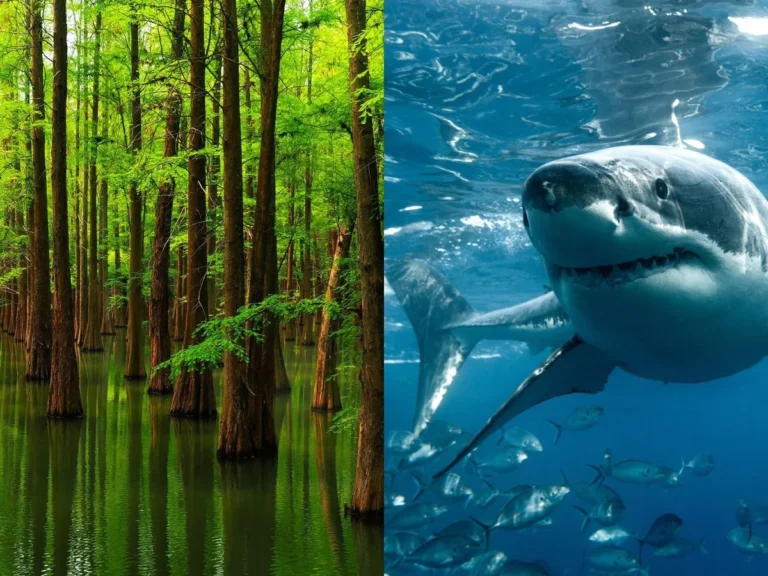

The scientific fact that sharks are older than trees has become one of the most celebrated revelations in evolutionary biology, yet behind this viral knowledge lies a fascinating story of deep-time paleontology. Decades before the first vascular plants engineered wood to conquer the continents, primitive cartilaginous fish were already navigating the depths of the Paleozoic seas as apex predators.
Paleozoic Chronology: When Cartilaginous Fish First Conquered the Oceans
To determine whether sharks genuinely predate terrestrial flora, evolutionary biologists examine microfossils preserved in Ordovician and Silurian rock strata. The earliest microscopic scales bearing the distinctive structural hallmarks of shark dermal denticles (placoid scales) date back roughly 450 to 455 million years to the Late Ordovician. Discovered in geological formations across Siberia and the Baltic basin, these minute fossils indicate that the stem lineage of Chondrichthyes (cartilaginous fishes) had already diverged from bony ancestors long before complex plants shaded dry land.
By the Early Devonian period, around 410 to 415 million years ago, undeniable fossilized teeth and fin spines of early chondrichthyans appear in the fossil record. Genera such as Elegestolepis and Doliodus problematicus exhibited modern predatory adaptations: specialized braincases, cartilaginous jaw articulation, and continuously replacing tooth whorls. This proves that the iconic shark body blueprint — sleek hydrodynamics, mineralized cartilage, and sensitive electroreceptive ampullae of Lorenzini — was swimming in world oceans tens of millions of years prior to the evolution of bark and wood.
Put into geological perspective, sharks possess an ancestry that humbles almost every terrestrial benchmark. They do not merely predate quadrupeds and dinosaurs, which arose during the Triassic period approximately 230 to 240 million years ago; they are also older than Saturn’s iconic rings, which astrophysicists now estimate formed within the last 100 to 400 million years. Studying ancient marine ecosystems offers vital clues about how paleontological analysis of ancient fossil tissues illuminates survival strategies that weathered five planetary mass extinctions.
When Did True Trees Evolve: The Green Revolution of the Devonian
The terrestrial plant kingdom underwent an arduous evolutionary transition from primitive aquatic green algae to towering forest canopies. The earliest land-colonizing plants, epitomized by Silurian fossils such as Cooksonia (dating to around 425 to 430 million years ago), were modest leafless stalks standing just a few centimeters tall. Lacking roots, secondary xylem (wood), and lignin-reinforced trunks, these pioneers were fundamentally herbs and cannot be categorized as trees.
A true tree is botanically defined by secondary growth: the ability to generate dense woody rings of xylem and an outer protective bark capable of lifting foliage tens of meters skyward. The earliest recognized tree-like organism in the geological record is Wattieza, a prehistoric cladoxylopsid fern relative uncovered in the fossil forest quarry of Gilboa, New York. Dated to roughly 385 to 386 million years ago (Middle Devonian), these organisms formed Earth’s first vertical canopies.
Shortly thereafter, around 370 to 375 million years ago, the progymnosperm Archaeopteris revolutionized terrestrial ecology. Possessing genuine wood anatomically comparable to modern conifers, Archaeopteris trunks reached heights of 30 meters and over a meter in diameter. Thus, even by the most conservative paleontological metrics, ancestral sharks had already been hunting in Paleozoic waters for 40 to 50 million years before the earliest tree cast a shadow on continental soil.
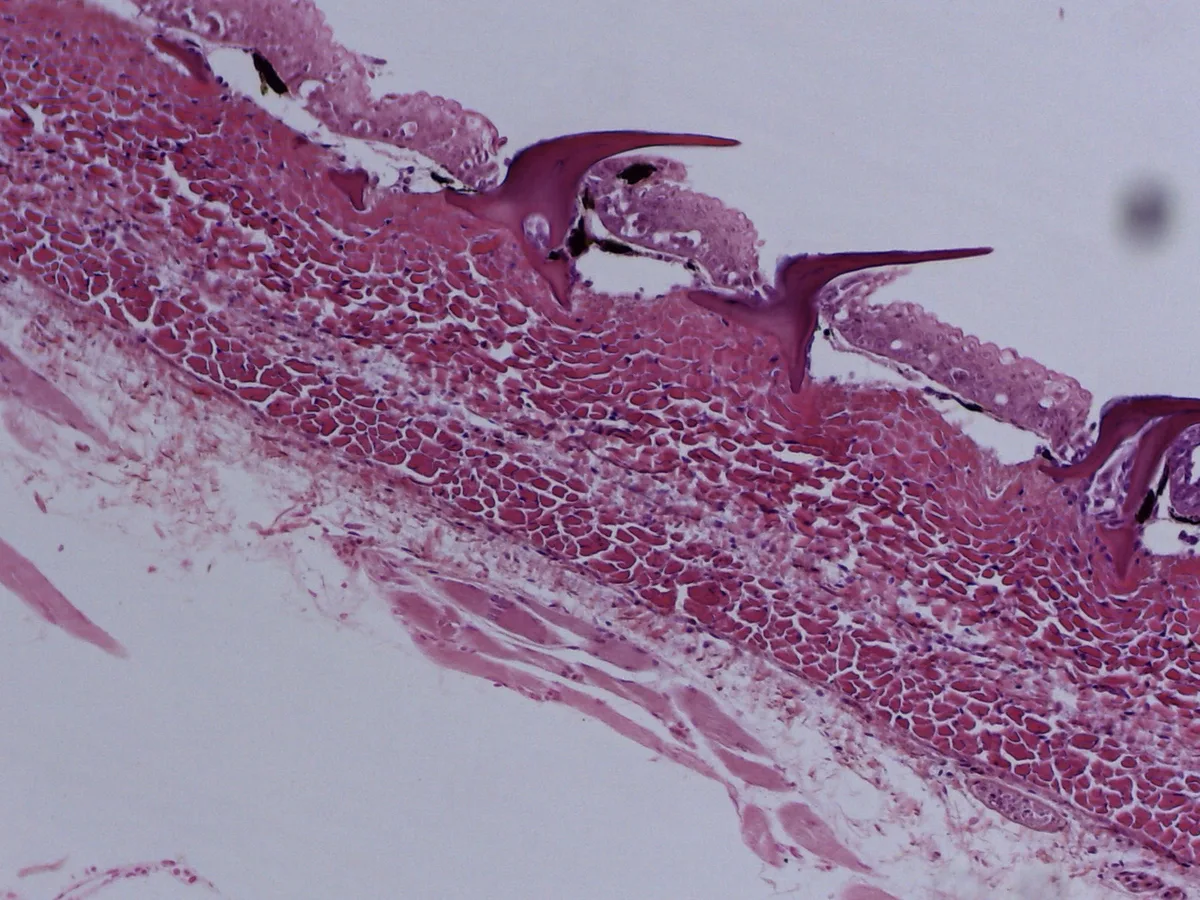
«The fossil record leaves no doubt: sharks are vastly older than trees. They ruled the waters when the continents were lifeless rocky wastelands, maintaining an essentially flawless hydrodynamic template across half a billion years.»
Emma Bernard, Senior Curator of Fossil Fishes at the Natural History Museum, London
Taxonomic Nuance: Stem Chondrichthyans vs. Modern Crown Sharks
While the phrase ‘sharks are older than trees’ holds true under phylogenetic scrutiny, taxonomists emphasize an important cladistic distinction. The conclusion depends entirely on how broadly one defines a ‘shark’. When referencing the total stem group Chondrichthyes — incorporating all extinct relatives closer to modern sharks than to bony fishes — the lineage undeniably exceeds 420 to 450 million years in antiquity.
Conversely, if one restricts the definition strictly to modern crown-group sharks (Neoselachii) — the direct ancestors of contemporary carcharhinids, lamnids, and squaloids equipped with calcified vertebral centra, protrusible jaws, and acute olfactory lobes — the timeline shifts drastically. Crown sharks did not proliferate until the Late Triassic or Early Jurassic, approximately 190 to 200 million years ago. By that era, dinosaurs dominated landscapes already carpeted by sprawling forests of ginkgoes, cycads, and seed ferns.
Nevertheless, paleoichthyologists overwhelmingly agree that the functional shark archetype remains one of evolution’s most enduring triumphs. The Late Devonian predator Cladoselache, swimming roughly 370 million years ago, was unmistakably shark-like in every outward aspect: a streamlined fusiform body, five open gill slits, stiff dorsal fins, and powerful caudal propulsion were perfected hundreds of millions of years before mammals existed.
Late Ordovician and Silurian placoid scales prove that stem chondrichthyan predators navigated oceans tens of millions of years prior to terrestrial forests.
The earliest true woody trees, Wattieza and Archaeopteris, evolved secondary xylem and lignin-rich trunks during the Middle and Late Devonian.
Cartilaginous skeletons, squalene-rich livers, and osmotic urea regulation allowed sharks to endure all five major planetary mass extinctions.
Dermal denticle riblets optimize aerodynamic efficiency, while miniature single-domain IgNAR antibodies unlock new frontiers in targeted oncology.
Biochemical Armor: How Sharks Survived Five Mass Extinctions
The extraordinary evolutionary endurance of sharks is rooted in their physiological versatility. Rather than investing metabolic energy into heavy mineralized bones like Osteichthyes, sharks opted for a pliable skeleton of prismatic calcified cartilage. This drastically lowered overall body density and energy expenditure, facilitating continuous pelagic cruising.
In place of a rigid swim bladder, sharks rely on an oversized lipid-rich liver saturated with squalene to achieve neutral buoyancy. Combined with a specialized osmoregulatory system that maintains high tissue concentrations of urea and trimethylamine oxide (TMAO), sharks can withstand radical environmental shifts in salinity, water temperature, and ocean chemistry. This biochemical resilience allowed them to survive the Ordovician-Silurian, Late Devonian, Permian-Triassic ‘Great Dying’, Triassic-Jurassic, and Cretaceous-Paleogene extinction events.
Protecting these ancient ocean denizens remains an imperative in the face of modern ecological disruption. Conservation research demonstrates that multi-year moratoriums on commercial fishing in critical aquatic corridors can effectively revive delicate marine biodiversity before ancient lineages disappear.
- Stem Cartilaginous Fishes (Sharks): ~450–420 million years ago (Late Ordovician – Silurian).
- Earliest True Woody Trees (Wattieza, Archaeopteris): ~385–370 million years ago (Middle – Late Devonian).
- First Dinosaurs: ~230–240 million years ago (Triassic period).
- Saturn’s Rings: Estimated by Cassini data to be only 100–400 million years old.
- Crown Modern Shark Families (Neoselachii): Diversified ~190–200 million years ago during the Jurassic period.
A 450-Million-Year Legacy: Lessons for Modern Science and Bionics
The ancient anatomy of chondrichthyans continues to inspire groundbreaking advances in engineering and medicine. The micro-riblets of placoid shark skin, which mitigate drag by suppressing turbulent vortices along the boundary layer, have been adapted into biomimetic coatings for aircraft fuselages, wind turbine blades, and high-performance maritime vessels.
Furthermore, the primordial yet exceptionally robust immune system of sharks produces heavy-chain single-domain antibodies known as IgNARs (immunoglobulin new antigen receptors). Due to their minute molecular dimensions, these antibody fragments can access cryptic epitopes within dense human tumors and cross physiological barriers that block standard human antibodies, offering exciting potential for targeted cancer therapies.
Ultimately, recognizing that sharks are older than trees is far more than trivia: it is a poignant reminder of evolutionary majesty. We share Earth with apex predators whose structural architecture was tested and perfected across half a billion years, surviving cosmic impacts and continental drifts that reduced ancient forests into subterranean seams of coal.