

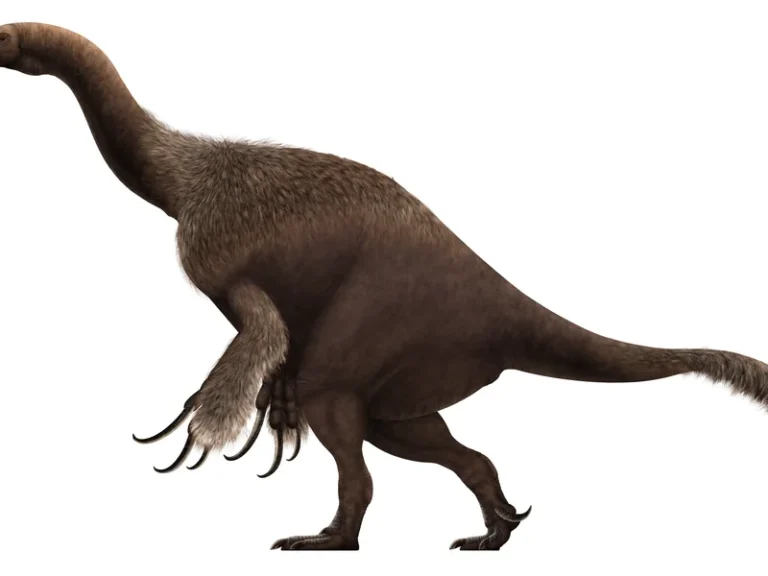

The extraordinary dinosaur Therizinosaurus (Therizinosaurus cheloniformis) wielded the most gigantic claws of any land animal in geological history: when covered with their living keratin sheaths, they extended over one meter (3.3 feet) in length. In popular dinosaur media and cinema, this bizarre Late Cretaceous theropod is routinely depicted as an aggressive slasher capable of disemboweling apex carnivores with effortless ease. However, rigorous engineering simulations have permanently overturned this fearsome reputation: the animal was actually a slow-moving, pot-bellied, feathered herbivore, and its meter-long scythes were structurally too fragile for combat, serving instead as extravagant visual tools for sexual display and social posturing.
The Bone Scythes of the Gobi Desert: Discovering Therizinosaurus
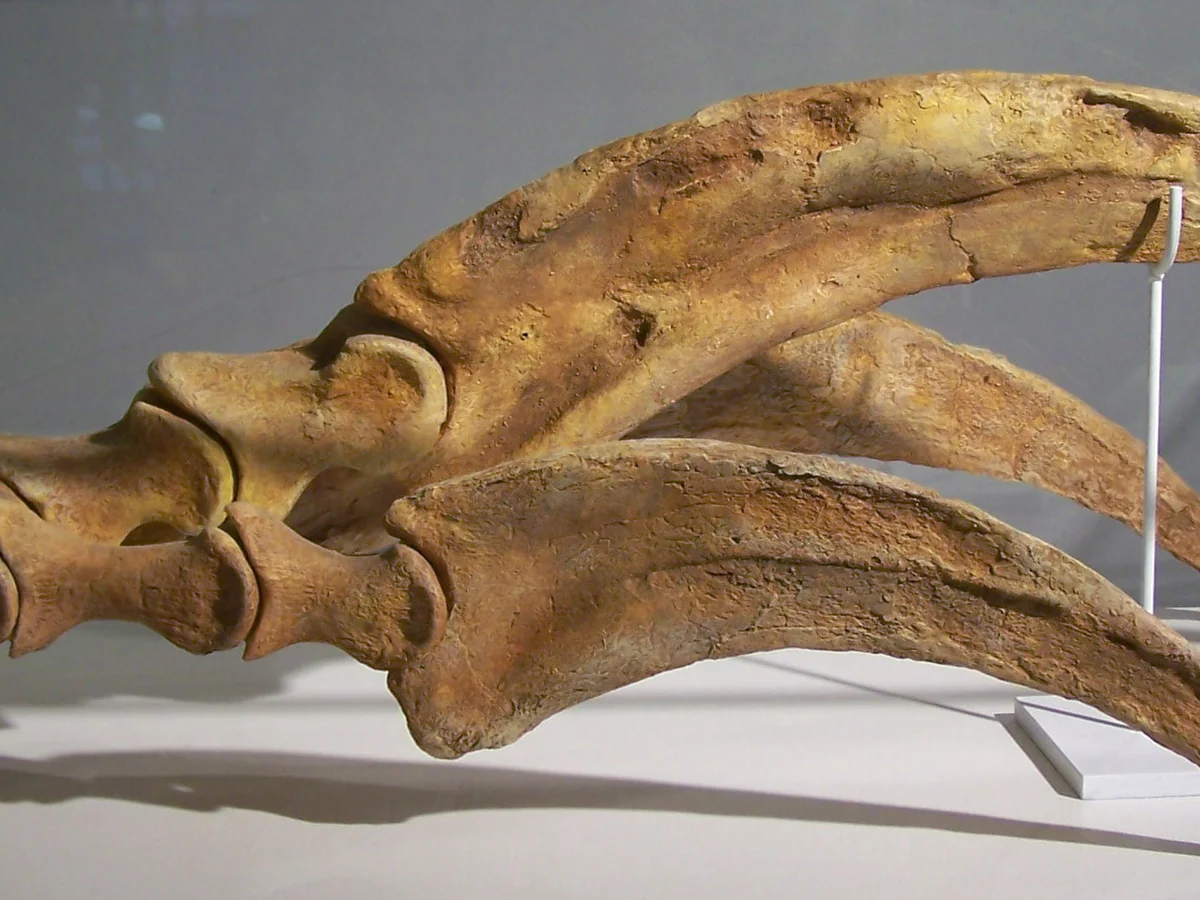
The scientific saga of one of paleontology’s most enigmatic creatures began in 1948 amidst the wind-swept, sun-scorched strata of the southern Gobi Desert in Mongolia. A joint Soviet-Mongolian paleontological expedition led by the esteemed academic and science fiction pioneer Ivan Efremov was excavating the fossil-rich deposits of the Nemegt Formation. Among diverse fossil skeletons, researchers unearthed several astonishing curved bones: gigantic, laterally flattened ungual claws that stretched roughly 70 centimeters in their bare fossilized mineral state.
In 1954, prominent Soviet paleontologist Evgeny Maleev published the formal description of the holotype, giving the taxon the binomial name Therizinosaurus cheloniformis, which translates to ‘scythe lizard shaped like a turtle.’ Maleev erroneously hypothesized that the fossil belonged to a titanic marine reptile related to sea turtles, speculating that the meter-long claws functioned as underwater sickles used to harvest marine vegetation. Only decades later, following discoveries of more complete skeletons of close kin like Alxasaurus and Segnosaurus in Mongolia and northern China, did scientists recognize its true identity as an aberrant theropod.
Therizinosaurs belong to the theropoda, the broad branch of bipedal saurischians that encompasses carnivorous luminaries such as Allosaurus, Velociraptor, and Tyrannosaurus rex. Yet the proportions of Therizinosaurus stunned paleontologists. Its complete forelimb measured an astonishing 2.4 meters (nearly 8 feet) long, terminating in three elongated fingers capped with massive claws. In life, covered by a dense horn sheath of keratin, the complete ungual surpassed 1 meter (3.3 feet) in total curve length, outstripping any other terrestrial appendage known to science.
For decades, researchers debated how the animal deployed these lethal-looking attachments. Competing hypotheses suggested it tore through massive termite mounds like modern anteaters, stripped thick bark from Cretaceous trees, hooked high tree branches, or slashed at encroaching predators. Verifying these hypotheses required moving beyond speculative morphology into the realm of modern digital engineering and biomechanical stress analysis.
An Anatomical Paradox: The Frankenstein Herbivore of the Cretaceous
Therizinosaurus cheloniformis was such an anatomical oddity that paleontologists frequently refer to the family Therizinosauridae as the ‘Frankensteins of dinosaurs.’ Reaching lengths of 9 to 10 meters and weighing roughly 5 metric tons, the creature walked upright on stocky, four-toed hind legs resembling tree trunks. Unlike typical slender theropods, its pelvic girdle was enormously flared outwards, creating an expansive abdominal bowl designed to house a voluminous, multi-chambered fermentation gut suited for digesting tough plant matter.
The body was capped by a long, slender neck supporting a disproportionately tiny skull equipped with a keratinous beak (rhamphotheca) and rows of small, leaf-shaped teeth with fine serrations. These dentitions were completely ill-suited for puncturing flesh or hunting prey. Furthermore, exceptionally preserved fossils of related Chinese taxa like Beipiaosaurus demonstrated that therizinosaurs were cloaked in a dense coat of primitive filamentous feathers, giving them the appearance of an enormous, shaggy avian cross between an ostrich, a sloth, and a giant panda.
This pacified botanical lifestyle directly conflicted with the presence of meter-long, sword-like appendages. In modern cinematic blockbusters, such as Jurassic World: Dominion, Therizinosaurus is dramatized as a ferocious, blinded horror capable of impaling massive apex carnivores like Giganotosaurus. However, the physical reality of bone biomechanics strictly refutes this sensationalized battle prowess.
The fossil bone core reached 70 cm; with its living keratin sheath, the complete claw curved over 1 meter (3.3 feet).
Despite theropod ancestry, Therizinosaurus possessed a toothless beak and a massive gut adapted exclusively for vegetation.
Finite Element Analysis (FEA) confirmed the claws suffered mechanical failure under simulated slashing or soil digging.
The giant blades functioned like a peacock’s plumage: used for sexual courtship, dominance signaling, and visual bluff.
Finite Element Analysis: Why the Claws Were Structurally Too Weak for Combat
A definitive resolution to the claw enigma arrived with a landmark study led by paleobiologist Zichuan Qin of the University of Bristol and the Institute of Vertebrate Paleontology and Paleoanthropology (IVPP) in Beijing, published in the high-impact journal Communications Biology. Qin and an international team of researchers subjected theropod claws to Finite Element Analysis (FEA)—a sophisticated computer modeling protocol commonly used by civil and aerospace engineers to evaluate structural failure thresholds under physical stress.
The researchers generated ultra-high-resolution 3D digital scans of claw unguals across a wide array of theropods and living animals, modeling both the internal trabecular bone geometry and the protective keratin sheath. They simulated diverse mechanical actions, including forceful substrate digging, predatory piercing and slashing against animal flesh, high-force foliage hooking, and static load bearing.
The simulations yielded an unambiguous outcome: while the claws of earlier, smaller therizinosauroids and alvarezsaurids possessed the structural robustness required for digging or pulling branches, the hyper-extended claws of Therizinosaurus failed catastrophically under simulated functional stresses. Due to their extreme length, severe lateral compression, and narrow base, executing a high-impact slash, digging into soil, or violently wrestling a branch generated massive bending moments. The localized stresses instantly exceeded the fracture threshold of the bone, guaranteeing severe breakage.
The research concluded that Therizinosaurus could not have utilized its claws for physical combat against contemporaneous apex predators like the tyrannosaurid Tarbosaurus bataar. Striking a predator would have left the herbivore with painfully fractured unguals and crippled digits.
«Our functional space analyses revealed that the gigantic claws of therizinosaurs were mechanically unsuitable for high-stress activities, functioning instead primarily as visual display organs.»
Zichuan Qin, Paleobiologist at University of Bristol and Institute of Vertebrate Paleontology and Paleoanthropology
Sexual Selection and Intimidation: The True Purpose of Meter-Long Blades
If the claws were mechanically unsuited for survival labor, what evolutionary pressure drove them to such gigantic proportions? The authors concluded that the claws evolved under the potent influence of sexual selection and visual communication. Nature abounds with morphological traits that develop far beyond utilitarian necessity, from the magnificent tail train of the peacock to the unwieldy claws of fiddler crabs and the monumental antlers of the extinct Irish elk (Megaloceros).
Qin and his colleagues demonstrated that as therizinosaurs grew in body mass over geological time, the mechanical utility of their claws diminished as their visual prominence increased. In earlier small-bodied ancestors, claws functioned effectively as hooks to bring high vegetation within reach of the beak. However, in five-ton giants, the appendages transformed into prominent social flags. By spreading its long, feathered arms and posturing with meter-long keratin scythes, a Therizinosaurus could broadcast dominance, resolve territorial disputes, and establish hierarchy without engaging in costly physical violence.
Furthermore, flawless, elongated claws signaled genetic vitality, high foraging efficiency, and robust metabolic health to prospective mates. During courtship rituals, individuals likely brandished their glistening blades in elaborate visual choreography. It was a triumph of evolutionary bluff and behavioral posturing over brute physical violence.
- Therizinosaurus cheloniformis lived 70 million years ago in the Nemegt Formation of Mongolia’s Gobi Desert.
- First uncovered in 1948 by Ivan Efremov, it was originally misidentified by Evgeny Maleev as a giant marine turtle.
- Digital FEA testing in Communications Biology revealed the claws lacked the structural strength for physical combat.
- The meter-long appendages evolved through sexual selection as visual ornaments for courtship and territorial posturing.
Evolutionary Significance in the Late Cretaceous Ecosystems of Mongolia
Unraveling the mystery of the claws illuminates the complex ecological tapestry of the Nemegt Basin approximately 70 million years ago. Therizinosaurus coexisted alongside immense hadrosaurs like Saurolophus, titanic sauropods like Nemegtosaurus, and the apex predator Tarbosaurus. With its immense vertical reach, the animal occupied an exclusive ecological niche, browsing high-canopy Cretaceous foliage inaccessible to smaller herbivores.
Even if the claws were too delicate for offensive impalement, their visual intimidation value was immense. An apex predator would hesitate before confronting a five-ton, five-meter-tall feathered giant rearing onto its hind legs while spreading broad, feathered arms adorned with glistening three-foot scythes. In the high-stakes game of survival, the illusion of lethal weaponry was more than sufficient to persuade carnivores to seek easier prey.
The groundbreaking work of Zichuan Qin and his team underscores how deceptive superficial anatomy can be in fossil interpretation. Evolutionary form does not always follow brute physical function; frequently, nature’s most bizarre designs are the sophisticated handiwork of courtship, behavioral nuance, and visual signaling. Therizinosaurus stands not as a movie monster, but as one of the most magnificent evolutionary experiments in Earth’s history. Also read our related investigative feature on ancient biospheres and mysterious biological adaptations.