



One of the most persistent, romanticized scientific fallacies in popular culture asserts that crude oil represents the liquefied remains of gigantic prehistoric dinosaurs. However, the definitive empirical findings of organic geochemistry and marine sedimentology prove the exact opposite: the true biological engine behind Earth’s petroleum reserves comprises trillions of microscopic photosynthetic phytoplankton, diatoms, and zooplankton that carpeted ancient anoxic oceans millions of years before dinosaurs roamed the continents.

The Dinosaur Fallacy: Deconstructing a Cultural Myth
For generations, school children and adults alike have entertained the charming notion that modern civilization fuels its transportation networks and plastic manufacturing with the liquefied carcasses of Tyrannosaurus Rex and Triceratops. This myth has been subtly perpetuated by corporate marketing campaigns (such as Sinclair Oil’s green apatosaurus logo) and the colloquial shorthand term “fossil fuels.” Yet, from the standpoint of quantitative planetary mass balance and thermodynamic reality, terrestrial dinosaurs played virtually zero role in the formation of Earth’s petroleum reservoirs.
Throughout the Mesozoic Era (252 to 66 million years ago), the total aggregate biomass of terrestrial dinosaurs was utterly negligible compared to the colossal hydrocarbon reserves cataloged today. More fundamentally, when a land dinosaur perished, its physical carcass remained exposed to atmospheric oxygen, scavengers, detritivores, and aerobic bacteria. In this oxidative environment, organic matter is completely broken down, releasing its stored carbon back into the atmospheric carbon cycle as carbon dioxide and water vapor. To construct a viable petroleum deposit, nature demanded an entirely different geological mechanism: oceanic scale, astronomical numbers of microscopic organisms, and total oxygen deprivation. Understanding how planetary biomes recycle and sequester energy has been a focal point of investigation on Vinegret.Net, as analyzed in our review of deep ocean chemical dynamics and abyssal energy pathways.
The True Architects of Petroleum: Microscopic Marine Plankton
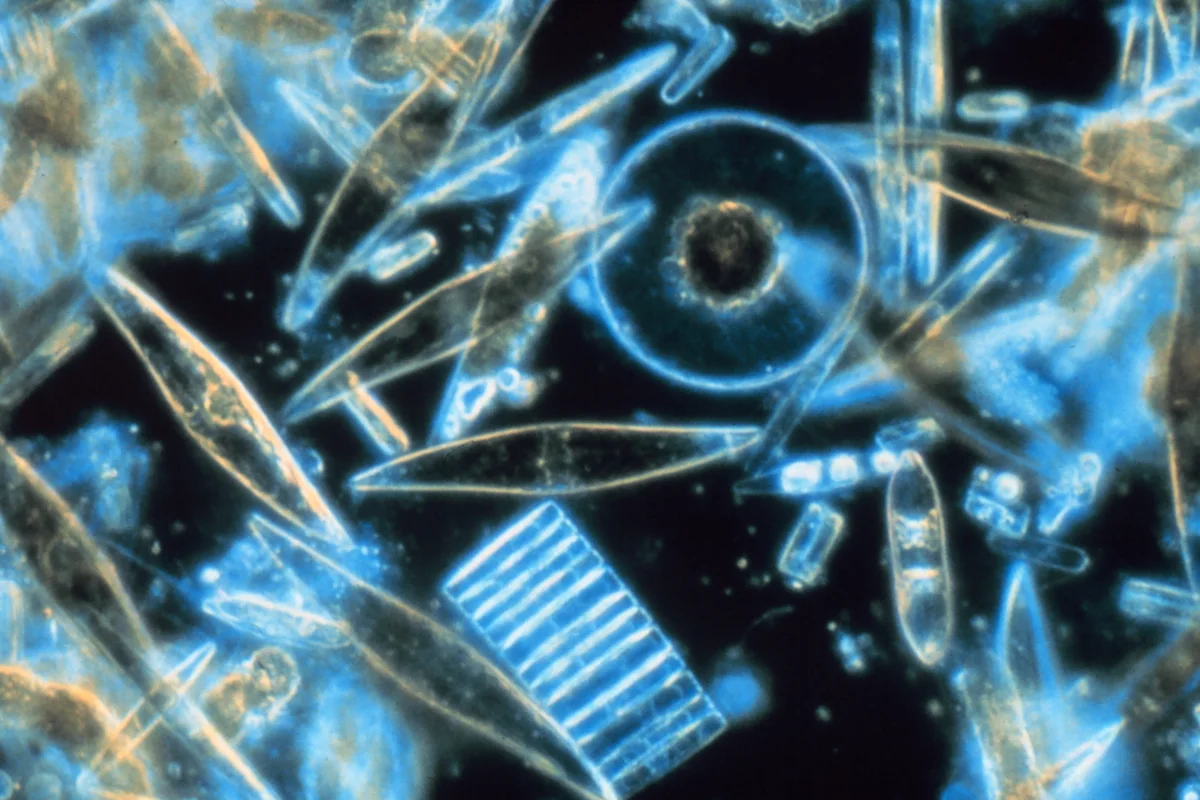
The authentic biological precursors of crude oil were microscopic, single-celled marine organisms: photosynthetic phytoplankton, silicate-encased diatoms, unicellular algae, and tiny zooplankton like radiolarians and foraminifera. During the super-greenhouse geological periods of the Paleozoic and Mesozoic, atmospheric carbon dioxide levels were substantially elevated, nurturing hyper-productive marine surface ecosystems across warm equatorial ocean currents.
In warm, shallow seaways such as the vast Tethys Ocean—which once spanned the geographic zones of the modern Middle East, North Africa, and the Gulf of Mexico—trillions of microscopic photosynthetic plankton bloomed, lived, and died in continuous cycles. Each microscopic phytoplankton cell synthesized minute internal droplets of lipids and neutral fatty acids to maintain metabolic energy storage and assist with water column buoyancy. When these organisms completed their brief life cycles, a relentless, snow-like blizzard of organic detritus descended toward the seafloor.
Anoxic Death Traps: The Creation of Sapropel and Kerogen
The critical catalyst enabling oil formation was marine water column stratification and widespread ocean anoxic events (OAEs). Because ancient equatorial seaways had restricted circulation and high surface temperatures, the deeper bottom waters frequently became completely depleted of dissolved molecular oxygen. In these suffocating abyssal zones, neither macro-scavengers nor aerobic bacteria could survive.
Instead of decaying, the raining planktonic biomass accumulated undisturbed on the seafloor, intermingling with fine clay minerals and carbonate silt to form a dense, dark, organic-rich mud known as sapropel. Over tens of millions of years, regional tectonic subsidence and the deposition of subsequent sediment layers buried these sapropel beds kilometers beneath the surface. Under escalating lithostatic pressure and moderate thermal compaction (the diagenesis phase), the lipid-rich organic material was stripped of volatile nitrogen and oxygen, transforming into a dense, insoluble organic polymer matrix termed kerogen (specifically Type I and Type II sapropelic kerogen).
Microscopic Biological Engine
Over 99% of all commercial crude oil originates from the lipid stores of unicellular marine phytoplankton and diatoms rather than the bones of terrestrial reptiles.
Anoxic Ocean Basins
Dead planktonic biomass settled into oxygen-starved seafloor environments across the ancient Tethys Ocean, which completely prevented aerobic bacterial decomposition.
Thermal Kerogen Cracking
Buried under kilometers of sediment within the “oil window” (60–150°C), solid kerogen undergoes geothermal catagenesis, transforming into liquid hydrocarbons.
Biomarkers Debunk Abiotic Theory
Porphyrin signatures (chlorophyll remnants) and optical light rotation conclusively demonstrate that petroleum is of strictly biological sedimentary origin.
Catagenesis and the Thermodynamic “Oil Window”
As continuing sedimentation drove the kerogen source rocks deeper into the crust—typically between 2 and 4 kilometers beneath the Earth’s surface—ambient geothermal heat steadily increased. In sedimentary geology, the temperature envelope between 60°C and 150°C is designated as the “oil window.” Within this precise geothermal corridor, kerogen undergoes natural catagenesis: thermal cracking breaks down the gigantic polymeric kerogen molecules into shorter hydrocarbon chains, yielding liquid crude oil and associated natural gas liquids.
If the source rock subsides even further—exceeding 4 to 5 kilometers in depth where temperatures climb past 150°C to 200°C—the system enters the “gas window.” Under these extreme temperatures, the previously formed liquid hydrocarbons are thermally cracked down to simple methane molecules (dry natural gas). Because hydrocarbons possess a lower density than the surrounding saline water saturating the pore networks of sedimentary rocks, the newly generated oil and gas buoyantly migrate upward through porous sandstone or limestone carrier beds. This upward migration continues until the fluids encounter an impermeable stratigraphic seal—such as dense shale, anhydrite, or evaporite salt domes—trapping the petroleum in an exploitable reservoir.
The Demise of the Abiotic Petroleum Hypothesis
During the mid-20th century, a faction of Soviet geologists proposed the “abiotic petroleum hypothesis,” positing that hydrocarbons were generated deep within the Earth’s mantle via Fischer-Tropsch-type inorganic reactions and continuously migrated into the crust. If true, oil reserves would be functionally limitless and renewable. However, modern gas chromatography and mass spectrometry have definitively debunked this claim.
Every barrel of natural petroleum contains telltale chemical signatures known as “biomarkers” or chemical fossils. Chief among these are vanadyl porphyrins—complex organic ring structures that are the direct degraded remnants of chlorophyll molecules synthesized by ancient photosynthetic algae. Furthermore, natural petroleum displays optical activity (the ability to rotate the plane of polarized light)—a chiral asymmetry produced exclusively by biological enzymes in living cells. Inorganic mantle reactions produce strictly racemic, non-optically active mixtures lacking porphyrin signatures.
Scientific Epilogue: Re-evaluating Earth’s Solar Legacy
Understanding that petroleum is not the pulverized remnant of thunderous sauropods, but rather the concentrated, fossilized solar energy of ancient marine plankton, profoundly alters our perspective on Earth’s finite resources. Every drop of gasoline represents millions of years of ancient ocean biology, captured and distilled by geothermal pressure—a non-renewable planetary heirloom that human civilization must steward with profound wisdom.