

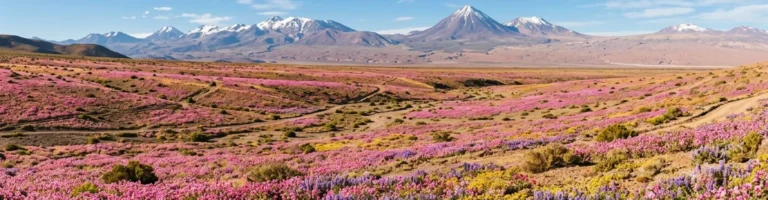

The Atacama Desert in northern Chile is globally renowned as the driest non-polar expanse on Earth: certain weather stations have recorded zero rainfall for centuries, and its desolate clay basins closely resemble the barren terrain of Mars. Yet when the powerful climate anomaly known as Super El Niño destabilizes the equatorial Pacific Ocean, this hyper-arid wilderness undergoes an astonishing ecological metamorphosis. Rare torrential storms awaken millions of dormant seeds entombed in the sunbaked crust, blanketing thousands of square kilometers in an iridescent tapestry of over 200 endemic wildflowers—a rare spectacle known as the desierto florido.
The Oceanic Engine: How Super El Niño Breaches the Coastal Inversion Barrier
Under baseline climatic conditions, hyper-aridity across the Atacama is maintained by two dominant meteorological forces: the cold Humboldt Current flowing northward along the Chilean coast and the quasi-permanent South Pacific Subtropical High. Cold sea surface temperatures refrigerate the lower marine boundary layer, creating a persistent thermal inversion that entirely inhibits vertical convection and rain cloud formation. Consequently, inland valleys receive only coastal fog—locally termed camanchaca—which cannot penetrate the desiccated subsoil.
This rigid climatic equilibrium collapses during a Super El Niño event within the El Niño–Southern Oscillation (ENSO) cycle. When easterly trade winds weaken or reverse, immense Kelvin waves transport massive reservoirs of warm tropical water eastward toward South America. Sea surface temperatures off northern Chile surge by 3 to 5 degrees Celsius above seasonal baselines, obliterating the temperature inversion and triggering convective storms capable of dropping unprecedented precipitation.
Remarkably, initiating the desierto florido requires as little as 15 to 20 millimeters of winter rainfall between June and August. Moisture saturates the gravel and gypsum soils, dissolving germination-inhibiting phytohormones such as abscisic acid embedded within seed coats. This biochemical purge triggers cellular rehydration and initiates explosive seedling emergence across vast arid basins.
Botanical Explosion: Purple Seas of Pata de Guanaco and Endemic Treasures
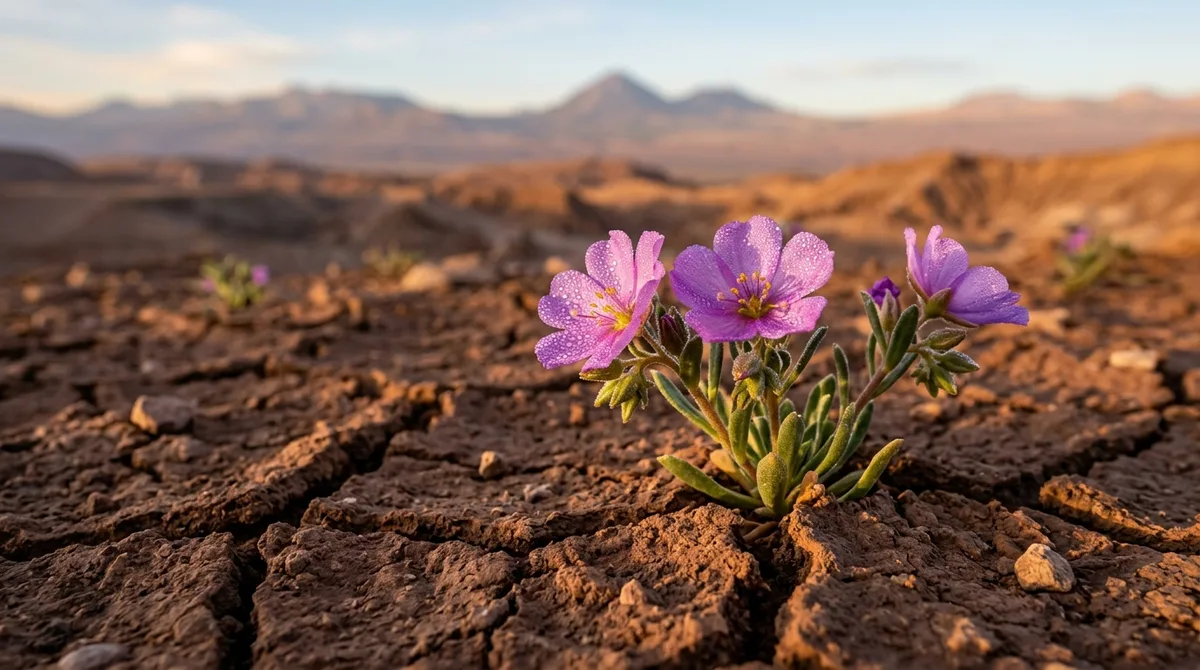
The dominant spectacle of the superbloom is spearheaded by Cistanthe longiscapa, affectionately called “pata de guanaco” (guanaco foot) by local communities. This fleshy succulent annual carpets vast stretches of undulating terrain with vibrant violet, magenta, and fuchsia blossoms. Within weeks, the monochrome ochre dunes of Llanos de Challe National Park are transfigured into electric purple expanses so immense they are clearly visible from Earth observation satellites.
Yet the floristic richness of the Atacama encompasses far more than a single species: botanists have documented over 200 vascular plant species participating in the event, with an astounding 60 percent classified as strict endemics native solely to this desert corridor. Golden fields of “añañuca” (Rhodophiala rhodolirion), pure white cups of Nolana, and fragile blue blossoms of Cristaria carterae emerge in rapid succession.
The synchronization of this phenological burst is extraordinary. Constrained by a strict ecological window before scorching springtime temperatures evaporate every trace of subsurface moisture, these ephemeral plants must complete their entire lifecycle within 6 to 8 weeks. They surge through vegetative growth, flower, attract pollinators, fertilize ovules, and produce new seed cohorts that immediately re-enter metabolic dormancy for future decades.
Super El Niño floods the coastal Pacific with warm water, shattering atmospheric inversions with heavy rain.
Millions of seeds survive decades of complete dehydration waiting for winter rainfall to leach out inhibitors.
Over 60% of the blooming wildflower species are found nowhere else on Earth, carpeting the desert in purple.
Drought-tolerance genes from Atacama flora are being decoded to fortify future global agricultural staples.
Ecological Cascade: The Resurgence of Native Pollinators and Desert Predators
The carpet of blossoms immediately catalyzes a dynamic multi-trophic cascade that ripples through the desert food web. Immense quantities of nectar and pollen awaken subterranean insect pupae and diapause eggs that have remained inactive beneath gypsum flats for years. The desert air buzzes with solitary bees, hoverflies, hawkmoths, and pierid butterflies specifically co-evolved to pollinate these endemic floral morphologies.
Higher trophic levels rapidly follow the invertebrate resurgence. Herds of wild guanacos (Lama guanicoe) migrate down from Andean foothills to feast upon succulent foliage, fulfilling their hydration requirements without surface water. Booming populations of desert rodents like leaf-eared mice attract apex predators including the culpeo fox (Lycalopex culpaeus), Magellanic horned owls, and kestrels.
For evolutionary ecologists, this explosive recurrence serves as an unparalleled model of metapopulation resilience. The Atacama demonstrates that hyper-arid biomes possess profound latent ecological memory, maintaining complex genetic diversity and ecological interactions in stasis until environmental thresholds trigger their temporary reanimation.
«The Atacama superbloom is not merely a breathtaking aesthetic phenomenon; it represents the ultimate triumph of evolutionary adaptation. These seeds can remain viable in extreme desiccation for decades, awaiting the singular hydrological cue required for germination.»
Dr. María Teresa Eyzaguirre, President of the Chilean Flora Foundation
Agricultural Biotechnology: Decoding Extreme Drought Resistance in Crops
Plant physiologists and geneticists worldwide are actively sequencing the genomes of Atacama flora to uncover the molecular foundations of extreme drought tolerance. Species within the genera Nolana and Cistanthe utilize Crassulacean Acid Metabolism (CAM) in tandem with high concentrations of late embryogenesis abundant (LEA) proteins and dehydrins, which shield cellular membranes and enzymes from denaturing even when cells lose over 90 percent of their water content.
Furthermore, their root systems engage in intricate symbioses with specialized extremotolerant actinobacteria and mycorrhizal fungi. These rhizosphere microbes synthesize osmoprotectants and solubilize locked minerals from gypsum-cemented regolith, allowing seedlings to thrive under hyper-saline, mineralized conditions that would prove toxic to conventional crops.
Amid accelerating global desertification and climate instability, these genetic adaptations hold transformative potential for international food security. Bioengineers are exploring pathways to introduce key osmoprotective and heat-shock gene pathways into commercial staples such as wheat, maize, and sorghum, offering viable pathways for resilient dryland agriculture in an increasingly arid century.
- A modest 15 to 20 millimeters of winter rainfall is sufficient to unlock the entire blooming phenomenon.
- Vast purple swathes of Cistanthe longiscapa expand across dozens of miles and are visible from space.
- The complete vegetative lifecycle must finish within a narrow 6 to 8 week window before spring heat returns.
- Chile created the 57,000-hectare Desierto Florido National Park in 2023 to protect this fragile ecological wonder.
Conservation Imperative: Establishing the Desierto Florido National Park
Despite its evolutionary tenacity, the superbloom faces severe threats from human encroachment and climate volatility. During peak flowering seasons, hundreds of thousands of tourists converge on the fragile desert plains. Off-road vehicles driving across untracked dunes crush delicate root mats and pulverize shallow seed banks, causing damage that requires generations to naturally heal. Additional threats stem from illegal seed trafficking and unpermitted livestock grazing.
In response to growing conservation demands, the Chilean government enacted milestone legislation in 2023, establishing the Desierto Florido National Park (Parque Nacional Desierto Florido) encompassing more than 57,000 protected hectares. The park imposes strict environmental protections, confining vehicular access to dedicated corridors and prohibiting mining concessions within critical biodiversity sanctuaries.
Scientists continue to model the long-term impacts of shifting ENSO oscillations under global climate warming. While more frequent El Niño occurrences might trigger superblooms more often, erratic unseasonal precipitation could disrupt critical dormancy cues. Preserving the Atacama’s miraculous seed banks remains an indispensable commitment to safeguarding one of the most resilient biomes on our planet.
To discover the historical progression of Atacama’s flowering seasons, visual field imagery, and the geography of the double rain shadow, read our companion feature: “Atacama Desert Bloom: How a Record El Niño Transformed Earth’s Driest Place into an Ocean of Flowers”.