



In a milestone achievement for observational astrophysics, Canada’s CHIME (Canadian Hydrogen Intensity Mapping Experiment) radio telescope has recorded the faint 21cm radio glow of neutral hydrogen dating back 9 billion years using solely its own internal data. This groundbreaking standalone detection proves that hydrogen intensity mapping works independently, paving the way for unprecedented 3D cosmic cartography and unlocking vital clues about the elusive nature of dark energy.
Cosmic Beacon: Why Neutral Hydrogen Is Crucial for Astronomy
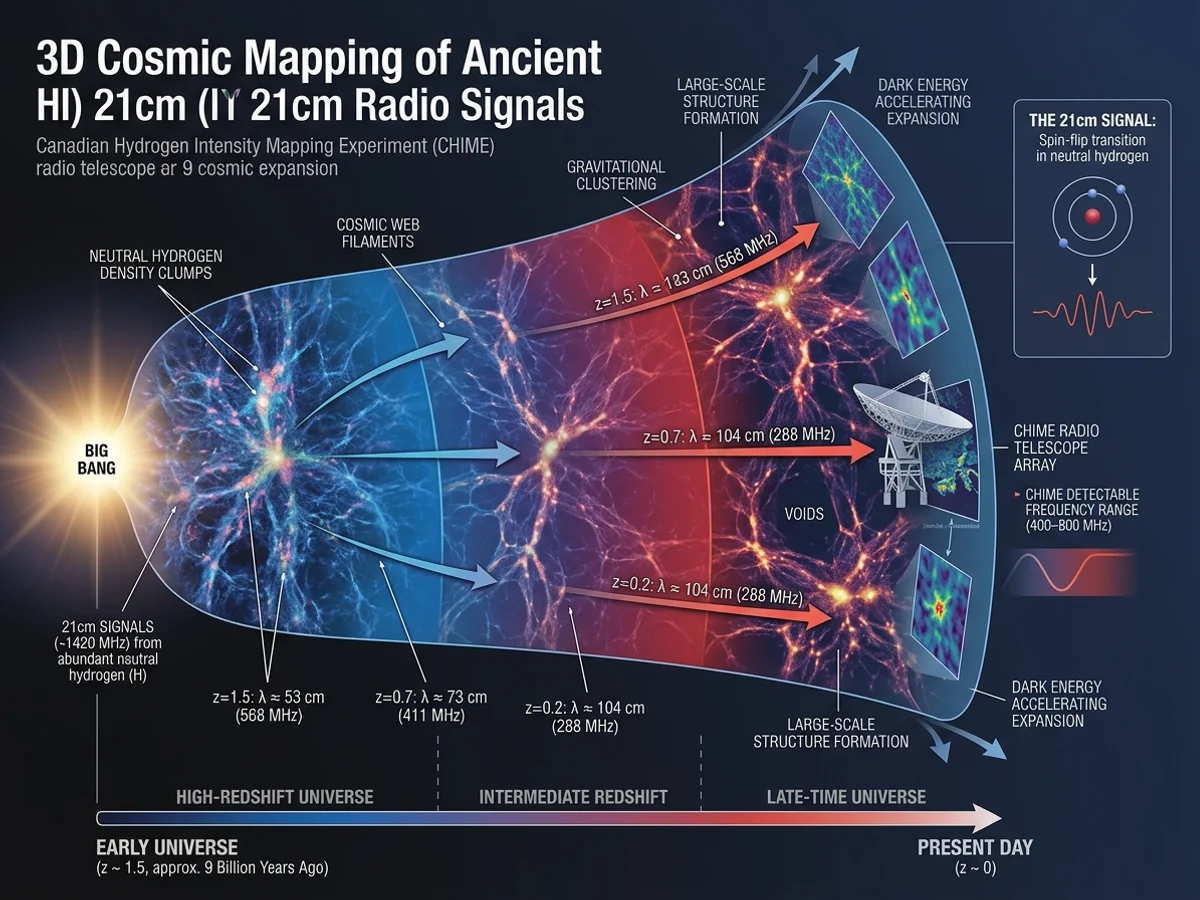
Neutral hydrogen is the most abundant element in the universe, serving as the raw primal fuel from which the earliest stars and galaxies formed. A lone neutral hydrogen atom possesses a fundamental quantum property: when the spins of its proton and electron flip relative to one another, the atom emits an electromagnetic radio photon at exactly 1420 MHz, corresponding to a wavelength of 21 centimeters.
Over billions of years of traveling through our expanding cosmos, these radio waves stretch, experiencing cosmological redshift. A signal emitted when the universe was merely 5 billion years old (redshift z ≈ 0.8–1.4) shifts from 1420 MHz right into CHIME’s optimal operating frequency band of 400 to 800 MHz. Hydrogen acts as a luminous cosmic tracer, revealing how cosmic web filaments, galaxy clusters, and immense cosmic voids took shape under the tug-of-war between gravity and dark energy.
Key Milestones of the CHIME Detection:
- Signal Age: Neutral hydrogen glow originating approximately 9 billion years ago (when the universe was only a third of its present age).
- Autonomous Autocorrelation: Achieved entirely through internal data without requiring cross-correlation with external galaxy surveys.
- Extensive Observational Baseline: Rigorously filtered across 94 nights of clear observations to cleanly eliminate terrestrial radio interference.
Engineering Feat: A Giant Radio Telescope With Zero Moving Parts
Nestled in the mountains of British Columbia at the Dominion Radio Astrophysical Observatory, CHIME rejects conventional steerable radio dish designs. Instead, it features four stationary 20 × 100-meter cylindrical parabolic wire-mesh reflectors that resemble enormous skate park half-pipes.
The telescope has no mechanical moving components. It relies on Earth’s rotation to sweep across the northern sky once every 24 hours. Suspended focal lines equipped with hundreds of dual-polarization antennas funnel massive streams of raw analog data into a customized high-performance GPU supercomputer cluster. This real-time digital beamforming engine processes hundreds of terabits per second, synthesizing over a thousand computational beams simultaneously.
Video Feature: How CHIME Decodes Deep Cosmic Radio Waves
In this video presentation from the Perimeter Institute for Theoretical Physics, researchers discuss the innovative design and computational techniques behind the CHIME collaboration:
Deciphering Dark Energy and the Accelerating Universe
Since the discovery in 1998 that cosmic expansion is accelerating, physicists have grappled with the enigma of dark energy. Making up nearly 68% of the total cosmic energy budget, its underlying mechanism remains one of physics’ greatest unsolved puzzles.
Determining whether dark energy acts as Einstein’s constant vacuum energy or as a fluctuating quantum field requires measuring the exact rate of cosmic expansion at varying historical epochs. CHIME’s hydrogen intensity mapping provides an immaculate cosmological standard ruler based on baryon acoustic oscillations. With this standalone milestone proven, astronomers are on the verge of producing the most comprehensive 3D map of the cosmos yet constructed.