

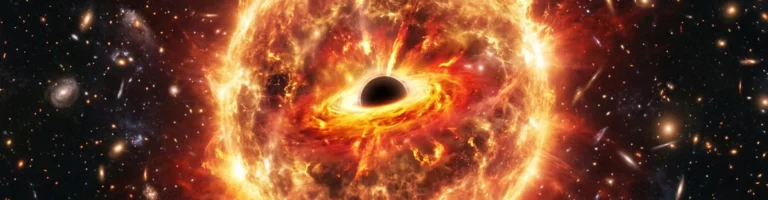

NASA’s James Webb Space Telescope (JWST) has identified a breathtaking class of cosmic objects in the early universe: “black hole stars,” also known as quasi-stars. This groundbreaking astrophysical breakthrough resolves a long-standing cosmological conundrum: how supermassive black holes grew to billions of solar masses shortly after the Big Bang.
What Is a Black Hole Star and How Does It Work?
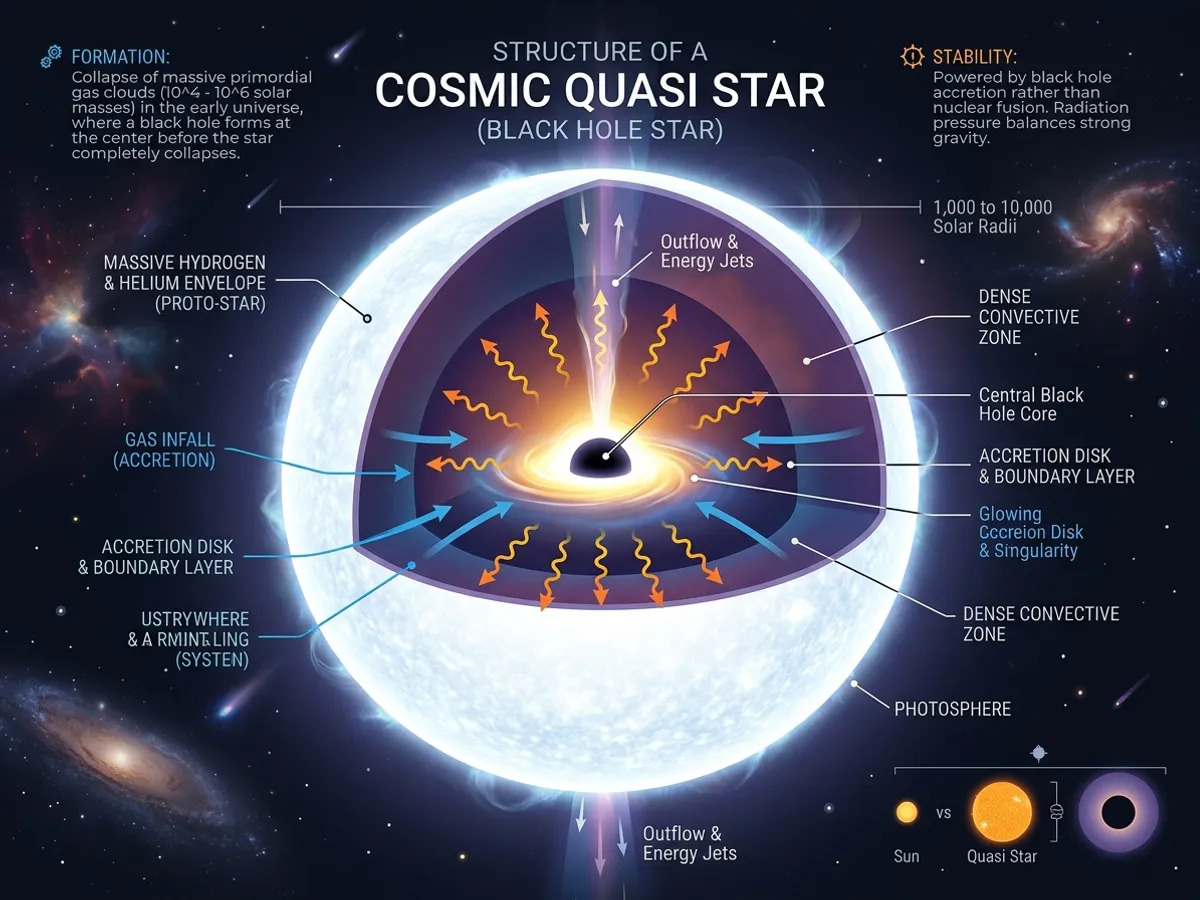
Unlike conventional main-sequence stars fueled by hydrogen-to-helium nuclear fusion, a black hole star operates on gravitational power. At its core lies an intermediate-mass black hole (roughly 100,000 solar masses) enshrouded by a colossal, convective cocoon of pristine hydrogen and helium spanning the diameter of Saturn’s orbit.
As primordial matter plunges onto the central event horizon, it generates immense radiant energy. The outward radiation pressure counters the crushing gravity of the dense envelope, preventing immediate collapse and allowing the object to shine brighter than hundreds of billions of normal stars combined.
Key Properties of Quasi-Stars (Black Hole Stars):
- Energy Source: Gravitational accretion onto a central singularity rather than thermonuclear fusion.
- Photosphere Diameter: 1,000 to 10,000 solar radii (comparable to the outer boundaries of the Solar System).
- Extreme Luminosity: Far exceeds the standard Eddington limit for normal stellar bodies, emitting intense infrared radiation.
Solving JWST’s “Little Red Dots” Cosmic Enigma
Ever since JWST began deep-sky surveying, astronomers have spotted hundreds of ultra-compact, glowing red objects designated Little Red Dots. Dating back to just 500 to 700 million years after the Big Bang, these sources exhibited paradoxically high mass combined with minute physical volumes.
Published in Nature, comprehensive spectroscopic analyses confirm that the emission profiles of Little Red Dots match the theoretical mechanics of quasi-stars. Alongside observations of relativistic jet kinematics in M87, JWST’s discovery unveils the true primordial origins of cosmic giants.
Plasma Fireworks Around Event Horizons
Super-Eddington accretion inside such swollen envelopes produces volatile magnetic turbulence and energetic outbursts. The scientific visualization from NASA Goddard below illustrates the dramatic flaring mechanics near an actively feeding black hole:
Cosmic Legacy: The Direct Genesis of Supermassive Black Holes
The lifespan of a black hole star is ephemeral in astronomical terms — lasting only a few million years. Once the gas envelope is exhausted or dispersed by radiation pressure, the glowing shell dissipates, leaving behind an intermediate-mass black hole seed exceeding 100,000 solar masses.
This revelation solves one of the greatest mysteries in modern cosmology: supermassive black holes did not need to feed slowly over billions of years. Instead, they were birthed directly inside colossal stellar incubators in the dawn of the cosmos.