

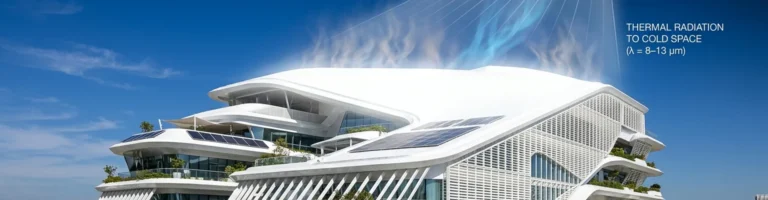

As global temperatures rise and intense summer heatwaves become the norm, traditional air conditioning has created a dangerous environmental paradox: while cooling indoor spaces, electric chillers pump waste heat onto city streets and consume vast amounts of electricity. However, fundamental thermodynamics offers a groundbreaking alternative: Passive Daytime Radiative Cooling (PDRC). This technology allows engineered surfaces to cool below ambient air temperatures under direct, intense sunlight with zero electricity consumption.
Space as an Ultimate Heat Sink: The Atmospheric Window
Every object in the universe continuously emits thermal energy through infrared radiation. The primary obstacle on Earth is our atmosphere: saturated with water vapor, carbon dioxide, and methane, it absorbs and reflects most infrared wavelengths back toward the ground, generating the greenhouse effect.
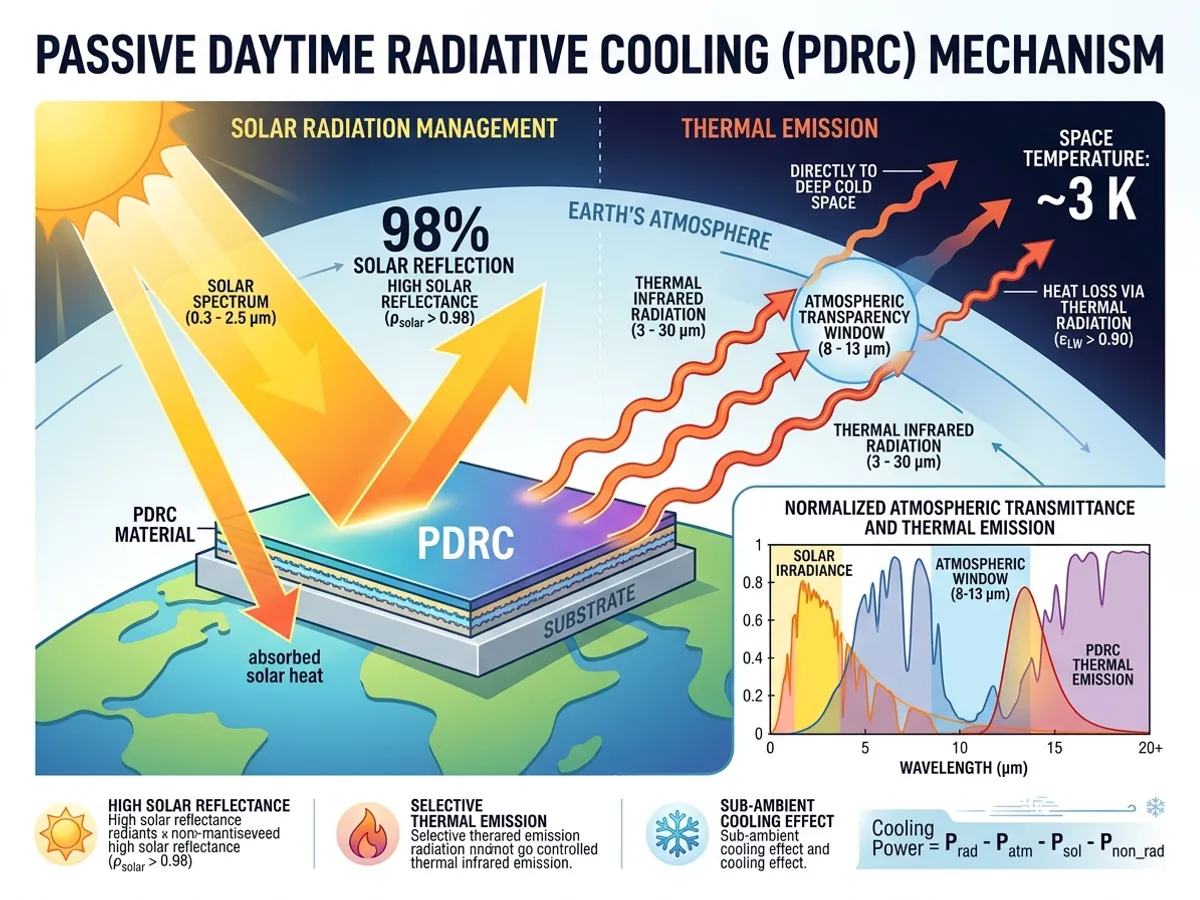
However, nature left an optical bypass: the atmospheric transparency window spanning wavelengths between 8 and 13 micrometers. In this specific spectral band, atmospheric gases are virtually transparent. Beyond Earth’s atmosphere lies the vacuum of deep space, chilling at the cosmic microwave background temperature of 3 Kelvin (-270 °C) — serving as an infinite, natural heat sink.
The Two Golden Rules of Radiative Cooling Surfaces:
- High Solar Reflectance (ρsolar > 96–98%): The surface must bounce away nearly all solar irradiance across UV, visible, and near-infrared bands (0.3–2.5 μm) to prevent absorption of peak sunlight.
- High Thermal Emissivity (εLW > 90–95%): The material must aggressively beam out its internal heat specifically within the 8–13 μm atmospheric window straight into cold space.
Ultra-White Paints and Nanocomposites: The Lab Breakthroughs
Radiative cooling occurs naturally at night; it is the reason frost and dew regularly form on car roofs and grass blades even when ambient air temperatures remain well above freezing. Yet cooling a surface during peak daylight is an extraordinary physical feat, as incoming solar flux delivers up to 1,000 W/m² of thermal power.
The landmark breakthrough emerged at Purdue University under mechanical engineering professor Xiulin Ruan. The research team formulated an ultra-white paint utilizing barium sulfate (BaSO4) nanoparticles with varied particle diameter distributions. By scattering diverse wavelengths across the entire solar spectrum, the coating achieves an unprecedented 98.1% solar reflectance.
Outdoor field trials proved that coated surfaces consistently stay 4.5 °C to 7 °C (8 °F to 13 °F) cooler than ambient air under direct noon sunlight, generating net cooling power exceeding 100 W/m². When paired with clean energy technologies, passive optical systems provide a vital tool against urban heating.
Experimental Demonstration and Real-World Testing
The following experimental demonstration breaks down the physics behind radiative coatings and measures real-time sub-ambient cooling under sunlight:
Real-World Impact: Rooftops, Solar Farms, and Cooling Fabrics
The widespread adoption of PDRC materials provides major sustainability advantages across multiple sectors:
- Slashing Grid Loads: Applying radiative paints to commercial roofs and data centers can reduce air conditioning demand by 40% to 70%.
- Mitigating the Urban Heat Island Effect: Replacing dark roofs and asphalt coatings prevents cities from trapping thermal mass, radiating heat outward instead.
- Boosting Solar Panel Efficiency: Silicon photovoltaic cells lose power output as they heat up; radiative films keep solar modules cool, preserving peak efficiency.
- Next-Gen Cooling Textiles: Porous polymer fibers engineered for infrared emission could soon protect workers and athletes in high-heat environments.
Passive radiative cooling demonstrates that fighting global heatwaves does not always require burning more fuel or running louder air conditioners. By utilizing the optical transparency of Earth’s atmosphere, we can tap into the chilling expanse of deep space to cool our world naturally.