

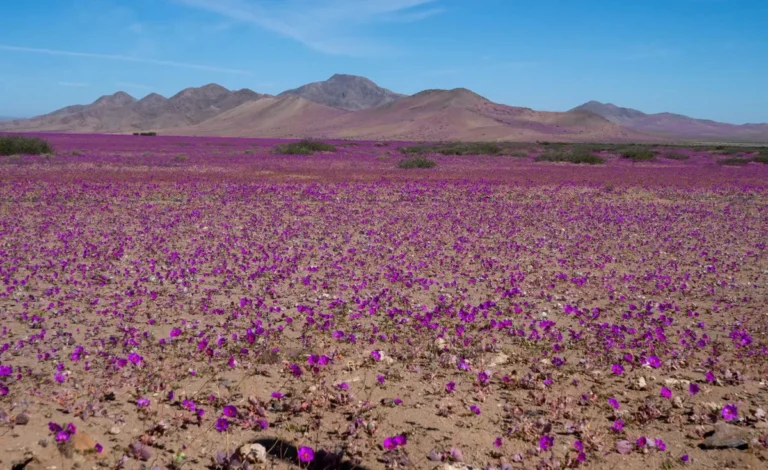

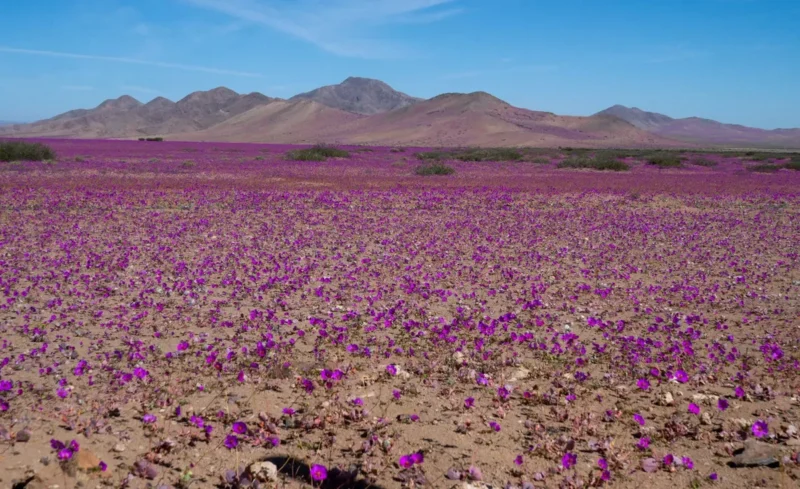
The Chilean Atacama Desert rightfully holds the status of one of the harshest and driest places on Earth. For decades, rainfall here has been measured in fractions of a millimeter, and its Mars-like expanse appears entirely devoid of life. Yet dramatic climatic oscillations can overturn this arid reality: fueled by the powerful Pacific El Niño phenomenon, this desolate wasteland has suddenly been blanketed by an ocean of vibrant blossoms.
This natural wonder, known in the scientific community as Desierto florido (“blooming desert”), captures the attention of botanists, climatologists, and travelers worldwide. But how do plants endure decades beneath a merciless sun, and why are the scales of this season’s bloom shattering historical records?
Anatomy of Extreme Aridity: Why Rain Rarely Falls in the Atacama
To grasp the magnitude of this miracle, one must understand the unique geography of the region. The Atacama is the driest non-polar desert on the planet. Average annual precipitation hovers around 15 millimeters, while in its hyper-arid hyper-core, annual rain rarely exceeds a token 1 to 3 millimeters.
The driving cause behind this exceptional dryness lies in a “double rain shadow” effect:
- From the East: The towering Andes mountain range forms an impassable natural barrier against moisture-laden air masses traveling from the Amazon basin.
- From the West: The cold Humboldt Current in the Pacific Ocean refrigerates the lower marine atmosphere, suppressing rain cloud formation, while the coastal Cordillera traps the remaining marine fog.
Trapped in this atmospheric vault, the territory endures conditions that closely mimic the surface of Mars.
Record El Niño: The Spark That Ignited the Superbloom
The equilibrium shifted when an exceptionally powerful El Niño event gathered strength in the eastern equatorial Pacific. Elevated sea surface temperatures radically altered global atmospheric circulation: humid frontal systems broke through the decades-long inversion barrier, dropping drenching rains across the parched soil.
Select sectors of the Atacama received up to 180 millimeters of rainfall—a staggering volume exceeding baseline norms tenfold. According to forecasts by Chilean ecologists and the National Forest Corporation (CONAF), at peak bloom the floral tapestry can cover an immense territory of up to 15,000 square kilometers.
However, researchers stress that rainfall alone is insufficient. The magnitude of this floral transformation hinges upon a delicate nexus of soil absorption kinetics, diurnal temperature swings, and solar radiation levels.
Survival Secrets: How Seeds Sleep for Decades
During prolonged droughts, the desert seems sterile, yet beneath its crust lies a colossal subterranean germplasm bank—an enduring reserve of resting seeds and bulbs. The Atacama flora comprises 1,893 plant species, the overwhelming majority of which are strict endemics found nowhere else on the globe.
These resilient seeds can retain viability in arid soil for a decade or more, sustained in profound cryptobiosis. They are fortified with remarkable physiological adaptations:
- Waxy Cuticular Coatings: Dramatically minimize transpiration, locking every molecule of moisture within plant tissues.
- Microscopic Trichomes: Reflect intense solar ultraviolet radiation, mitigating thermal shock and surface scorching.
- Specialized Root Systems: Maximize absorption velocity, capturing fleeting pulses of subsurface water before evaporation sets in.
Race Against Time: Why Desert Blossoms Radiate Such Vivid Hues
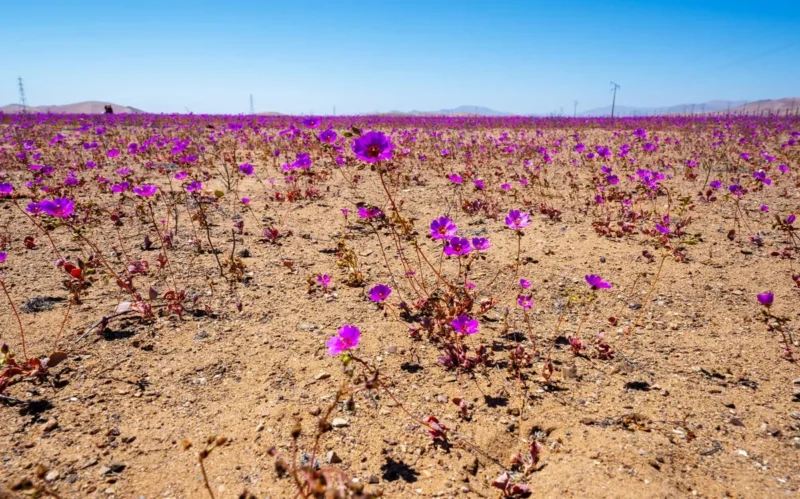
Once water saturates the topsoil, endemic flora trigger an accelerated ontogenetic cycle: sprouting, blooming, and setting seed in merely a few brief weeks before blazing springtime heat desiccates the sand.
This compressed temporal window explains the dramatic chromatic intensity—from electric magenta and deep purple to lemon yellow and sky blue. Pollinators in hyper-arid landscapes are exceptionally scarce. To lure solitary desert bees, hawkmoths, and beetles from afar, flowers must present maximum visual contrast. This represents an unforgiving mechanism of natural selection: fail to captivate a pollinator swiftly, and the genetic lineage ends.
Climatic Shifts: Is the Natural Calendar Breaking Down?
Historically, full-scale desierto florido events occurred sporadically—roughly 15 times over the past four decades (every 3 to 10 years). Over recent decades, however, this recurrence interval has compressed noticeably.
Following major blooms in 2015 and 2017, botanists documented an unexpected flowering in 2022 (a phenomenon considered anomalous as it transpired during a cold La Niña phase). Subsequent events in 2025 and the current season mark an extraordinary milestone: consecutive blooming events across back-to-back years. Climatologists are investigating these shifts, assessing how anthropogenic climate disruptions are destabilizing historical ENSO oscillations.
For a comprehensive molecular breakdown of dormancy termination (abscisic acid leaching), CAM metabolic insights for global agriculture, and the multi-trophic cascade from native bees to culpeo foxes, explore our deep-dive scientific study: “Super El Niño and the Atacama Superbloom: How Earth’s Driest Desert Transforms into a Sea of Flowers”.
Conclusion: Safeguarding a Fragile Heritage
The Atacama superbloom represents far more than a breathtaking natural spectacle or a magnet for regional ecotourism: it is a poignant testament to the profound resilience of Earth’s biosphere. Life demonstrates an indefatigable capacity to endure within the harshest frontiers, awaiting the slightest hydrological opening to flourish. Preserving this irreplaceable seed bank and protecting vulnerable desert biomes from human disturbance remains an imperative for global conservation.